“In 1990, a small group of law professors and lawyers created the Environmental and Natural Resources Law Center, Inc. to establish a nonprofit law firm dedicated to meeting the needs of the public interest in environmental issues facing Florida. In 1995 the organization hired Richard Grosso, the former Legal Director of 1000 Friends of Florida, as its Executive Director, to establish a legal representation program at Nova Southeastern University in Ft. Lauderdale, Florida. The name of the organization was officially changed in October of 1996 to the Environmental and Land Use Law Center, Inc.
The firm began to expand, adding three additional attorneys to the team, including Senior Staff Attorney Lisa Interlandi in 2001 and now Executive Director and General Counsel Jason Totoiu in 2006. In 2006, the firm changed its name to the Everglades Law Center to reflect its unique role in providing legal, strategic and policy advice to the dozens of organizations and individuals working to restore the Everglades.
Today, the Everglades Law Center celebrates over 20 years of providing legal counsel to nearly forty national, state, and local environmental and conservation organizations. We tackle issues from the Kissimmee River Basin to Florida Bay. We also assist clients on issues affecting other imperiled landscapes and watersheds throughout Florida. Our lawyers are strategically located across the greater Everglades ecosystem.”
“The Foundation employs a team of scientists to serve as technical expert sources for the environmental community. These resources include providing sworn expert testimony in legal proceedings, testimony at public hearings, and general education and training for environmental partners. The Foundation also provides fellowships and internships to graduate students from regional and national universities working on Everglades projects, all to ensure that the next generation of Everglades experts will be well-trained to face the mission in front of them well into the first half of the century. Areas of fundamental interest in the science program are: hydrology, natural resource planning, water quality and ecology”
Check this out! It’s so cool!
Leading Science Initiatives
Hydrology
Water is the key to understanding the Everglades and the built environment. One in every three Floridians relies on the Everglades for their water supply and the native flora and fauna are finely tuned to the seasonal water cycles. Part of what we do at the Everglades Foundation is discover how the Everglades works, convert that to mathematics, and then program it on a computer. Once you do that, you can run “what-if…” scenarios that help decide what can and should be done to restore the Everglades. Hydrology and engineering allow us to look for solutions to restore the “River of Grass.” Thomas Van Lent, Ph.D., Senior Scientist
Ecology
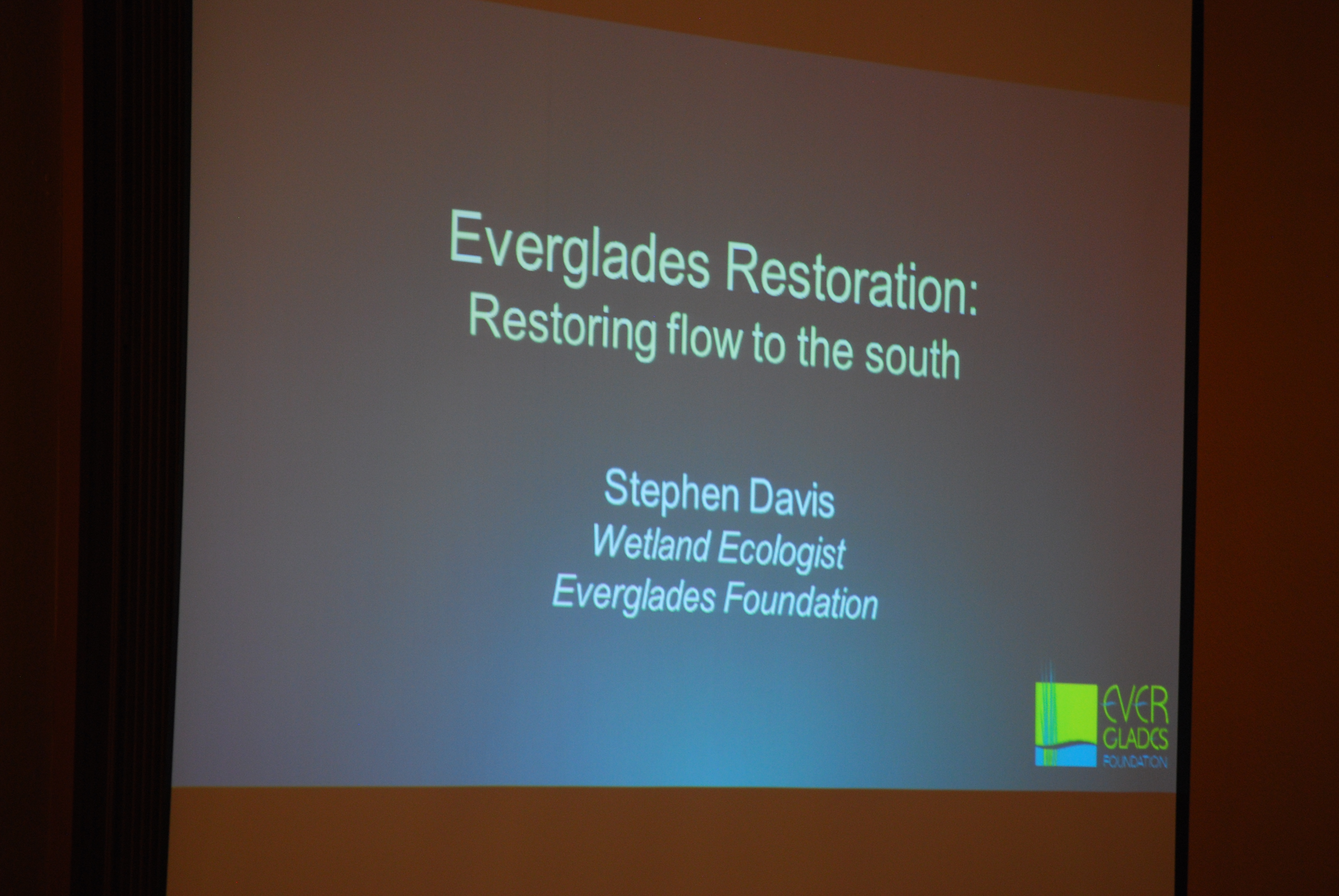
Ecological research at the Everglades Foundation is centered on understanding how human impacts such as the introduction and spread of exotic invasive species, urban development, off-road vehicle (ORV) use, oil and gas activity, water management and nutrient inputs have affected plant and animal life across the Everglades. To do this, we partner with agencies, academic institutions and environmental organizations across the region to tap into the extensive body of scientific information and peer-reviewed research. We analyze data and provide input regarding various social and political issues that may offset the current ecological balance of the Everglades or thwart progress of Everglades restoration. Stephen E. Davis, III, Ph.D., Wetland Ecologist
Water Quality
Restoring the Everglades will take more than just putting the right amounts of water back. It will also require that the water be clean. We conduct research on what causes imbalances in native flora and fauna, and then determine what actions are needed to correct those problems. The survival of the Everglades depends on the quality of its water. Melodie Naja, Ph.D., Water Quality Scientist
Planning and Project Implementation
Research and ideas alone will not restore the Everglades. These ideas must be converted into specific actions and projects. The science team at the Everglades Foundation works with government agencies and stakeholders to implement science-based solutions. We contribute modeling information, review scientific research and analyses, provide scientific and engineering input to restoration and water quality projects, and work to educate decision makers and the public on the issues. This helps to build consensus and get things done. Hong Xu, Environmental Engineer and Aida Arik, Ecological Engineer
Synthesizing Everglades Research
“No single entity is tackling or can tackle all of these issues,” Van Lent says. “It’s actually a concerted effort on the part of government agencies, non-profit organizations such as ours, and research entities to get this accomplished.” The single most important project being accomplished by Foundation scientists is not in-the-lab, test-tube science. It’s the synthesis of all scientific work conducted on the entire Everglades ecosystem from the Kissimmee River through Lake Okeechobee and into the southern Everglades and Florida Bay.
“The project combines all the available information and seeing which is most likely to get us to the goal,” says Van Lent. “This will guide us to recommend public policy that will lead to decisions to fix the ecosystem.” The initiative, financed by the U.S. Department of the Interior, involves explaining the work of 15 top scientists in Everglades-related fields for the past decade and making their work understandable to decision-makers and the public. “We’re taking the reports off the shelf and making them useful,” says Van Lent. “We’re the bridge between the laboratory and the real application of the science. We make the science useful.”
Science!
Stephan has a bunch of studies. I tried to get an account to read but I’m not with an institution.
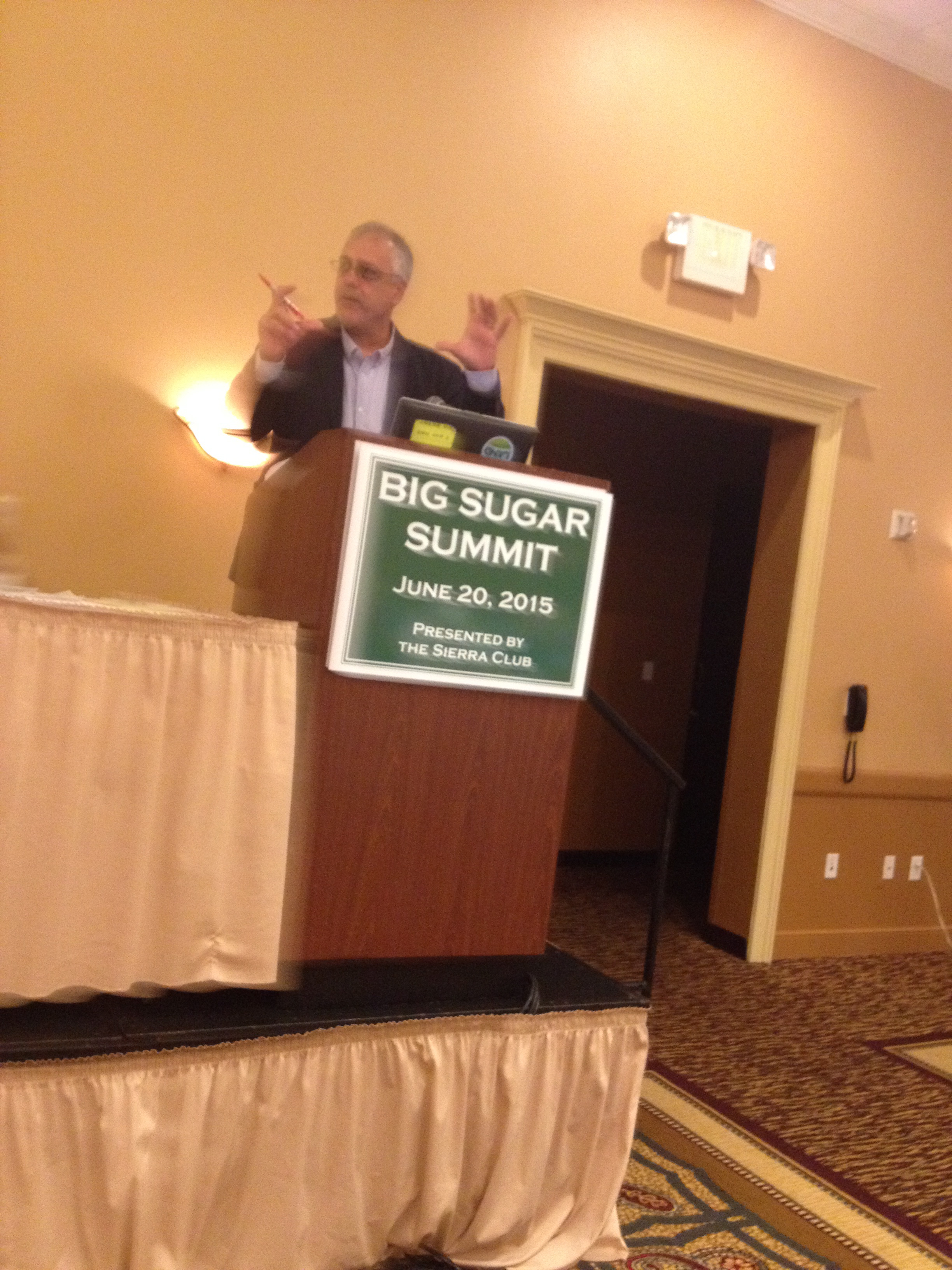
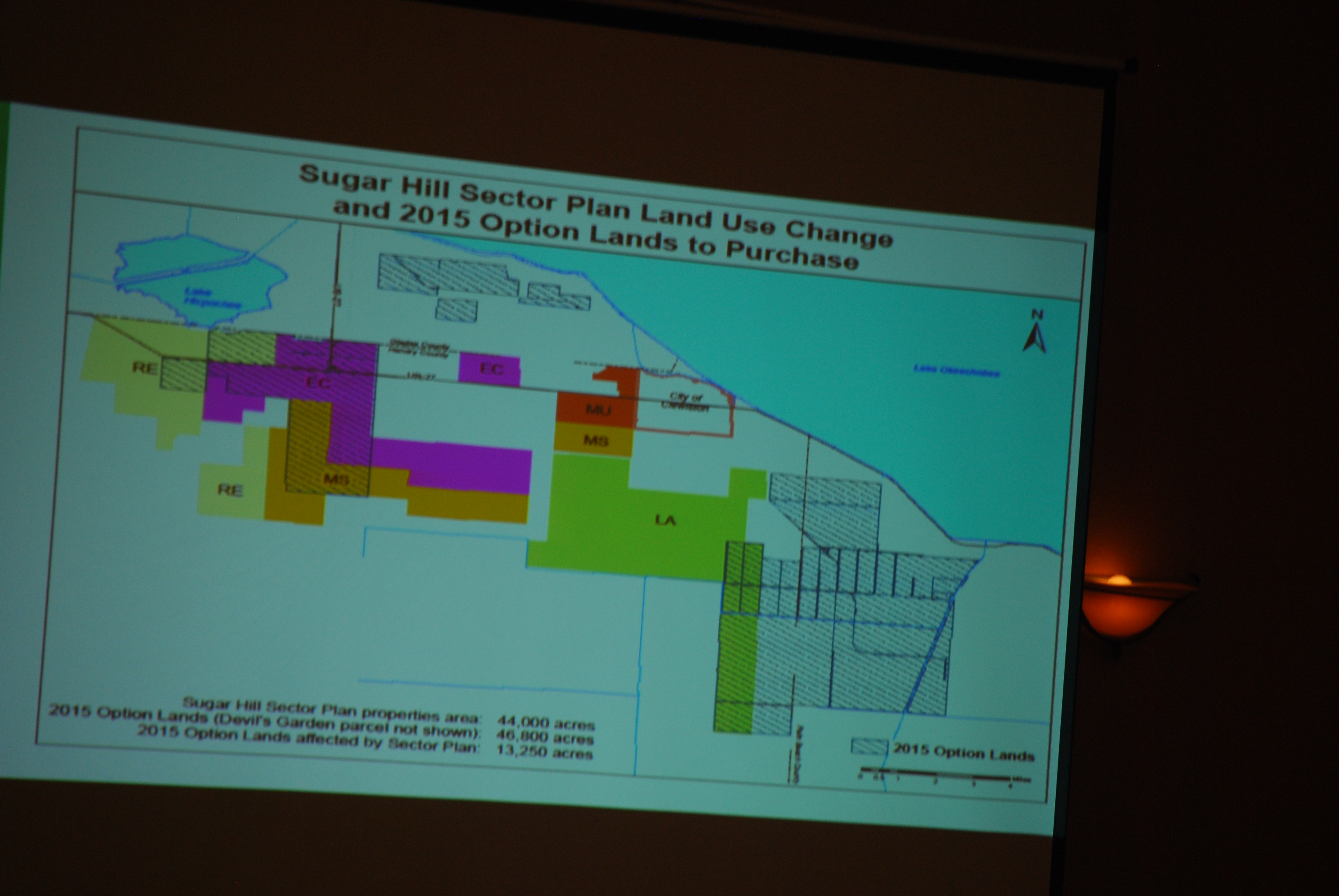
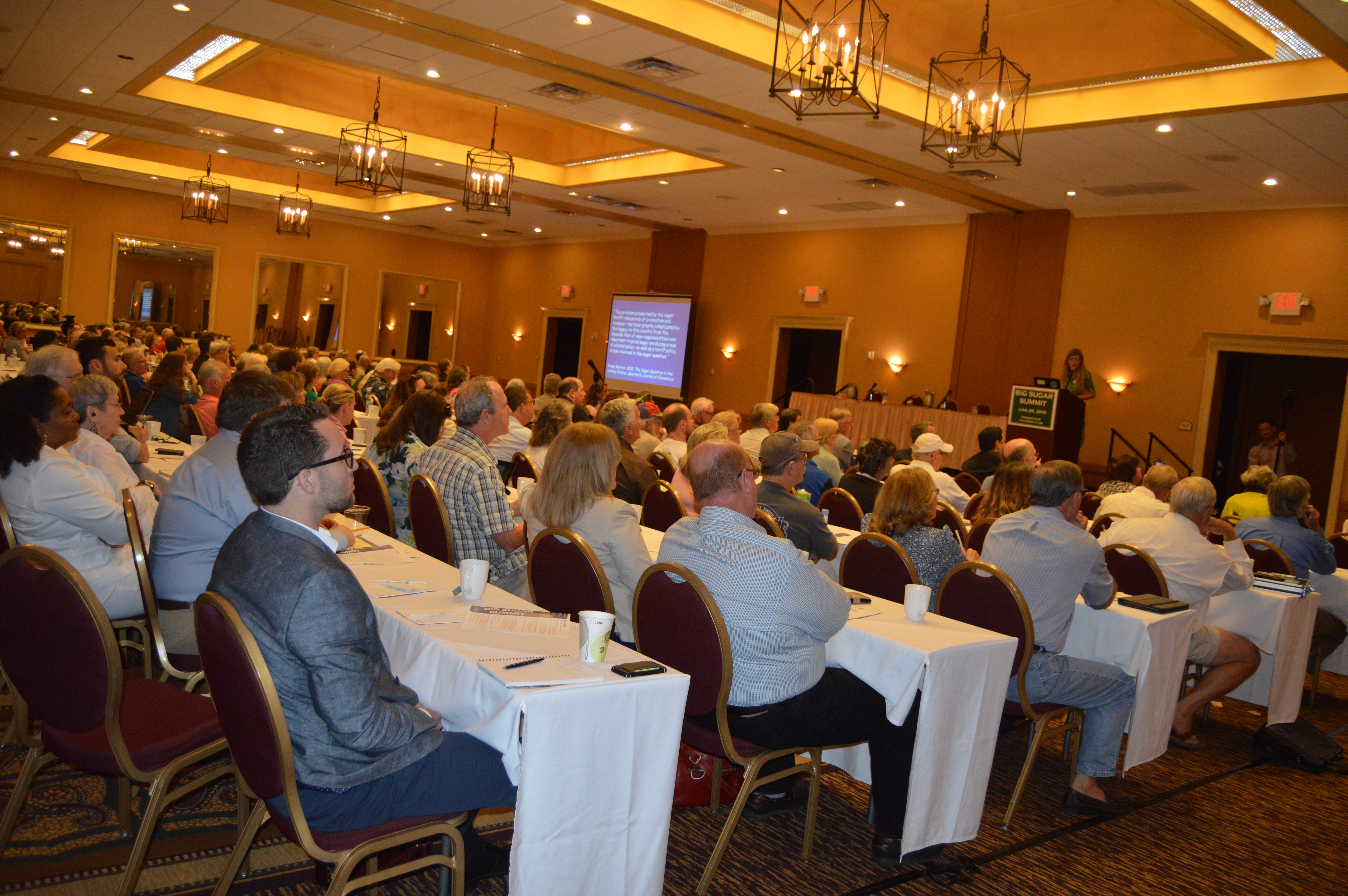
Big Sugar Summit: Dr Gail Hollander, “Raising Cane in the Glades.”
So excited hear this lecture. As I said before there will a final video with all the bells and whistles and slides professional done by some else. This is only part of the lecture so I hope when the video is done you’ll watch.
The title of the lecture was
“The History of Big Sugar in the Everglades Agricultural Area”
Dr Gail Hollander is an Associate Professor of Geography, Department of Global and Sociocultural Studies, Florida International University. She is the author of “Raising Cane in the Glades: The Global Sugar Trade and the Transformation of Florida.
Over the last century, the Everglades underwent a metaphorical and ecological transition from impenetrable swamp to endangered wetland. At the heart of this transformation lies the Florida sugar industry, which by the 1990s was at the center of the political storm over the multi-billion dollar ecological “restoration” of the Everglades. Raising Cane in the ’Glades is the first study to situate the environmental transformation of the Everglades within the economic and historical geography of global sugar production and trade.
Using, among other sources, interviews, government and corporate documents, and recently declassified U.S. State Department memoranda, Gail M. Hollander demonstrates that the development of Florida’s sugar region was the outcome of pitched battles reaching the highest political offices in the U.S. and in countries around the world, especially Cuba—which emerges in her narrative as a model, a competitor, and the regional “other” to Florida’s “self.” Spanning the period from the age of empire to the era of globalization, the book shows how the “sugar question”—a label nineteenth-century economists coined for intense international debates on sugar production and trade—emerges repeatedly in new guises. Hollander uses the sugar question as a thread to stitch together past and present, local and global, in explaining Everglades transformation.
“US sugar is owned 30% by the Mott Foundation. 30% is owned by the Mott Children’s Health Center. “They don’t put their money in Florida” Mary Barley told us at the Big Sugar Summit. “The other 40% is owned by their pension fund and the employees.”
We even know some of these people!
“Funny because one of the top four things that the Mott Foundation does is the “environment and clean water.”
“US Sugar are convicted Felons” said Barley. “They plead guilty to knowingly putting hazardous waste in the water. In our water. Then backpumping it back into Lake Okeechobee. ”
“Why should we allow convicted criminals to buy our politicians?”
“Big Sugar add .01 percent to Florida’s economy. If that.”
This year’s summit also will mark the 10-year anniversary of a landmark agreement between the United States and Canada to protect and manage the Great Lakes region’s shared freshwater resources. Those efforts were further advanced in 2008 with federal passage in the United States of the Great Lakes Compact, a first-of-its-kind legal framework that is helping to preserve the lakes as environmental and economic assets.
or the Mott Children’s Health Center, a corporate takeover offer to buy U.S. Sugar for $293 a share could have meant a payday of $125 million — enough to care for 12,000 children a year for more than 14 years.
Last year, the offer was taken off the table. Then this spring, U.S. Sugar suspended its dividend. That has left the charity with a big block of paper that, for the purpose of financing its operations, is essentially worthless. There is no market for the stock in U.S. Sugar, a private company, and the medical center cannot make the company buy back the shares.
Angry former employees of U.S. Sugar say that the needy children of Flint are the victims of the same financial maneuvers that have undercut the workers’ retirement plan. The Children’s Health Center was carrying the U.S. Sugar stock on its books at $153 a share in 2005, they say, when the offer emerged for $293 a share.
The “offer thus presented the opportunity to receive 91 percent more,” the former employees say in a lawsuit against the company and some other shareholders. A no-brainer, they say: The children of Flint would have been much better off, had the health center sold its shares.
Gov. Charlie Crist is proposing that Florida buy all of U.S. Sugar’s land — roughly 181,000 acres — for $1.3 billion, then lease it back to the company for seven years so that farming can continue while the state starts building systems to restore the flow of water to the Everglades.
After seven years, the company would sell off its extensive sugar milling and refining assets, and production would cease. Control of the company would remain with the current shareholders.
U.S. Sugar’s Chief Executive Officer Robert H. Buker Jr. has estimated that shareholders could receive $365 a share during the course of seven years under these arrangements.
The board of U.S. Sugar on Monday recommended the state’s buyout proposal over the rival proposal, an offer of $300 a share in cash for all of the company’s stock, made by the Lawrence Group, a large and reclusive father-son agriculture concern.
Robert E. Coker, a senior vice president at U.S. Sugar, has said that a letter from the Lawrences summing up their offer was insufficient and did not amount to a firm proposal. He also called it a hostile offer that could not be compared with the Florida bid.
The Lawrences dispute that, insisting that their offer is complete and hostile only to the company’s management, which does not want to be replaced.
The board is expected to send its recommendations to U.S. Sugar’s shareholders for a vote. But no matter what the board recommends, the major shareholders of U.S. Sugar may have no choice. Some of the biggest ones are philanthropic institutions in Flint that long ago signed confidential agreements that they would not sell their shares to anyone trying to take over the company.
That would appear to preclude them from accepting the Lawrence Group’s offer, even if it proves superior — which could set the stage for a legal showdown. The boards of public charities are required by law to maximize the value of the assets under their control, on behalf of their beneficiaries. In this case, the beneficiaries include thousands of impoverished children in Flint.
U.S. Sugar’s shares are a big part of the portfolio of the Mott Children’s Health Center, a charity that provides low-cost care to needy children in Flint. Another major shareholder is the Mott Foundation, named for the Flint industrialist who was once the biggest shareholder of General Motors. The Community Foundation of Greater Flint also owns a block of U.S. Sugar shares.
There have been estimates that Mott Children’s Health Center and the Mott Foundation would get $100 million each from a deal while the Community Foundation of Greater Flint would get $33 million.
These institutions have not had a chance to sell their shares until now, because there has been no market for the stock since U.S. Sugar went private in 1983. That was not an issue for years, because U.S. Sugar was profitable and paid the charities dividends they could use to finance their operations.
Leader of Mott Foundation Charged in Lawsuit by Sugar-Company Employees
By Ben Gose
Descendants of Charles Stewart Mott, the industrialist who created the foundation that bears his name, have been accused of cheating employees at a sugar company out of an opportunity to sell shares in their retirement plan at an attractive price…
and this from SFWMD when they used to be mensches.
The Charles Stewart Mott Foundation gave away more than $100 million
in 2006. Among the 545 grants were $100,000 to the Civil Society
Institute in Druzhby Narodiv, Ukraine, and $300,000 to the Genesee
County Land Bank Authority in Flint, Mich. Is it too much to ask that next
year’s grants include employment assistance to Belle Glade and
Clewiston?
The Mott Foundation. Kings of Pollution and Poverty.
So that’s the Mott Foundation and there seems to be an issue with the pension fund. It’s look like from the articles that everyone was on board with deal Charlie made for the land. What happen?
No. really maybe those three on the top can fill us – Robert Coker, Judy Sanchez or Bubba Wade. What happened? Why the hold out?
Are you just holding out to make more money on that land for the pension fund? Is this what is destroying our chances of clean water and no more discharges?
“Restoration of the Everglades, however, briefly became a bipartisan cause in national politics. A controversial penny-a-pound (2 cent/kg) tax on sugar was proposed to fund some of the necessary changes to be made to help decrease phosphorus and make other improvements to water. State voters were asked to support the tax, and environmentalists paid $15 million to encourage the issue. Sugar lobbyists responded with $24 million in advertising to discourage it and succeeded; it became the most expensive ballot issue in state history.[62] How restoration might be funded became a political battleground and seemed to stall without resolution. However, in the 1996 election year, Republican senator Bob Dole proposed that Congress give the State of Florida $200 million to acquire land for the Everglades. Democratic Vice President Al Gore promised the federal government would purchase 100,000 acres (400 km2) of land in the EAA to turn it over for restoration. Politicking reduced the number to 50,000 acres (200 km2), but both Dole’s and Gore’s gestures were approved by Congress.
The purpose of this case study was to examine the impact that environmental activism can have on agriculture by focusing on the Florida sugar industry’s reaction during the 1996 “sugar tax” amendment campaign. During the campaign, proponents and opponents of the three proposed Everglades-related amendments to Florida’s constitution spent more than $40 million to sway the public. As a result of the public relations and political campaigns, communicators from Florida agricultural industries realized that they must increase their efforts to project a positive public image.
In 1996, the issue finally was contested when a small, but well-funded environmental activist group named Save Our Everglades Committee authored three proposed amendments to the Florida Constitution, collected enough signatures to get the proposals on the November 1996 ballot, and began a campaign aimed at voters in support of the amendments (U.S. Sugar Corporation, 1997). The Florida sugar industry spent $24 million and the Save Our Everglades Committee (SOE) spent over $14 million on the most expensive public relations campaign in the state’s history (Marcus, 1997). The three proposed amendments were as follows:
• Amendment Four: if passed, this amendment would put a penny-a-pound tax on all sugar grown in Florida. If passed, it has been estimated that sugar farmers would have had to pay $1 billion (U.S. Sugar Corporation, 1997). • Amendment Five: this proposed amendment, commonly known as the “polluters pay” amendment stated that those in the Everglades Agricultural Area “who cause water pollution within the Everglades Protection area or the Everglades Agricultural area shall be primarily responsible” for paying the costs of clean-up (Kleindienst, 1997). • Amendment Six: this amendment was designed to establish a state trust fund reserved for Everglades clean-up.
The fight
For several months before Election Day in November, Florida voters were the targets of television and radio advertisements, direct mail pieces, persuasive phone calls, and door-to-door campaigning — all related to the proposed amendments. The sugar industry, which is comprised of two large corporations, a farming cooperative, and numerous small, independent farmers, was unprepared to face a serious challenge from a well-organized activist group. In addition, the industry was surprised by early polls that indicated widespread public support for the measures.
The sugar industry considered the proposed amendments a threat to its very existence. Seldom if ever before had a single agricultural commodity been singled out as “primarily responsible” for nonpoint-source pollution (pollution that is not the result of a direct, detectable environmental accident or contamination). One sugar industry statement said that “there are few times in the life of a business when one event can have a literal life or death impact; for U. S. Sugar and the Florida sugar industry, the threat of the $1 billion tax was such an event” (U.S. Sugar Corporation, 1997).
For two months, the public relations battle continued, with each side of the argument accusing the other of distorting facts and deceiving the public. On November 6, Amendment Four was defeated, while Amendments Five and Six passed. Although the second two amendments passed, the sugar industry claimed the victory since the penny-per-pound tax was voted down.
Over the course of the campaign, the sugar industry responded to being referred to as “Big Sugar” (a derogatory term) by attacking the founders of SOE. The industry referred to chairperson Mary Barley as “a millionaire land development heiress” and to financial supporter Paul Tudor Jones as a “mega-wealthy Connecticut commodities broker” (U.S. Sugar Corporation, 1997). In addition to attempting to promote a negative image of SOE, the sugar industry also aired television and radio advertising portraying employees of the South Florida Water Management District (the regulatory agency with primary jurisdiction over the Everglades) as bureaucrats with a reputation for squandering public money on luxuries such as limousines and jet planes. This particular advertisement provoked then-Governor Lawton Chiles (who had remained quiet about the amendments issues thus far) to write a letter to the sugar industry chastising it for intentionally damaging the reputation of the water management district’s employees (Marcus, 1997).
The sugar industry also distributed a number of press releases geared toward informing the public about the progress the sugar industry had already made toward cleaning up farm run-off. The message conveyed in several of the releases (that phosphorous levels in farm water had been reduced by 68% in just three years of voluntary management practices) was well-received by the mass media. In addition, just two weeks before the election, the start of the sugar harvest was delayed so that almost 2,000 employees could go door-to-door and personally ask communities to vote “no” (U.S. Sugar Corporation, 1997).”
(Miami Herald LTE, Jan 31, 2012) For 15 years Florida taxpayers have been carrying dirty water for the sugar billionaires. When Florida’s voters passed the Polluters Pay Amendment to Florida Constitution, the sugar industry was supposed to pay 100 percent of their pollution cleanup costs. In one of the most cynical abdications of governance in history, the Legislature has refused to implement Polluters Pay. In doing so, they have dumped billions in extra property taxes on the homeowners of South Florida and enabled Big Sugar to dump millions of tons of excess pollution on the Everglades.
So not only do the sugar billionaires get unearned taxpayer dollars through unnecessary federal import quotas and subsidies, but they get their pollution cleanup costs paid by the taxpayers of South Florida. Our legislators need to swear off their addiction to sugar campaign money and make them pay all their cleanup costs.
Albert Slap, Key Biscayne
Fast forward to our present legislators and Rick Scott and you’ll hear in the video they changed the law.
The measure, HB 7065, would rewrite the state’s plan to clean pollution flowing from farms in the Everglades’ agricultural zones to the protection areas in the south. Supporters say the legislation is needed to codify the agreement between Scott and the federal government that calls on Florida to spend $880 million over 12 years to build storm water treatment and water storage to intercept runoff from the farms, preventing further pollution of an ecosystem that is vital to the state’s economy, environment and drinking water needs.
The legislation, though, does far more than that. It would roll back the enforcement of water discharge permits, clearing the way for farming operations to pollute regardless of how much the state erred in issuing them a permit or policing it. That opens a door for polluters and increases the pressure on regulators at the South Florida Water Management District to follow the Legislature’s lead in going soft on the industry. Even the district opposes that measure. It would rather keep the permitting process intact than create a public impression that the system is corrupt.
The measure also caps the industry’s financial obligation for funding the cleanup. While the legislation would extend the $25 per acre agriculture tax until 2024 — eight years longer than under current law — it holds that those payments and improved management practices would “fulfill” the industry’s obligation for the cleanup under Florida’s “Polluter Pay” requirement in the state Constitution.
That is an outright sellout. Extending the agriculture tax generates less than $7 million per year — pennies compared to the $880 million that taxpayers will spend to treat the polluted water. The very governor who forced the water management districts to cut their budgets now intends to ask Florida taxpayers to commit $32 million a year for 12 years for this program — all in addition to the money that will come from property owners in South Florida. Meanwhile the industry responsible for two-thirds of the pollution entering the Everglades walks away from any long-term obligations even before the new water projects are in place.
Just two weeks into the legislative session, HB 7065 has sailed through two committees and is headed for the House floor. This bill has leadership’s blessing, which is why Scott and the Senate are likely the last defense. Sen. Wilton Simpson, R-New Port Richey, who is shepherding the Senate bill, which is much better, needs to do what the House and several of his bay area counterparts failed to do and insist that the polluters pay their share. Shifting these costs onto the public is unfair, and every dollar the state spends on behalf of polluters is a dollar it won’t have for police, schools and other legitimate priorities.
Audubon and other organizations have objected to these changes to the Everglades Forever Act. We are hoping for some serious discussions about increasing the amount of money sugar growers pay to clean up the pollution coming off their land. We have also objected to the part of the bill that nullifies enforcement of discharge permits. This section of the bill seems deliberately written to eliminate the basis of a recent legal challenge to three discharge permits for the dirtiest Everglades farms.
The Senate companion bill – SB 768 – has none of the offending provisions.
Why Your Voice is Important
The sugar industry has dozens of lobbyists.Money has been given to legislators and political committees. Many members of the Florida House have already made up their mind on this bill. Some have been, by their own admission, heavily lobbied by the sugar industry.
“Back when he first ran for governor of Florida as a self-styled outsider, Rick Scott lambasted his opponent in the Republican primary for taking campaign money from U.S. Sugar, one of the worst corporate polluters of the Everglades.
Scott indignantly squeaked that Bill McCollum had been “bought and paid for” by U.S. Sugar. He said the company’s support of McCollum was “disgusting.”
“I can’t be bought,” Scott declared. Seriously, that’s what the man said. Stop gagging and read on.
Four years later, the governor’s re-election campaign is hungrily raking in money from U.S. Sugar, more than $534,000 so far.”
So to review, and please if I got this wrong help me out!
In 1996 the Save the Everglades Committeeauthored three proposed amendments to the Florida Constitution, collected enough signatures to get the proposals on the November 1996 ballot.
• Amendment Four: if passed, this amendment would put a penny-a-pound tax on all sugar grown in Florida. If passed, it has been estimated that sugar farmers would have had to pay $1 billion (U.S. Sugar Corporation, 1997). • Amendment Five: this proposed amendment, commonly known as the “polluters pay” amendment stated that those in the Everglades Agricultural Area “who cause water pollution within the Everglades Protection area or the Everglades Agricultural area shall be primarily responsible” for paying the costs of clean-up (Kleindienst, 1997). • Amendment Six: this amendment was designed to establish a state trust fund reserved for Everglades clean-up.
We lost the penny-a -pound tax but we got polluters pay and the Everglades trust. Then under Rick Scott, The measure, HB 7065, would rewrite the state’s plan to clean pollution flowing from farms in the Everglades’ agricultural zones to the protection areas in the south. Supporters say the legislation is needed to codify the agreement between Scott and the federal government that calls on Florida to spend $880 million over 12 years to build storm water treatment and water storage to intercept runoff from the farms, preventing further pollution of an ecosystem that is vital to the state’s economy, environment and drinking water needs.
What it ended up doing was rolling back the enforcement of water discharge permits, clearing the way for farming operations to pollute regardless of how much the state erred in issuing them a permit or policing it. This opens a door for polluters and increases the pressure on regulators at the South Florida Water Management District to follow the Legislature’s lead in going soft on the industry.
Then, the very governor who forced the water management districts to cut their budgets now intends to ask Florida taxpayers to commit $32 million a year for 12 years for this program — all in addition to the money that will come from property owners in South Florida. Meanwhile the industry responsible for two-thirds of the pollution entering the Everglades walks away from any long-term obligations even before the new water projects are in place.
So we went from polluters paying to us paying, the voters.
Remember us.
Slick.
Sick.
Slicky RIcky
omg
But don’t forget folks your getting ten bucks back on your inflated cell phone bill and no taxes on your textbooks.
Where was the news when this happened?
So it all comes down to one thing really. We have to make sure that we have legislators that cannot be bought off by an industry that pollutes, that really does nothing for our economy and fills the pockets of corrupt politicians. We have to pay attention and we must vote.
The legislature taketh and then they taketh some more.
“How do I know the funds will be spent wisely?
Florida’s conservation programs have a great track record of spending these funds wisely. Amendment 1 ensures that funds are used solely for conservation purposes and cannot be used for any other purpose by the Legislature. Using the state’s existing successful programs as a model, objective criteria will continue to determine how funds are spent in order to keep politics out of the process.
Now that Amendment 1 has passed, who will be in charge of the money?
While citizens can dedicate funding for water and land conservation in the state constitution, we cannot appropriate funds via the constitution. Appropriations are solely the Legislature’s responsibility.”
Citizen Amendments explained by the University of California.
Florida’s constitution of 1968 allows citizens to amend the constitution by initiative. The initiative provision was first put to use in 1976, when voters adopted an amendment sponsored by Governor Ruben Askew requiring public disclosure of campaign contributions. During the period 1968-2006, voters over 80 percent of initiated amendments, the highest approval rate among active states. Most amendments have been placed on the ballot by the legislature — of the 110 amendments approved through 2006, 22 were initiatives and 88 were legislative measures.
The state legislature and courts have frequently sought to curtail citizen lawmaking. In response to passage of the first initiative in 1976, the legislature approved bills that banned the collection of signatures at polling places, and imposed a 10-cent-per-signature “verification fee” on submitted petitions.
In 2000, environmentalists won a major victory with passage of an initiative mandating creation of a high-speed rail system capable of speeds in excess of 120 miles per hour, and in 2002 voters approved a constitutional amendment guaranteeing a minimum living space for pregnant pigs, an amendment that was ridiculed by some officials as trivializing the constitution. Unhappy with these amendments, in 2003 Governor Jeb Bush vetoed funding for the high speed rail project and in 2004 led a successful initiative campaign to repeal the high-speed amendment. In 2006 the legislature placed an amendment on the ballot requiring a 60 percent affirmative vote to approve initiated constitutional amendments. With the passage of the 60-percent majority amendment, Florida became one of only two states in the nation to require a supermajority for constitutional amendments, and the only initiative state with such a requirement.
In recent years, state courts have been very aggressive enforcing the single subject rule, striking several measures from the ballot after signatures had already been collected.”
Remember the part about the single subject rule.
Our legislature is making is harder and harder for us to have a voice.
Anything to gag us. Because we elected kings, queens, lords apparently they feel like they have no responsibility towards us. Only for their corporate welfare.
Any group of people that have taken away my right to free speech have got to go.
a room full of voters
My friends worked really hard for amendment one. Then they worked hard begging for land to build reservoir only to have our water management district, our legislatures and rick scott kicked us and our water in the heads.
Three environmental groups filed a lawsuit this afternoon against the Florida legislature, claiming lawmakers misappropriated funds intended for land and water conservation and land purchases to protect the environment.
The 10-page lawsuit was filed by EarthJustice, a non-profit public interest law firm that has represented environmental groups in more than 20-years of lawsuit over restoration of the Everglades. The groups who launched the lawsuit are the Florida Wildlife Federation, St. Johns Riverkeeper, the Environmental Confederation of Southwest Florida and Manley Fuller, president of the Florida Wildlife Federation.
“The constitutional amendment is clear,” said Earthjustice attorney David Guest. “A third of the tax on real estate deals is to be used to prevent every last inch of Florida land from getting chewed up by development. But most lawmakers are simply not listening. That’s why we have to go to court.”
The lawsuit was filed in Leon County Circuit Court in Tallahassee.
As managing attorney for the Earthjustice office in Tallahassee, I have savored waging litigation wars with big corporations and their friends in government agencies. In courtrooms around Florida I have tried environmental cases for almost 30 years. In one way or another, they have been mostly about water. Before development, half of Florida was under water during the wet season and its 1,500 miles of coastline were teeming with life. But its beauty invited its consumption. Millions of acres were drained and converted into agricultural, industrial, and urban developments. As a result, rivers and lakes are being polluted and closed off to the public, ground waters are being depleted by uncontrolled withdrawals from aquifers, and the ecosystems that depend on water are threatened.
Most of my career has focused on going to court to fight for everything that can still be saved. Protecting rivers and lakes has not just required many weeks of bitterly contested trials against big corporations in their hometowns. It has also meant late nights poring over ancient maps, military records, and 150-year-old handwritten diaries. It has meant interviewing hundreds of witnesses in dingy restaurants and motels. (One interview was interrupted while the witness removed a 4-foot Black snake from the living room and chased it out the screen door with a broom.) And it has meant many hot days wading waist-deep in alligator infested rivers, marshes, and swamps, finding relief only with the driving rain of the late afternoon.
In the course of my work for Earthjustice, I have moved to the cities of the phosphate mining district of Southwest Florida for trials long and short. I once moved my whole office to a town of 3,000 on the shore of Lake Okeechobee for a six-week jury trial. And I have spent weeks at a time living out of motel rooms in small coastal towns while trying cases to protect manatees from speeding motor boats, estuary sea life from marina development, and sea turtles from the destruction of their nesting beaches.
My earlier water pollution cases were against the EPA, pulp mills and sugar companies. Now, I have come to realize that water contamination is an increasingly serious public health threat to disempowered people. My new cases are trying to halt the growing number of algae outbreaks in Florida lakes, streams and estuaries that kill wildlife and sicken humans.
Solving the hardest environmental problems by taking on the worst actors head-to-head can change people’s attitudes about what is possible. That’s why I’m with Earthjustice.
and here is a good article about Manly Fuller, President of the Florida Wildlife Federation.
Manley Fuller has a history of speaking out for rivers. First, in 1982, there was the battle over the extent of protections offered by the North Carolina Wilderness Act — he succeeded in getting a tract of wetlands and rare coastal peat forest protected. Then there was the controversy over the proposed dam on the New River along the North Carolina-Virginia border — the dam was never built. Then there was the dam on Alligator River . . . and many others
I’ve been involved in land conservation and battles over wetlands and rivers for twenty years now,” Fuller tells me over the phone, “But this time I wasn’t actively looking for a local conservation issue. This problem I just couldn’t avoid because it was right in front of my face.”
Here is the video from Saturday.
and this is a clip from our rally last summer.
In 1993, Fuller, who is president of the Florida Wildlife Federation, moved into a small ranch house two miles south of Wakulla Springs State Park. Like others, he was drawn to Wakulla County because it’s still quiet and rural and home to one of the most beautiful spring-fed rivers in the state. Wakulla Springs, however, also lies just eight miles from the sprawling interface of Tallahassee, and most residents knew it was only a matter of time before the developers began knocking at their doors.
Here is his video from the Big Sugar Summit
Our legislators may have lost their muchiness but the people who want clean water still have their humanity and for that I am thankful.
Instead, as Craig Pittman and Michael Auslen of the Tampa Bay Times reported, that great pile of Amendment 1 money is going to pay for items that normally would have been funded out of the regular budget. For stuff like park maintenance.
But the legislators, in cynical disregard of their constituents’ intent, earmarked $13.65 million of the Amendment 1 money to bail out a water storage project that auditors from the South Florida Water Management District had found was wildly out of whack in terms of cost effectiveness.
That’s just $3.75 million less than what Florida Forever will be getting for new land purchases.
The $13.65 million will bail out agricultural outfits like Alico, with major Florida holdings in citrus, ranching, farming and the very lucrative operations known as “water farming.”Alico is the largest of landowners around Lake Okeechobee paid to store water behind earth berms, meant to keep it from exacerbating the problems of the polluted estuaries of the St. Lucie and Caloosahatchee rivers. As the Tampa Bay Times reported, a 57-page auditor’s report last year found these water farming contracts cost the public 10 times more if these than storage projects had been built on public land. Water farming is a massive boondoggle.
Which might have been beside the point, given that the South Florida Water Management District had run out of money to fund water farming anyway. But all that Florida Forever money presented the likes of Alico another fat funding source.
The money will be used for water and land conservation, management, and restoration in Florida. The funds dedicated by Amendment 1 will:
Restore, manage, and acquire lands necessary to protect Florida’s drinking water sources and protect the water quality in our rivers, lakes and streams;
Protect our beaches and shores;
Protect and restore the Everglades and other degraded natural systems and waterways;
Manage fish and wildlife habitat, protect forests and wetlands, and restore conservation lands that are an important part of Florida’s economy and quality of life;
Provide funding to manage existing state and local natural areas, parks, and trails for water supply, habitat and recreation.
All this will be achieved with no increase in taxes.
Why did we need to amend the state constitution?
Since 2009, the Legislature has dramatically reduced funding for water and land protection, cutting key programs by more than 95%. Amendment 1 would ensure that water and land conservation projects are adequately funded – the funds cannot be diverted to other purposes – without increasing taxes. The only way to secure significant, sustainable resources for water and land conservation, management and restoration for the long-term is to take this issue directly to Florida voters through a constitutional amendment.
The legislature taketh and then they taketh some more.
How do I know the funds will be spent wisely?
Florida’s conservation programs have a great track record of spending these funds wisely. Amendment 1 ensures that funds are used solely for conservation purposes and cannot be used for any other purpose by the Legislature. Using the state’s existing successful programs as a model, objective criteria will continue to determine how funds are spent in order to keep politics out of the process.
Florida Forever and its predecessor Preservation 2000, for example, have been the most successful state land conservation programs in the nation, protecting more than 2.4 million acres of critical water resources, natural areas, wildlife habitat, parks, greenways and trails. Restoration of the Florida Everglades is the most comprehensive ecological restoration project in history. Florida’s land managing agencies and water management districts have done a tremendous job restoring degraded natural systems, including the state’s longleaf pine forests, the upper St. Johns River watershed and Rookery Bay. Amendment 1 ensures funding so that this critical restoration work will continue.
Now that Amendment 1 has passed, who will be in charge of the money?
While citizens can dedicate funding for water and land conservation in the state constitution, we cannot appropriate funds via the constitution. Appropriations are solely the Legislature’s responsibility. Fortunately, Florida has a number of excellent programs already in place for making project selection decisions. The state has a stellar track record of selecting conservation projects based on objective criteria and science, which includes review by citizens and oversight panels composed of experts from the appropriate fields. The existing Acquisition and Restoration Council is one good example. Amendment 1 does not change these existing project selection systems. So while the Legislature must appropriate the funds, the existing tried and true systems in place for project selection would not change now that Amendment 1 has been ratified.
One source for money to revive the water-farming contracts was money from the taxpayers from the rest of the state, via the Legislature. But the water district’s governing board, under state law, is not allowed to hire its own lobbyists to pursue funding.
Instead, Alico did it for them.
The company employed 16 lobbyists last year, and it turned them loose on the Legislature to get $13 million to pump new life into the project. Alico spokeswoman Sarah Bascom said the company was just helping out a state agency in need, and its lobbyists did not specifically ask for money for Alico’s own contract.”
The Florida Legislature Gags Health Care Workers. How not to save a life.
Just file this under “Kick me in the head.”
As well as others, like people who don’t want their houses to float away in Miami, or their drinking water to be all salty, or just us folks here in Stuart/Jensen Beach that don’t want to have to worry about pollution, trains with bombs, and getting flesh eating bacteria when we go to the beach only to be eaten by horny sharks.
When does this endless intrusion end?
Honestly. I’d rather be some sharks dinner than have to figure out how to deal with this garbage.
The people who couldn’t even pass half the credentialing that’s needed to work in the health care field passed a terrible law again to punish all of us that are trying to do our jobs.
This whole mess started when a woman took her child to the pediatrician in Ocala. Pediatricians go to meetings with other pediatricians. and in those meeting they come up with a list of things to “educate” their clients. Just like us nurses do. Especially now that everything is computerized we can’t upload our admission unless all the questions are answered. Many of our safety questions are mandated. That’s just for regular medical people. I’m not even talking about psych.
Let me repeat that one more time. WE CAN’T UPLOAD OUR PAPERWORK UNLESS THE ALL THE QUESTIONS ARE ANSWERED.
At any rate, the pediatrician is doing his job and this girl totally goes off on him and she gets in touch with her state rep who lives in Sanford. The Florida NRA gets a hold of all this and they just run with it. I’d have to go back and look it up but I think the pediatrician refused to see the patient not because of the gun. Because she went off. Doctor’s have the right to tell patients they don’t want to come back. It happens all the time.
Guess what. One of those questions is “Do you have a gun?” or “Do you have any weapons?” or “Do you have any fire arms? ” We ask this question, honestly ,with the same tone in our voices as did you poop today? It’s just one more question in a zillion questions when you are doing an assessment of a patient. It’s just one little bit of education. We talk about all kinds of things: scatter rugs, seat belts, steps. Anything that is about the safety of patient is OUR business. Because that’s our job. Our first priority is to make sure our patients are safe and if they are not we have a legal/moral/ethical responsibility to make sure we fixed the situation so the patient is safe.
I’ve have never in all my years as a nurse had anyone who was upset about this question. I’ve had some great discussions about safety especially when children are involved.
I’m not antigun. We had Dad’s army guns in the house and we had guns in Maine at our camp. I was a sharpshooter at summer camp in New Hampshire and I carried a rifle on my back in the field of the kibbutz I lived on in Israel. I was taught to be responsible.
There are some cases that I do need to know if someone has gun. Because if I don’t ask and the person hurts them self or someone else its malpractice. It beyond malpractice. It’s immoral. It’s beyond reason. Just the thought that I could after all my hard work be responsible for the death of someone because my legislators are idiots just slays me.
“Several years ago, the American Medical Association advised doctors to ask their patients about firearms and “educate patients to the dangers of firearms to children” in the name of public health. But doctors in Florida may be suppressed from giving this medical advice, now that a federal appeals court upheld a Florida law that became known as the “physician gag rule” because it punishes doctors for talking about guns.”
Except it not just about physicians. It’s about all health care workers. We are all gagged and we are all open to disciplinary action.
“The American Academy of Pediatrics likens counseling on gun safety to counseling on lead paint avoidance or seat belt use. Pediatricians, the group’s recent policy statement reads, are “urged to counsel parents about the dangers of allowing children and adolescents to have access to guns inside and outside the home.” Doctors are encouraged to promote trigger locks, lock boxes, and gun safes. Some distribute cable locks. The American College of Physicians is similarly proactive, calling gun violence a public health issue “requiring immediate attention.” The group, of which most practicing internal-medicine doctors are members, declared in its recent position statement: “Physicians must become more active in counseling patients about firearm safety.” The college implores doctors to open that conversation by asking patients (with and without children in their homes) about gun ownership.”
790.338 Medical privacy concerning firearms; prohibitions; penalties; exceptions.—
(1) A health care practitioner licensed under chapter 456 or a health care facility licensed under chapter 395 may not intentionally enter any disclosed information concerning firearm ownership into the patient’s medical record if the practitioner knows that such information is not relevant to the patient’s medical care or safety, or the safety of others.
(2) A health care practitioner licensed under chapter 456 or a health care facility licensed under chapter 395 shall respect a patient’s right to privacy and should refrain from making a written inquiry or asking questions concerning the ownership of a firearm or ammunition by the patient or by a family member of the patient, or the presence of a firearm in a private home or other domicile of the patient or a family member of the patient. Notwithstanding this provision, a health care practitioner or health care facility that in good faith believes that this information is relevant to the patient’s medical care or safety, or the safety of others, may make such a verbal or written inquiry.
(3) Any emergency medical technician or paramedic acting under the supervision of an emergency medical services medical director under chapter 401 may make an inquiry concerning the possession or presence of a firearm if he or she, in good faith, believes that information regarding the possession of a firearm by the patient or the presence of a firearm in the home or domicile of a patient or a patient’s family member is necessary to treat a patient during the course and scope of a medical emergency or that the presence or possession of a firearm would pose an imminent danger or threat to the patient or others.
(Because EMT’s have nothing better to do while they are saving the life of your family member.)
(4) A patient may decline to answer or provide any information regarding ownership of a firearm by the patient or a family member of the patient, or the presence of a firearm in the domicile of the patient or a family member of the patient. A patient’s decision not to answer a question relating to the presence or ownership of a firearm does not alter existing law regarding a physician’s authorization to choose his or her patients.
(5) A health care practitioner licensed under chapter 456 or a health care facility licensed under chapter 395 may not discriminate against a patient based solely upon the patient’s exercise of the constitutional right to own and possess firearms or ammunition.
(Who does this anyway? How do you people come up with this garbage? We’re health care workers. It’s our job NOT to judge anyone. Just because your judgmental doesn’t mean we are. A case of pure projection.)
(6) A health care practitioner licensed under chapter 456 or a health care facility licensed under chapter 395 shall respect a patient’s legal right to own or possess a firearm and should refrain from unnecessarily harassing a patient about firearm ownership during an examination.
(7) An insurer issuing any type of insurance policy pursuant to chapter 627 may not deny coverage, increase any premium, or otherwise discriminate against any insured or applicant for insurance on the basis of or upon reliance upon the lawful ownership or possession of a firearm or ammunition or the lawful use or storage of a firearm or ammunition. Nothing herein shall prevent an insurer from considering the fair market value of firearms or ammunition in the setting of premiums for scheduled personal property coverage.
Another care of guilty until proven innocent.
(8) Violations of the provisions of subsections (1)-(4) constitute grounds for disciplinary action under ss. 456.072(2) and 395.1055.
History.—s. 1, ch. 2011-112.
If violated we get to go in front of disciplinary board.
How would you suggest we not ask this question since it required? I’m pretty sure we all similar computer programs which ask basically the same question.
Almost 20,000 people committed suicide in the United States with firearms in 2011. More than 11,000 were killed by firearms that year, and more than 200 were killed in accidents with guns. In 2009, almost 7,400 children were hospitalized because of injuries related to guns.
Doctors who ask about guns aren’t doing so because they’re nosy. They’re doing so because the vast majority of those deaths and injuries are preventable.
It’s entirely possible to keep a gun in your home safely. But studies show that the majority of people who keep guns in their homes do so in an unlocked space. Few have any kind of trigger locks. More than 10 percent report keeping their guns loaded or near ammunition, in an unlocked area.
That’s often how children get hurt. Few people argue that young children should have access to guns or ammunition. But that’s what’s happening in far too many homes in the United States. Research shows that guns kept in the home are more likely to be involved in accidents, crimes, or suicides than in self-defense.
The gag law, nicknamed the Docs vs. Glocks law by its detractors, was passed by an overwhelmingly Republican Legislature brimming over with money from NRA lobbyists. It would seem to be an obvious First Amendment violation: For asking a patient a question that could save his child’s life, a doctor in Florida could lose her medical license or be fined $10,000. The state has no rational—let alone compelling—interest in censoring doctors from asking this basic question, much less preventing doctors from making evidence-based recommendations about public health and safety. And the law is so broad and vague that even an indirect inquiry could potentially qualify as illegal “harassment of a patient regarding firearm ownership.”
I can’t wait for next year! I bet we won’t be able to ask people if they pooped.
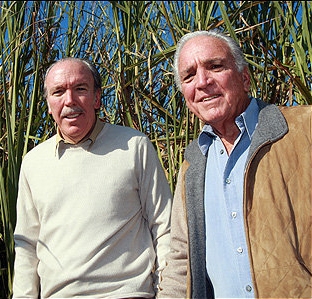
The Fanjul brothers’ were born in Cuba and are descendants of the Spaniard Andres Gomez-Mena who immigrated to Cuba in the 19th century and built up an empire of sugar mills and property by the time he died in 1910. In 1936, his descendant Lillian Gomez-Mena married Alfonso Fanjul, Sr, the heir of the New York-based sugar companies the Czarnikow Rionda Company and the Cuban Trading Company. The couple’s holdings were then combined to create a large business of cane sugar mills, refineries, distilleries, and significant amounts of real estate. Due to Fidel Castro‘s 1959 MarxistCuban Revolution, the family moved to Florida along with other wealthy, dispossessed Cuban families. In 1960, Alfonso Sr., the father of the current CEO of Fanjul Corp. Alfonso Jr., bought 4,000 acres (16 km2) of property near Lake Okeechobee along with some sugar mills from Louisiana and started over on the US. Alfonso Sr. and his son Alfy Fanjul got the firm off its feet and Pepe, Alexander and Andres joined in the late 1960s and 1970s.[1] Pepe Fanjul Jr. joined the sugar firm in 2002. As of 2008, the company owned 155,000 acres (630 km2) in Palm Beach County.
Here are some great articles and blogs on the Fanjul’s.
But managing water is a state responsibility; Big Sugar’s interest in counties goes deep into the bread and butter of local politics: land use zoning. While Big Sugar wages water use and water quality battles on many levels of judicial review, fighting tooth and nail to dictate every last term of its water pollution control measures, it wages war on the land use zoning front by ensuring complicit county commissioners are well funded. If not sugar cane, then rock mines and inland ports and shopping centers and subdivisions strategically placed to thwart the aims of environmentalists to protect the Everglades and our rivers and streams and estuaries.
Jose “Pepe” Fanjul, one of four brothers who control a sugar empire that includes Domino and Florida Crystals. Fanjul and his family have held at least two fundraisers for Rubio at Florida properties this year, while donors associated with Florida Crystals have given Rubio at least $81,100 since 2009.
(also some money from the Koch Brothers. Koch Industries, the conglomerate run by conservative activist brothers Charles and David Koch: $37,200. (Koch has donated $17,000 to Sen. Paul since 2010.)
Now, contrary to what almost anyone could have imagined, the 76-year-old Fanjul has begun to reassess old grievances and tentatively eye Cuba as a place for him and other U.S. businessmen to expand their enterprises. Quietly, without fanfare, Fanjul has started visiting the island of his birth and having conversations with top Cuban officials.
“If there is some way the family flag could be taken back to Cuba, then I am happy to do that,” Fanjul said in a rare interview, publicly discussing his recent visits to the island for the first time.
Here’s an early story on the Fanjul sugar interests well worth reading: “The power and wealth of the Fanjul family is enormous, so much so that they can quietly control their public image. But behind that image lies a family with a reputation for ruthlessness whose riches were made on the backs of migrant laborers and at the expense of America’s public resources and tax dollars. Without the artificial federal price supports of sugar, their industrial advantage and wealth would collapse.
The Fanjuls of Coral Gables and Palm Beach are among the richest farmers in America. The family interests own Florida Crystals/ Flo Sun in lands formerly of the Everglades.
I wouldn’t care except that the Fanjul’s sugar growing interest in the Everglades Agricultural Area is a home-grown Florida polluter whose influence in the political sphere has contributed to the destruction of millions of acres of publicly owned property and irreplaceable natural resources. What adds to my ire is that in the execution of its business strategy, Fanjul lobbyists and attorneys take maximal positions in defense of the last dime of profit– even when lands like the 50,000 acre Talisman Farm have been committed to public ownership– causing years and years of delay.
Sugar growers in this country, long protected from global competition, have had a great run at the expense of just about everyone else — refineries, candy manufacturers, other food companies, individual consumers and farmers in the developing world. But now the nation’s sugar program, which guarantees a domestic price for raw sugar that can be as much as three times the world price, needs to be terminated. It has become far too costly to America’s global economic and strategic interests.
The less defensible a federal policy is on its merits, the greater the likelihood that it generates (or originates from) a great deal of cash in Washington, in the form of campaign contributions. Sugar is a sweet case in point. The Fanjul brothers, Florida’s Cuban-American reigning sugar barons who preside over Palm Beach’s yacht-owning society, were alone responsible for generating nearly $1 million in soft-money donations during the 2000 election cycle. Alfonso Fanjul, the chief executive of the family-controlled Flo-Sun company, served as Bill Clinton’s Florida co-chairman in 1992 — and even merited a mention in the impeachment-scandal Starr report, when Monica Lewinsky testified that the president received a call from him during one of their trysts. Meanwhile, brother Pepe is equally energetic in backing Republicans, so all bases are covered.
The Fanjuls harvest 180,000 acres in South Florida that send polluted water into the Everglades. (A crucial part of their business over the years has been to lobby not just against liberalization of the sugar trade, but against plans to have the sugar industry pay its fair share of the ambitious $8 billion Everglades restoration project.) The Fanjuls had been Cuba’s leading sugar family for decades before Fidel Castro’s takeover. Crossing the Straits of Florida, they bought land in the vicinity of Lake Okeechobee, which feeds the Everglades, and imported platoons of poorly paid Caribbean migrant workers. Their business was aided by the embargo on Cuban sugar. The crop is protected from other competition by an intricate system of import quotas that dates back to 1981.
The government does not pay sugar producers income supports as it does many other kinds of farmers. Instead, it guarantees growers like the Fanjuls an inflated price by restricting supply.Only about 15 percent of American sugar is imported under the quota rules, and while the world price is about 7 cents a pound, American businesses that need sugar to make their products must pay close to 21 cents. Preserving this spread between domestic and world sugar prices costs consumers an estimated $2 billion a year, and nets the Fanjuls — who have been called the first family of corporate welfare — tens of millions annually.The sugar exporters who are able to sell to the United States also benefit from those astronomical prices. The Dominican Republic is the largest quota holder, and one of the big plantation owners there is — surprise — the Fanjul family.
The sugar situation hurts American businesses and consumers, but its worst impact is on the poor countries that try to compete in the global agricultural markets. Their farmers might never be able to compete with corn or wheat farmers in the United States, even if the playing field were leveled. But they can grow cotton and sugar at lower prices than we can, no matter how advanced our technology. Our poorer trading partners bitterly resent the way this country feels entitled to suspend market-driven rules whenever it appears they will place American producers at a disadvantage.
In fairness, the United States is not alone in distorting the sugar trade, and the European Union’s massively subsidized exports of beet sugar make it the biggest culprit. The American sugar lobby uses that fact as a shield, arguing that the crop not be included in any regional trade deals until distortions are addressed by all countries at the World Trade Organization. But quotas are set between trading partners, not on a global level. Right now the United States is negotiating the creation of a hemispheric free trade area that would benefit many United States industries, including other agricultural sectors. It is ridiculous for the sugar lobby to argue — as it does vociferously — that sugar should not be included in the agreement even though it is one of the few products that some Latin American republics can hope to ship to the American market.
So far the Bush administration has rightly rejected the sugar lobby’s push to keep the commodity off the table. The danger, however, is that American trade negotiators might still prove far too deferential to sugar industries when hammering out the trade deals’ specifics. For instance, any move to phase in elimination of sugar quotas over a period longer than a decade (as was done in the North American Free Trade Agreement) would undermine any promise a trade deal might hold for poor farmers in Latin America. The strength of the protectionist sugar lobby in Washington — which unites Southeastern cane growers and Midwestern beet farmers — was apparent in the success of Senator Mary Landrieu of Louisiana last year in bashing Nafta’s modest sugar provision during her re-election bid.
If the sugar trade were liberalized, world prices would start creeping up and domestic prices would fall, which would benefit both the developing world and the American economy. The industry itself cites ”alarming” studies that if the United States imported an additional two million metric tons — roughly the amount Central America exports — domestic prices would be cut in half. But that is no argument for opposing trade liberalization. That is an argument for the handful of individuals who control the sugar business in this country to start thinking about a new line of work, and be grateful for the long run they had.
Harvesting Poverty: Editorials in this series remain online at nytimes.com/harvestingpoverty.
The Fanjuls are looking back to the future with Cuba
Now, contrary to what almost anyone could have imagined, the 76-year-old Fanjul has begun to reassess old grievances and tentatively eye Cuba as a place for him and other U.S. businessmen to expand their enterprises. Quietly, without fanfare, Fanjul has started visiting the island of his birth and having conversations with top Cuban officials.
“If there is some way the family flag could be taken back to Cuba, then I am happy to do that,” Fanjul said in a rare interview, publicly discussing his recent visits to the island for the first time.
This, I’m sure, will make Marco Rubio’s head spin.
U.S. Rep. Ileana Ros-Lehtinen (R-FL), Chairman of the Subcommittee on the Middle East and North Africa, made the following statement on reports of Cuban-American sugar tycoon Alfonso Fanjul considering investing in Cuba:
“At a time when the democracy activists on the island are facing even harsher reprisals from the brutal Cuban regime, it’s pathetic that a Cuban-American tycoon feels inspired to trample on the backs of those activists in order to give the communist thugs more money with which to repress. The only little old thing that is standing in Alfy’s way of realizing these sleazy business deals with the devil is US law. He doesn’t talk about the arbitrary arrests of pro-freedom leaders in Cuba or the continual beatings endured by the peaceful Damas de Blanco. Oh no, for Alfy, the only hindrance to turning a profit off the suffering of the Cuban people is pesky US laws and he is working with groups to undo those laws. It is sickening to read that he brings up the separation of the Cuban family when he is doing all he can to exacerbate that problem. Shame on him..”
A little trouble in Paradise!
Despite the Fanjul family’s influence over U.S. policy and access to government officials at the highest levels of power, Alfy Fanjul has never become a U.S. citizen. He remains a permanent U.S. resident who maintains Spanish citizenship. Alfonso Fanjul served as co-chairman of Bill Clinton’s Florida campaign in 1992 and is a major contributor and fundraiser for the Democratic Party. His brother Pepe, who is a U.S. citizen, contributes to the Republicans.
ACOE and the Herbert Hoover Dike: We should be up in arms together!
Let’s take a moment to remember when the discharges came back in 2013 and we all went to Phipp’s Park. 7000 of us together in true Solidarity. The day most of us met each other.
That day we all heard this speech from the Indian RiverKeeper Marty Baum.
For many of us this was a call to action. For the people of Clewiston it was a call to flood them and make them float away. Of course, that’s not what Marty said. He didn’t say flood the houses. He said flood the fields and he was referring big sugars ability to keep their water at the exact height needed.
I posted that video of Marty on my old video blog on UVU which was part of WPBT2. I’m not sure what happened to UVU but I posted a lot of content there.
I posted Mark Perry, the video of the march to the locks, and others that got a decent amount of views. Marty’s video got 2400 views which is huge.
After the Sugarland Rally, when the people of Clewiston were accusing us of wanting to flood them I realized that probably every person in Clewiston probably saw that video. There was no explaining to them what the intention was. Their minds were set.
We heard that we HAD to have to discharges to protect the people that live south of the lake. Most of us understand that. That was 2 years ago and many millions of dollars.
Are the people south of lake any safer today than they were then?
. The levee is expected to fail. I know that sounds bad, and it is. FEMA is apparently planning to update flood assessments this summer and redraw flood maps for Palm Beach and Martin counties. These flood maps are expected to be drawn as if the levee around Lake Okeechobee didn’t exist. In other words, they are not counting on the levees to protect against flooding.
2. The Herbert Hoover Dike is in the highest failure category of the Army Corps risk scale. Current efforts are being directed at reducing the risk category, but as it stands (and even after millions of dollars worth of improvements) the levee protecting the area still carries the highest risk classification (DSAC 1) of any dam in the United States.
3. There is no emergency spillway, nor is one planned to be built. There is no good, controlled way to drain off excess water from the lake should a large amount of rain fall in a short amount of time. Lake Okeechobee fills six times faster than it can be drained, and a foot of rainfall would result in 3 to 4 feet of water rise in the lake. Current levees will start to fail when the lake rises above 18.5 feet above mean sea level (it’s at roughly 14 feet currently), and significant levee problems are almost certain to occur when the lake reaches 20 feet over MSL.
“In what appears to be a never-ending task, U.S. Army Corps of Engineers crews in Florida continue working on the outdated Herbert Hoover Dike surrounding Lake Okeechobee — the state’s largest freshwater lake. Since 2007, teams have performed various tasks to reduce the risk of dike failure due to flooding from high water levels.”
Because of the construction methods used in the 1930s, the dike is susceptible to erosion of the earthen embankment,” said John Campbell, public affairs specialist of the Jacksonville District, U.S. Army Corps of Engineers (USACE). “Over the past six years, we have installed a 21.4 mile concrete barrier known as a cutoff wall into the southeast quadrant of the dike. The cutoff wall is designed to reduce seepage and prevent erosion.”
The cutoff wall extends from roughly 6 ft. (1.8 m) from the top of the dike through the foundation to several feet beyond the limestone bedrock, averaging between 60 to 80 ft. (18.3 to 24.4 m) below the crest of the dike. It’s considered crucial to the rehabilitation effort, although is by no means a solution to a complex problem. Despite a multi-million dollar effort by USACE, the dike remains on a national shortlist of unsafe class 1 dams, with a category defined as either “almost certain to fail under normal operations” or at “extreme risk of failure with high fatalities and economic losses.” Campbell said progress has been made, but there is a long way to go.
“The $200 million invested so far made it possible to install the cutoff wall in the southeast quadrant of the dike between Port Mayaca and Belle Glade,” said Campbell.
TWO HUNDRED MILLION DOLLARS and the people are no safer than they were two years ago.
We should be up in arms because as long as this is the case our discharges will never stop.
We should be up in arms together.
I feel like Danny Kaye in this clip.
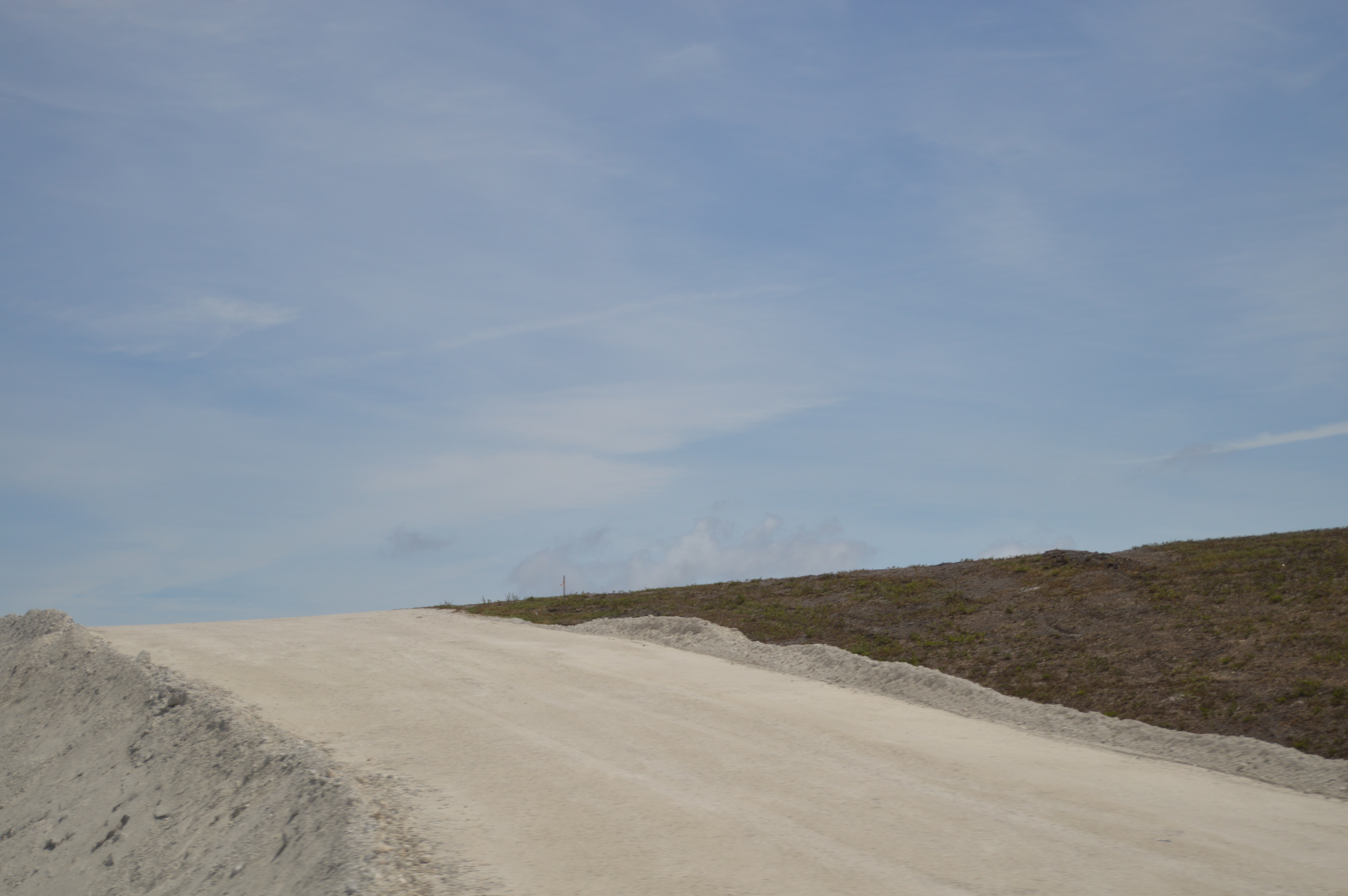
Here are some photo’s I took from the car as Julie and I whizzed by last weekend.
There was one spot that looked like a giant sand bag. Not a lot of confidence going into hurricane season.
The reason I bring this up is because our campaign to build a reservoir ended with discharges and toxic green algae sightings and it felt like what went around came around and we were back to square one with the ACOE. The people south of the lake are still in grave danger.
Don’t you think that having a reservoir south of the lake would take some pressure off those dikes and help to keep those people safer?
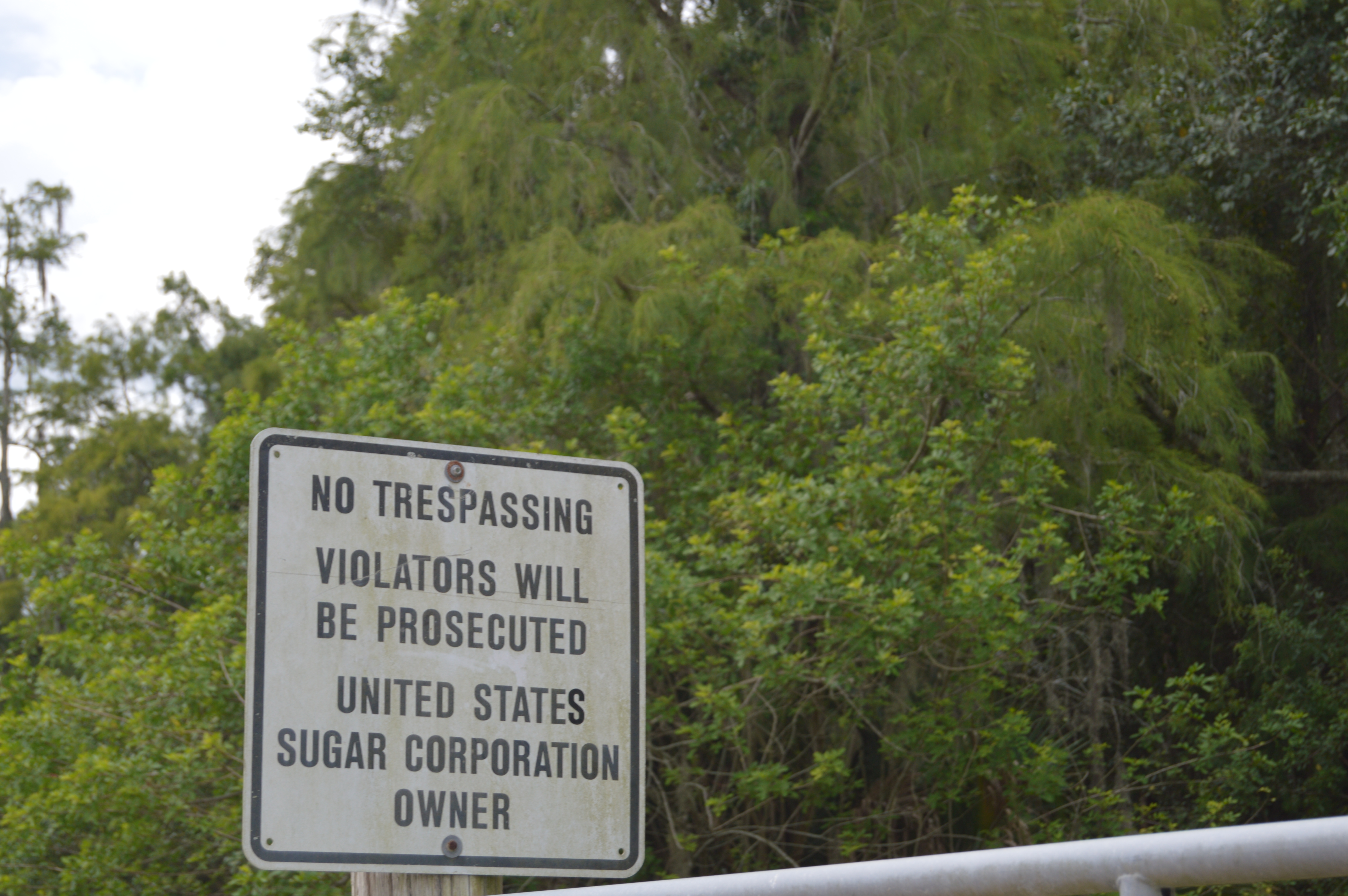
So just a note to the folks out in Clewiston. If you want to be upset with someone be upset with the ACOE and be upset with your bosses at big us sugar corp who are against anything that will keep you safe.

















 cyndi lenz