Loggerhead turtles hanging on the back of a truck waiting to be returned to the ocean after their rehab at Loggerhead Marine Life Center in Juno, Florida.
Over 30 years ago, long-time Juno Beach resident Eleanor Fletcher started what is now Loggerhead Marinelife Center. Eleanor and her husband Robert had a real estate business in Juno Beach. Eleanor began to notice there were many sea turtles nesting on the shore in spring and summer. She was curious about why so many hatchings headed landward after hatching, rather than back to sea, and as a result, began some of the earliest research on sea turtles in our area.
As she learned more and more about the sea turtles, she began to see that the turtles were threatened by the encroachment of man as he moved and built closer and closer to the shoreline. She decided that educating children about the sea turtles and the need for conservation and protection was the best hope for the sea turtles to survive over the long term. She began giving classes, first in her home, then above the real estate office as more and more children enjoyed her programs.
In April 2007, the organization relocated to a new 12,000 square foot certified “green” facility and changed its name to Loggerhead Marinelife Center. The new facility includes a state-of-the-art full service veterinary hospital, exhibit hall, outdoor classroom, research lab, and resource center. They have an awesome gift shop. I usually go there this time of year to buy ocean related child books for my nieces and this year for my grandson.
Loggerhead Marinelife Center is a 501(c)3 non-profit education and ocean conservation facility located on the Atlantic Ocean in Palm Beach County, Florida. The facility houses a variety of exhibits, live sea turtles and other coastal creatures. Exhibits include a massive prehistoric Archelon sea turtle replica, salt water aquaria and displays of local wildlife, as well as educational displays about South Florida’s marine environment.”
I included the photo above and some video in my multi award winning documentary film “The Garbage of Jupiter Beach” because these gentle giants often come with plastic bags in their guts, or filled with fishing line or some other garbage people have thrown in the ocean. So before you liter please put these guys in your head and understand the damage that can be done.
Here are photos from the last time I was there last year.
You can go here and see whose in the hospital now.
This is wonderful place to support. I am looking forward to the day I can take my Grandson Ethan.
Brian Yablonski, Chairman of the Florida Fish and Wildlife Conservation Commission (FWC) was recently compelled to publish an editorial entitled “The Hunter Conservationist Paradox”. In response, I thought it important to dispel some myths and to present a true and accurate portrayal of the man known as the “Conservation President”; as well as some of his protégés. Perhaps some people should take notes as to what true conservation is.
Mr. Yablonski’s most recent piece was submitted as a celebration of Theodore Roosevelt’s 157th birthday and his conservation legacy. This editorial was published on the FWC website five days after the first Florida black bear hunt in 21 years, and was in obvious response to the public criticism of the FWC decision to host this hunt. It was also intended to pay tribute to the one we know as the conservation President. “The Hunter Conservationist Paradox” summarized the conservation accomplishments…
Xenophobia is the fear of that which is perceived to be foreign or strange.[1][2] Xenophobia can manifest itself in many ways involving the relations and perceptions of an ingroup towards an outgroup, including a fear of losing identity, suspicion of its activities, aggression, and desire to eliminate its presence to secure a presumed purity. Xenophobia can also be exhibited in the form of an “uncritical exaltation of another culture” in which a culture is ascribed “an unreal, stereotyped and exotic quality”.
A Pew Research Center survey released on September 29 shows a mixed and polarized response among Americans to the Syrian refugee crisis. By a narrow margin of 51 to 45 percent, the public approves of the Obama administration’s decision to accept more refugees. Democrats favor this move by 69 to 29 percent, while Republicans oppose it by a similar margin of 67 to 30. The split among Independents, with 51 percent in favor and 43 percent opposed, closely mirrors the population as a whole.
Breaking down the response by subgroups, some familiar patterns emerge. Accepting more refugees is backed by racial and ethnic minorities, young people, those with college and professional degrees, and by Catholics and religiously unaffiliated individuals. Groups in opposition include whites, older Americans, those with less than a college education, and white mainline as well as evangelical Protestants.
When asked a more general question—whether the United States should be “doing more” in response to the refugee crisis, the response was less polarized. Fifty percent of Democrats said we should do more, 11 percent less, while 35 percent thought our current level of effort is about right. Among Republicans, 35 percent favored an increased effort, 28 percent thought we should do less, and 29 percent supported our current policies.
The European Refugee Crisis and Syria Explained
It’s a great video and explains how the Syrian people got to where they are.
What is a crisis but something happens when you don’t deal with an issue. The world has ignored the issue and now we have a crisis and the world needs to deal with it.
What if we had a room where we could send representatives to all sit down and try to figure out a solution. Ohhh we have one. This is what they have been up to.
“But it’s important to remember: The brutal leaders of Islamic State, or ISIL, do not represent Islam. This is a truly extreme death cult, and it should not be succeeding in the 21st century. There are an estimated 1.6 billion Muslims worldwide, while the number of fighters for ISIL number perhaps 30,000, according to CIA estimates. So why has this fringe cult accomplished as much as it has? Why are candidates for the U.S. presidency, including former Gov. Jeb Bush, seriously talking about abandoning such basic constitutional principles as separation between church and state, proposing that the United States help only Christian refugees?
One word: fear.”
The GOP wants you to be scared so you’ll vote for them. You’ll crawl from under you bed and run quickly to the polls or get a mail in ballot and then go hide your bed because the boogie man is going to get you.
Fear motivates people to behave irrationally. To throw away all human kindness.
Mista Gimleteye from Eye on Miami wrote this today.
Psychologists are amassing more concrete data on the factors that lead some people to terrorism—and using those insights to develop ways to thwart it.
By Tori DeAngelis
“While researchers now agree that most terrorists are not “pathological” in any traditional sense, several important insights have been gleaned though interviews with some 60 former terrorists conducted by psychologist John Horgan, PhD, who directs the Pennsylvania State University’s International Center for the Study of Terrorism.
Horgan found that people who are more open to terrorist recruitment and radicalization tend to:
Feel angry, alienated or disenfranchised.
Believe that their current political involvement does not give them the power to effect real change.
Identify with perceived victims of the social injustice they are fighting.
Feel the need to take action rather than just talking about the problem.
Believe that engaging in violence against the state is not immoral.
Have friends or family sympathetic to the cause.
Believe that joining a movement offers social and psychological rewards such as adventure, camaraderie and a heightened sense of identity.”
We are human. No one one wakes up in the morning asks to be disenfranchised, alienated or angry.
FOR IMMEDIATE RELEASE
Tampa Bay, FL – “Governor Scott’s demand that Congress act to prevent Syrian refugees from settling in Florida reminds me of another shameful time in U.S. history,” said Democratic Progressive Caucus of Florida President Susan Smith. “Seventy-six years ago, the S.S. St. Louis, carrying almost 1,000 Jews seeking refuge from the Nazis, was refused entry into the United States. Those refugees were forced to return to Germany where many of them did not survive the Holocaust.
“Republican governors and politicians are feeding hysteria that threatens to poison our country for years to come,” said Smith. “By falling into this trap, we inadvertently support and further the mission of ISIS to foment hatred and division, and we will once again find ourselves on the wrong side of history.”
President Obama calls this rejection of Syrian refugees “a betrayal of our values.”
“In school, we all learn the words to the poem which is inscribed on the Statue of Liberty,” Smith said. “Give me your tired, your poor, Your huddled masses yearning to breathe free, The wretched refuse of your teeming shore. Send these, the homeless, tempest-tossed to me, I lift my lamp beside the golden door!
“And who, today, is more tempest-tossed than Syrian refugees? No one is suggesting that we open our borders without security checks. But as leaders on the global stage, we have a responsibility and an opportunity to demonstrate the values on which our country was founded: welcoming those who seek safety and freedom from oppression.
“We can do better. We must do better.”
The Democratic Progressive Caucus of Florida is a chartered caucus of the Florida Democratic Party.
###
let love not hate and common sense and compassion prevail.
Lyrics to Thick as a Brick. (Jethro Tull) Sing with me!
Really don’t mind if you sit this one out.
My words but a whisper your deafness a SHOUT.
I may make you feel but I can’t make you think.
Your sperm’s in the gutter your love’s in the sink.
So you ride yourselves over the fields and
You make all your animal deals and
Your wise men don’t know how it feels
To be thick as a brick.
And the sand-castle virtues are all swept away in
The tidal destruction
The moral melee.
The elastic retreat rings the close of play
As the last wave uncovers
The newfangled way.
But your new shoes are worn at the heels and
Your suntan does rapidly peel and
Your wise men don’t know how it feels
To be thick as a brick.
And the love that I feel, is so far away
I’m a bad dream that I just had today and you
Shake your head and
Say it’s a shame.
Spin me back down the years
and the days of my youth.
Draw the lace and black curtains
and shut out the whole truth.
Spin me down the long ages, let them sing the song.
The big story this week was the terrorist attack in Paris. I was just sitting here quietly finally watching “Homeland” and the phone just lit up with tweets about Paris. I have alternately been glued to the news and then turning it off. I can’t stand the sensationalism. My heart goes out to all the people. I can’t imagine.
Thank goodness for John Oliver. He totally put it all in perspective if you can do that. Warning profanity. Fitting but profane.
A woman who identifies herself as a Pastafarian, a follower of a religion that teaches that an airborne “spaghetti monster” could have created the universe, has succeeded in her bid to wear a colander on her head in her driver’s license photo.
Brook is my favorite Florida Squeeze writer. It’s a good blog so you should read.
Nutrition is a huge part of my life. Every day I tell my patients the eat good whole foods with fruits and vegetables. They look at me like I’ve lost my mind. These are the people that really have no choice but to eat food in cans and processed food which is what is killing us. Food in cans is filled with sodium and processed food is filled with sugar.
Most of these people are on fixed incomes because they are over 65. Most, if they can get food stamps, get 15 dollars a month for food stamps. The cheapest food you can get is the stuff in a can or in box which is the food that is bad for you. This is my $15 challenge. No one can eat on 15 dollars a month.
Most people on both sides are totally unaware. Unless you worked in the community every day how could you be?
One of the biggest list I have at work is my list of food banks. I encourage them to go for the fresh fruits and veggies if possible.
If you think about it when we have food drives that’s what we bring. We bring our old canned food and food in a box.
We bring out most unhealthiest food to the most vulnerable people.
We’re killing people with our kindness if you think about it.
I look at issues through the eyes of Abraham Maslow.
Many people in our state barely have their physiological needs taken care of. Clean water and food. I know my representatives really do not care if our citizens have this.
The citizen’s of Martin County do make this happen. We are the ones fighting for clean water and we are the one’s that worry about making sure people have food.
No matter if this is 15 dollars minimum wage or over $15 for our elderly and disabled people we have got to do better. My challenge to you if to find someone near you and make sure they have good whole foods and fruits and vegetables and clean water.
There’s so much more to write but I’ll save that for another day.
Instead of waiting for something to happen. Let’s just make it happen.
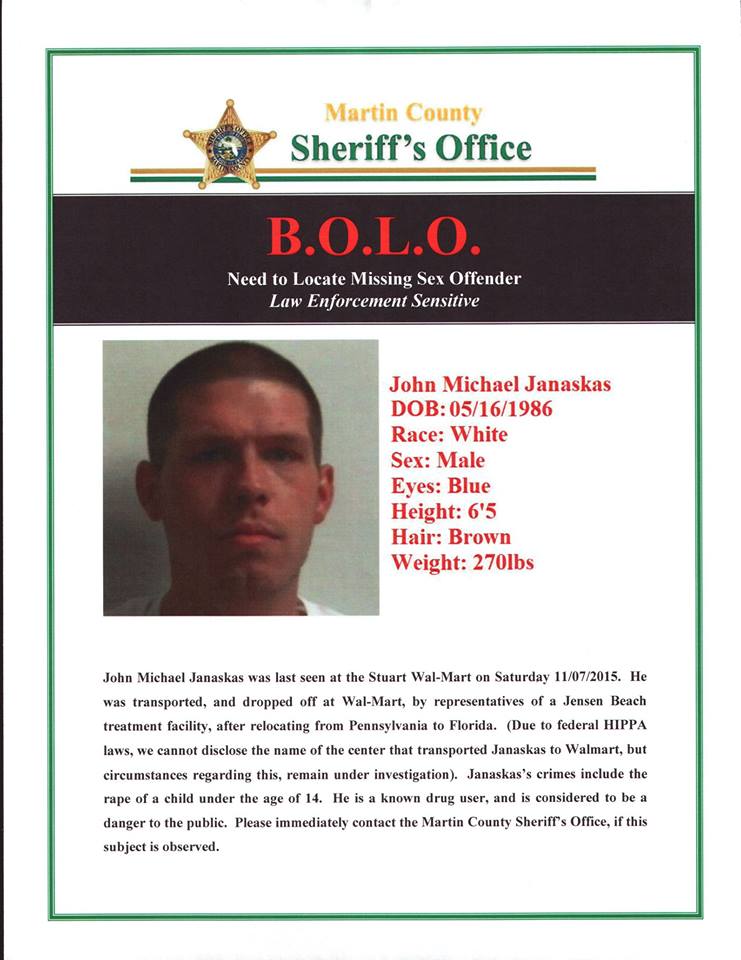
So according the news John Michael Janaskas, who was court ordered to drug rehab in Jensen beach, was dropped off at a Walmart because the rehab center “didn’t want the heat.” The news reported that “Martin County sex offender” was taken to another rehab in Miramar. We still have lots of questions.
I want to be very clear. I am very much for good treatment. Our citizens do not have the option of a special treatment houses. They have nothing. Our mentally ill end up in jail. Or they get 15 minute at New Horizens to get their prescription refilled. I worked on a great CD unit in Ft Lauderdale. In order to work there I had to be credentialed. A few months ago I had an issue with urinating for my urine test. I had to pay 250 dollars for a blood test and I was happy to do so. But I (The RN with no record is guilty and has no to proven innocent). These guys are just innocent and through some loop hole they do not have to obey the same laws and rules as the rest of us.
Why won’t our legislators do something about this?
How does a person who is a sex offender get court ordered to Jensen Beach to a licensed drug rehab around the corner from me and then get dropped off at Walmart? Do these people have the good sense to do business and keep the the rest of us safe?
The news reported they could not say which recovery center because it was protected by HIPAA. People are protected by HIPPA not buildings. Rehabs, sober houses etc are a matter of public record.
So yesterday I heard a bunch of things. I was told these places cannot be regulated. This place can and is regulated under the laws of the State of Florida which means it follows the rest of the rules that we all do. They will be investigated but we still have not answered the question as to why are people being ordered for treatment in Florida a state with such an incredible huge drug problem. This is like the issue of the Lost dogs of South Carolina. Why are we bringing more dogs to a state that has a huge amount of homeless dogs that are being euthanized.
So someone needs to find out about this. How does this work?
The treatment center dropped him off at Walmart and not the Martin County Sheriff’s office because “They didn’t want the heat.”
So in fact, the people that put us in danger was the treatment center and the person in question found his way to another treatment center because he knew he was in deep doodoo.
Apparently, when he got kicked out of the treatment center he reached out to the outreach coordinator at the facility in Jensen Beach who got him here in the first place. This person got him into the center in Miramar. Where was the person when the BOLO went out? Did this person call the police explain the situation?
So the treatment center has a lot “splainin to do.
And they will. They have lots of people to answer to.
The good news is this issue has put this issue front and center. I wrote last week about motels being bought up and turned into treatment centers, sober homes, half ways houses for the people up north is really coming to light. The fact Martin County has allow these place to sprout up everywhere in our neighbors it seems they have a lot of “splanin to do.
Instead of repeating the same thing over and over again there are things that can be looked at. There is a difference between a “sober home” and a licensed facility.
The sheriff himself confused calling this a sober home when it’s not. It’s a licensed drug rehab. So someone please educate him as to the difference.
“A lot of people have reached out to me this week which is great. What I heard is this: “They are popping up everywhere and people are worried. One person said she is constantly calling the police and no one is doing anything. I heard the problem is Epic is Rio. That MCSO has no interest. There is drug abuse and distribution and break ins.”
Which is why I laugh when some guy want’s to build some massive yuppie land in Rio. Who is going to buy these places between the drug issues and the train horns and the filthy dirty stinky water? A lot of people. Want to know why? All this will get sweep under the rug. It won’t get dealt with.
We know this happens because we see it. I see it in FIsherman’s Haven. I see it at the corner store when someone asks me for money to buy pot. Everyday it get scarier over there.
http://articles.sun-sentinel.com/2014-03-08/news/fl-sober-homes-state-crackdown-20140308_1_sober-houses-sober-homes-group-homes
“For years, the proliferation of sober houses has been a source of frustration for city leaders and neighbors.
Both groups groused about the lack of regulation in place to govern sober houses, which are group homes that shelter people recovering from drug and alcohol addictions.
“It’s the wild west,” Delray Beach Mayor Gary Glickstein said.
Sober houses dot the landscape in several Broward and Palm Beach county communities, including in Delray Beach, Boca Raton, Deerfield Beach and Pompano Beach.
But now two proposals aim to bring order to what many say is a chaotic situation.
A proposed state law under consideration in the annual Florida legislative session would impose regulations on the facilities.
“Unfortunately, there are houses popping up everywhere which are “addiction counseling” houses. Some on my very street. When I asked what I can do about it, the city basically said “Follow your instinct. We can’t refuse because it is an ADA compliance.”
The measure would require registration with the state, including disclosure of the number of people served at each site, and implement background checks. Operators would have to show proof of fire, safety and health inspections and compliance with local zoning ordinances. And felons convicted of violent crimes wouldn’t be allowed as owners and operators.
Neighbors seethe over unsupervised residents congregating in and around the homes and city officials complain they’re powerless to do anything, even in the face of problems, because people recovering from addictions are protected under federal fair housing and disability laws. Clemens, Glickstein and Hager said government officials don’t know who’s staffing the homes, what kind of people are residing in them, or even basic numbers about how many exist and how many residents are there.
“Unregulated sober homes are popping up in the middle of neighborhoods and in many cases essentially changing the character of those neighborhoods,” Clemens said. Hager said the sober homes “have been plaguing our cities and our residents.”
Glickstein and state Rep. Gwyndolen “Gwyn” Clarke-Reed, D-Deerfield Beach, said the number of sober homes increased during the real estate meltdown, during which foreclosed houses were bought cheaply and turned into sober homes.
“Something definitely has to be done,” Clarke-Reed said.
Not so fast, said James Green, a West Palm Beach lawyer who has repeatedly and successfully challenged cities’ attempts to restrict sober homes in South Florida. He said people in recovery are a protected class under the Fair Housing Act and Americans with Disabilities Act.
“It’s a problem that’s motivated by hostile neighbor prejudice against people in recovery,” Green said, urging people to substitute blacks or Jews for people in recovery. “If there was neighborhood opposition to people who belong to other protected groups, we’d be saying that they were racist or anti-Semitic.”
Efforts to impose restrictions amount to politicians pandering to “the voices of intolerance,” he said. “It’s more easy to demonize than understand.”
He said the model of having people “who are committed to sobriety” living and working together is a successful way to help people stay away from drugs and alcohol.”
This is great but it’s not what is happening.
The issue I have with Mr Green is this. I understand what he is saying. but we have no idea who the people are that are running these places. Are they even licensed mental health counselors. We are all for recovery. What we are not for is becoming alcoholic/drug center of the universe. There is no regulation. I’m a nurse and in order to work with people who are protected under the American’s Disabilities Act I have to be credentialed. Finger prints. urine tests, FBI background checks, physicals, tb tests, cpr and more. It cost’s me a fortune to stay credentialed. If a person is protected under the American’s Disabilities Act then the people taking care of them need to be credentialed. It’s not intolerance. It’s keeping the people safe.
This is Florida. Land of the Scam. If there is a loophole it will be found and only until something tragic happens will something maybe be done.
Again and again the people of Martin County are not protected. We are the Cassidaga of drug addiction. Send us your heroin addicts. We don’t have enough of our own.
So these are the big ticket items that we need to know about.
Who is running these sober homes? Are they credentialed under the State of Florida?
Why are people getting court ordered from Florida? How does that work?
Is there a limit to how many facilities can go into a county.
Why are these places even here and our citizens do not have any services? (Who does that)
Are the police going to clean up Rio and other areas where drug abuse, drug distribution is rampant
This morning there is nothing on the new about John Michael Janaskas. Why is that?
Just driving to Miami deserves a medal. The entire blog post brought tears to my eyes.
On the topic of being a good neighbor I’ve writing a short series about a pedophile that court ordered to my town from up north. He was suppose to register at the sheriff’s office and the rehab staff dropped him off at Walmart. A manhunt ensued. He found his way to another rehab. He turned himself in and yesterday was in jail with a 100,000 bond and today there was virtually nothing in the news that I saw. I’ve been getting lots of great feedback and I’m happy this incident happened to bring this whole thing to the forefront. Why are people being court ordered to a facility that is literally feet from a playground, a ball field and a skate park. Stay tuned.
Here is Daniel Tiger who I was introduced to this weekend. Thank goodness I have apple tv and PBS kids. So enjoy. Let’s all try and be a good neighbor.
In the Hood: Worse than I thought. Rapist on the loose.
Just last week I wrote this blog post about Motels being bought and turned into drug rehabs.
Not one or two but many. Not for our citizens but for people from out of state. As far as I can tell there is no regulation. This happened
From the Martin County Sheriff’s office
“CITIZEN’S BOLO, ABSCONDED SEX OFFENDER, PLEASE SHARE
The Martin County Sheriff’s Office is seeking information about 29-year old, John Michael Janaskas. Janaskas is a registered sex offender, who recently relocated from Pennsylvania to a alcohol and drug rehabilitation facility in Jensen Beach.
Over the weekend, representatives from the facility transported Janaskas to the Stuart Walmart, where they dropped him off. No further contact, or forwarding information was taken. Due to federal HIPAA Laws, we cannot disclose the name of the facility. The circumstances surrounding this incident are under investigation.
(I don’t think that’s true. It the patient that is protected not the building.)
Janaska’s crimes include the rape of a child under 14. He is a known drug user, and is considered to be a danger to the public. If you see him, or have information on his whereabouts, you are asked to call the Martin County Sheriff’s Office.
Florida law requires sex offenders and predators to register with the Martin County Sheriff’s Office, so our detectives know, at all times, where they can be located. Janaskas did not register, nor were we notified that Janaskas was dropped off at this public venue, in Martin County without forwarding information, until today.”
This unknown protected HIPAA place took two days to report this. Two days. Two days they have let a known rapist into our community.
Yesterday I was told that nothing could be done because these criminals that are being imported from up north are protected by law. I’m pretty sure not any other state takes rapists into their communities.
Yesterday My friend Victoria found that one company is buying up all these places. They are also the people who are importing criminals from up north. I don’t have all my facts but when I do I’ll put them here UNLESS the news and the police actually do it first. I won’t hold my breath.
Enough is Enough.
You have not protected us from anything. Not the discharges. Not the trains. Not criminals and rapists. nothing.
Our beautiful Stuart and Jensen Beach are being destroyed bit by bit.
Cyndi Lenz is a multi-talented psychiatric nurse, award-winning documentary filmmaker, writer, and environmental advocate. Describing herself as a “crazed river warrior,” she is widely known for her dedicated grassroots work protecting the Indian River Lagoon and marine environments in Florida. Over several decades, her career has uniquely intersected healthcare, artistic storytelling, and environmental activism.
Early Life and Background
Lenz grew up with strong ties to the Boston, Massachusetts area. Before establishing her career in nursing and film, she lived in Cambridge, Massachusetts, where she explored a variety of creative passions. During this early period, she worked as a singing waitress in a Gershwin revue and performed as part of a local mime troupe. In 1984, she relocated to Florida, which became her home for over forty years.
Career in Nursing and Filmmaking
Professionally, Lenz has balanced a long-standing career as a psychiatric home health nurse with a prolific output of visual media. Driven by a love for silently capturing stories behind a camera lens, she transitioned into documentary filmmaking and digital content creation. Her professional highlights include:
Documentary Film: Her work on IMDb credits her as a creator or key contributor for projects like Social Work (2006), Musician Physician (2007), and The Visionary Life of Helmut Ziehe (2012).
Environmental Exposure: She wrote and produced the multi-award-winning documentary The Garbage of Jupiter Beach, highlighting the hazardous impact of ocean litter on sea turtles.
Digital Media Recognition: Her extensive local video content earned her the “Most Prolific Vlogger” award from Miami’s local public television station, WPBT20.
Advocacy and Blogging
Lenz channels her expertise into public education through independent writing and blogging. Her blog serves as a platform to spread awareness on critical causes:
Environmental Action: She reports heavily on water quality and ecosystem threats facing the Florida coast, often partnering mentally with preservation hubs like the Loggerhead Marinelife Center.
Mental Health Awareness: Utilizing her healthcare background, she frequently writes pieces aimed at demystifying mental illness and advocating for patients.
Community News: She spent considerable time reporting and writing local interest columns on the Newsbreak platform.
Personal Life and Recent Transition
Beyond her activism, Lenz is an avid photographer, a practitioner of Reiki, and a student of meditation and spiritual counseling. She is a passionate lover of golden retrievers and deeply values her family role as a grandmother. After sustaining a severe arm injury that forced her to step away from clinical nursing, she made the pivotal decision to relocate from Florida to embark on her next chapter of writing and creative exploration.
As a self-described “crazed river warrior,” Cyndi Lenz uses her environmental writing to blend direct grassroots activism with educational storytelling. Writing primarily on her personal blog Cyndi Lenz, she covers local ecological crises along Florida’s Treasure Coast, transforming complex scientific problems into urgent calls to action. [1, 2, 3, 4]
Key Themes in Her Writing
The Fate of the Indian River Lagoon: Lenz writes extensively about the Indian River Lagoon and the St. Lucie River. She documents the devastating environmental impact when the St. Lucie Locks open. Her posts capture how the resulting influx of polluted, fresh lake water from Lake Okeechobee disrupts water salinity, sparks toxic blue-green algae blooms, and kills off vital local oyster beds.
Protecting Coastal Wildlife: Her writing shines a spotlight on vulnerable local species. She has documented the steep decline of Florida’s wading bird populations, such as the Little Blue Heron, using them as a ecological barometer for the health of local wetlands and marine food chains. She also covers land conservation issues, highlighting the behavior and habitat needs of Florida’s native black bears.
Cyndi Lenz’s award-winning documentary work centers heavily on grassroots community efforts, local heroism, and environmental preservation. Operating with a personal, hands-on style, she has independent filmmaking credits spanning writing, shooting, producing, and editing. Her most celebrated projects use regional stories to deliver universal messages about human impact and civic responsibility.
The Premise: The film captures a unique, community-driven deal made between a local resident named Anita Lankler and the City of Jupiter, Florida. The arrangement allowed residents to bring their dogs to the beach in exchange for taking full responsibility for keeping the shoreline clean.
The Movement: The project chronicles how this small initial group expanded into a massive organization called the Friends of Jupiter Beach, eventually growing to over 4,000 members. Lenz captured monthly beach cleanups where volunteers ranging from ages 6 to 86 gathered to clear tens of thousands of pounds of trash.
Awards and Accolades: The film earned critical acclaim on the independent festival circuit, winning “Best Green Short” at the Delray Beach Film Festival and securing a first-place standing in the short documentary category at the Moondance International Film Festival.
Creative Elements: Beyond Lenz’s cinematography and editing, the short film is well-known for its vibrant tone, featuring archival footage and a lively, localized soundtrack performed by the musical group Big Vince and the Phat Cats. [1, 2]
Across her videography and documentary work, Lenz maintains a signature approach to storytelling:
Civic Action over Academic Theory: Rather than focusing on abstract environmental data, Lenz’s films focus on everyday people executing hyper-local solutions to global problems.
Human-Animal Connections: Her visual work often emphasizes the symbiotic relationship between people and animals, whether documenting beach-going dogs motivating ocean cleanup or highlighting the plight of marine life threatened by coastal development.
The “One-Man Crew” Model: Lenz is a staunch proponent of accessible digital media, frequently utilizing standard, portable camera gear to shoot, write, and fine-tune her footage independently. This guerrilla-style approach earned her the “Most Prolific Vlogger” title from public television station WPBT20. [1, 2]
Cyndi Lenz’s environmental advocacy is heavily rooted in collaboration. Believing that individual voices must unite to combat massive systemic crises like the Lake Okeechobee discharges, she has partnered with a diverse network of grassroots groups, youth organizations, and prominent regional activists to amplify the clean water movement along Florida’s Treasure Coast.
Key Activists and Mentors
Jacqui Thurlow-Lippisch: Lenz has a long-standing collaborative relationship with Jacqui Thurlow-Lippisch, a highly influential Florida environmentalist, former mayor, and South Florida Water Management District board member. The two have frequently cross-promoted each other’s educational content, shared aerial photography to track toxic plumes, and co-documented environmental events like anti-rail flotillas on the St. Lucie River.
Evangelizing Regional Pioneers: In her writing, Lenz actively honors and keeps the legacies of foundational Florida conservationists alive to educate modern voters. She has collaborated with modern figures like Captain Mike Connor and Michelle Roberts—granddaughter of Johnny Jones, the famed champion of the Kissimmee River restoration—to reinforce historical knowledge within contemporary movements.
Grassroots Organizations & Coalitions
The “Solidarity Fish” and “Send It South” Movements: Lenz heavily aligned her independent film and blogging efforts with collective grassroots actions pushing the state of Florida to buy agricultural land and direct clean water south into the Everglades, rather than discharging toxic runoff into coastal estuaries. She documented collaborative treks to Tallahassee alongside independent advocates like Kenny Hinkle and Janeen Mclain to demand legislative action.
Friends of Jupiter Beach: Her award-winning documentary work was entirely a collaborative effort with Anita Lankler and the Friends of Jupiter Beach community. By highlighting their collective monthly beach cleanups, she provided the organization with a highly effective visual tool to expand its volunteer base to thousands of members. [1, 2]
Lenz strictly maintains an “A-political” stance, focusing her efforts entirely on clean water as a basic human right. This has allowed her to collaborate broadly across political divides. She famously spoke about the Lake Okeechobee discharges at political rallies, directly challenging leadership across multiple party lines—including green, independent, democratic, and republican platforms—to sign environmental declarations and publicly acknowledge Florida’s water emergency. [1]
Cyndi Lenz’s environmental writing on Lake Okeechobee discharges focuses on how the intentional release of lake water destroys South Florida’s fragile coastal estuaries. Lenz targets the St. Lucie Locks—which she dramatically refers to as the “Gates of Hell”—as the localized epicenter of this ecological crisis. [1, 2, 3]
Her coverage details how these discharges cause severe environmental, ecological, and civic damage to the region.
The Problem: It’s Not Just the Pollution, It’s the Fresh Water [1]
A distinct element of Lenz’s environmental commentary is her insistence on educating the public about salinity disruption. She frequently writes that even if the water leaving Lake Okeechobee were perfectly clean, it would still act as an ecological weapon. [1]
Estuary Destruction: The St. Lucie River and Indian River Lagoon are brackish systems dependent on a delicate balance of salt and fresh water.
Habitat Death: Massive, multi-billion-gallon pulses of fresh lake water drop the salinity so sharply that it instantly kills off vital seagrasses, local mangrove forests, and million-dollar oyster beds.
Tracking the “Toxic Summers”
When nutrient pollution—primarily nitrogen and phosphorus agricultural runoff—is mixed in, the discharges fuel massive toxic blue-green algae blooms (cyanobacteria). Lenz’s blog posts historically document the devastating “Toxic Summers” along the Treasure Coast:
Visual Evidence: She collaborates with local pilots and fellow environmentalists like Jacqui Thurlow-Lippisch to publish photos and aerial footage tracking the bright, fluorescent green sludge as it travels from the lake into coastal communities.
Public Health Warnings: As a registered nurse, Lenz emphasizes the human toll of the toxic blooms, warning her readers about the airborne neurotoxins produced by the algae that force local marine workers to wear respirators and keep tourists away from the beaches.
Performative Protest: In May 2014, to capture public attention and symbolize the despair of local residents, Lenz helped organize and document a symbolic “Funeral for the St. Lucie River and Indian River Lagoon” right next to the Phipps Park locks.
Lenz’s writing consistently champions a single, definitive engineering solution to the crisis: sending the water south. [1]
Historically, Lake Okeechobee overflowed naturally southward into the Everglades. Decades of development and agricultural zoning blocked this flow, forcing the Army Corps of Engineers to dump excess water east and west into coastal rivers instead. Lenz uses her platform to aggressively pressure the Florida Legislature to buy back agricultural land south of the lake. She argues that restoring the natural southern flow is the only way to simultaneously save the coastal estuaries, recharge South Florida’s drinking aquifers, and hydrate the dying Everglades. [1, 2, 3, 4]
Demanding Accountability at Public Rallies
Lenz routinely utilized public rallies, political gatherings, and town halls to challenge elected officials face-to-face.
The Anti-Discharge Protests: During peak crisis periods, Lenz helped coordinate and film major grassroots protests at the St. Lucie Locks. She used these events to publicly name and shame politicians who accepted campaign contributions from the agricultural industries responsible for Lake Okeechobee’s nutrient pollution.
The “Funeral for the River” Event: By co-organizing the symbolic funeral for the St. Lucie River and Indian River Lagoon, Lenz created a high-visibility media spectacle. This event forced local county commissioners and state representatives to either attend and answer to their constituents, or face public backlash for staying away.
Cyndi Lenz’s political pressure campaigns focused heavily on aggressive accountability, non-partisanship, and giving a platform to regular citizens. Rather than working through traditional lobbying channels, she used her camera, her blog, and public forums to force local and state politicians to directly confront Florida’s water crisis.
Weaponizing Digital Media and Crowdsourcing
Lenz recognized that politicians are highly sensitive to public perception, so she used her digital media footprint to apply constant, visible pressure.
Tracking Votes and Funding: She used her blog to break down complex state legislative bills, tracking exactly how local representatives voted on conservation funding and water quality standards. She presented this data in simple terms, explicitly telling her readers who to vote for—or against—based solely on their environmental record.
On-Camera Confrontations: Utilizing her background as a documentary filmmaker, Lenz frequently recorded public comments at local government meetings. By publishing unedited footage of politicians deflecting or avoiding clean-water questions, she created an online archive that kept local officials accountable long after the meetings ended
In response to The Daily Post’s weekly photo challenge: “Ornate.”
Here is a video of Janeen talking about the project.
“The Solidarity Fish Project This simple wooden fish is splashed in vivid colors on one side, but when flipped over it reveals in stark contrast skeletal remains on a black background. Viewed individually each is unique and beautiful. When they are exhibited together by the thousand(s) they are a monumental temporary public art installation that connects participants and passers-by.
The Solidarity Fish, painted by kids and ordinary people are an icon of the clean water movement in Florida. They have been from the Everglades to Washington, D.C., from the steps of the Capitol Building in Tallahassee to the cover of most major Florida newspapers and in the New York Times.
Raising awareness and inspiring stewardship with a striking participatory art project created by ordinary people doing extraordinary things. Working together to change the status quo.
Solidarity, Janeen Mason Author/Illustrator/Speaker National Award Winning Children’s Books”




 cyndi lenz