Lakepointe and the Pacific Legal Foundation

Lakepointe and the Pacific Legal Foundation.

When it looks like a duck, and walks like duck, quacks like a duck it’s a duck.

Or in this case a big polluting rubber ducky.

duck

I’ve written about the Pacific Legal Foundation and explained who they are. When I first moved here I read about Lakepointe and even wrote to some friends about them. Something was not kosher there. Something was rotten in Denmark.  Unfortunately, at the time I didn’t have the knowledge to really understand.

Well wow. Now things are falling into place.

Here we found out how the Pacific Legal Foundation is messing with our Panthers

https://cyndi-lenz.com/2015/07/09/panthers-manatees-and-bears-oh-my/

Then we asked why are they even involved in all this.

https://cyndi-lenz.com/2015/07/10/who-is-the-pacific-legal-foundation-and-why-are-our-panthers-manatees-and-bears-their-business/

They are a Koch Brothers, Scaife Foundation lackeys hiding out in bosom of an unending cash cow and really sticking their nose where it doesn’t belong but where their masters want them to go.

and they want to go to Martin County. They want to destroy us.

Then I wrote about their relationship to Martin County and our Economic Foundation

https://cyndi-lenz.com/2015/07/11/bring-it-on-home-the-pacific-legal-foundation-and-martin-county/

Don’t believe me. Believe this:

http://eyeonmiami.blogspot.com/2009/08/wade-hopping-follows-jim-king-by.html

“Hopping was also chairman of the Pacific Legal Foundation. The PLF “was established in 1973-74 by a group of attorneys from California’s Justice Department to counter reform of the welfare system and the liberal public interest legal groups that were pressing for better environmental and health regulations. Especially targeted were the Sierra Club and the Environmental Defense Fund. Governor Ronald Reagan of California appears to have provided the required financial links to Pittsburg billionairre Richard Mellon Scaife who funded the initial office in Sacramento.” The PLF’s interest in Florida coincided with the acceleration of government initiatives to protect the the Florida Keys and East Everglades in the early 1990’s.

The PLF obituary notes, “(Hopping’s) notable achievements included coordinating the Florida business community’s efforts to enact laws relating to manatee protection, an expedited environmental permitting process, and the Bert J. Harris Jr. Property Rights Protection Act.” The Bert Harris Act is the best example how the unintelligent design of laws provides energy to a precept of radical conservatism: that self-interest of corporations can protect the public interest better than rules and regulations.”

We have a comp plan in Martin County. Developers don’t like it. They don’t like some of our commissioners. They certainly don’t like that we pay attention and we don’t want to be an extension of the cement jungle of South Florida. and they don’t like Maggy Hurchella who is one of our greatest gifts.  Maggy fights for us day and night and all she got for her efforts was a silly SLAPP suit which is costing her thousands of dollars.

http://opinionzone.blog.palmbeachpost.com/tag/maggy-hurchalla/

“Lawsuits meant to silence questions about development in Martin don’t pass smell test”

This is how you destroy American. Quietly through money supplied by the Koch Brothers.

This is from last year from the Hobe Sounds Currents. (The pro Lakepoint pro development paper)

http://hobesoundcurrents.com/hard-to-keep-up-with-comp-plan-lake-point-lawsuits/

“The evidence from Heard’s hearing, according to court records, is important to Lake Point’s case against former County Commissioner Maggy Hurchalla for allegedly making false statements to county commissioners with the intention of interfering with Lake Point’s ability to conduct business. Lake Point filed suit at the same time against Martin County and the South Florida Water Management District for breach of contract.

Lake Point filed a motion in January seeking permission from the court to amend its lawsuit to charge Martin County with tortuous interference. A public records request filed by Lake Point with County Attorney Michael Durham asked for copies of all correspondence, public and private, between three county commissioners and Hurchalla regarding Lake Point. Apparently the request was ignored for a year.”

http://hobesoundcurrents.com/blog/page/4/

“The Pacific Legal Foundation—a 40-year-old public interest firm known for winning its cases to protect US landowners against excessive government regulation and the loss of private property rights—questioned this week not only the county commission’s closed-door sessions, but also the apparent disregard of Florida’s Public Records Laws by two commissioners, Ed Fielding and Sarah Heard, for failing to report and protect their private electronic communications used to conduct public business.

If the allegations by Lake Point Water Restoration Project attorneys prove accurate regarding the “manipulation” or deliberate destruction of Fielding’s and Heard’s secret emails with environmentalist Maggy Hurchalla, both commissioners also are likely to face criminal charges, as well as ethics violations.”

Maggy is a citizen. She is not an elected official. This is just a circus pointed to our commissioners to destroy Martin County.

http://www.tcpalm.com/business/key-player-in-lake-point-restoration-project-to

“George Lindemann Jr., a key partner in the Lake Point Restoration project, and companies associated with him have been very generous to Martin County commissioners and commission candidates who support business causes.

Lindemann Jr. and the companies based at 4500 Biscayne Blvd., Miami, Suite 105, contributed a total of $32,000 in the past five years to the political campaigns of three county commissioners and two commission candidates, campaign finance records show.

He is the son of George Lindemann Sr., an investor whose family is reported by Fortune magazine to have a net worth of $2.2 billion.

Lindemann Jr. gained national prominence in the early 1990s as an equestrian with Olympic aspirations. He made headlines when he received a 33-month prison sentence in January 1996 after his conviction in federal court in Chicago for fraudulent insurance claims on a show horse he ordered killed, according to published media reports.

In Martin County, Lindemann Jr. is known for the controversial Lake Point project in southwestern Martin County and his campaign contributions to five pro-business candidates for countywide office since 2008.

Commissioner Doug Smith and former Commissioner Ed Ciampi received a total of $9,000 each from Lindemann and his companies in the past five years, records show. Former Commissioner Patrick Hayes received a total of $7,000.

They said they believe the Lake Point stormwater facility is good for the environment and Martin County because it reduces the amount of polluted water going into the St. Lucie Estuary.

The rock mine also provides building materials and jobs that are helping Martin County’s economy, Smith said.

“It is to clean up the nutrients out of the water,” Smith said. “Every project that we add into the mix that diverts dirty water … is a good thing.”

How’s that going Doug?

“But new Commission Chairwoman Sarah Heard and some of her political allies questioned Lindemann’s campaign contributions to their political adversaries and the Lake Point rock mining agreement that calls for the donation of about 1,800 acres to the South Florida Water Management District in 20 years..

“I don’t think it’s a good deal for Martin County taxpayers,” Heard said about the “It looks to me like all they’re doing is digging holes and selling off the rock or sand, whatever they’re mining out there. How is that a benefit for Martin County?”

Critics of the Lake Point project like Maggy Hurchalla, an environmentalist and former county commissioner, say a proposal to siphon water from the St. Lucie Canal into the Lake Point property and send it south to utilities in Palm Beach County could harm the St. Lucie Estuary instead of helping it.

The St. Lucie Canal receives water from Lake Okeechobee, Hurchalla said. So increasing the number of customers relying on the lake for water could lead to more water storage, higher lake levels, larger discharges of polluted water into the St. Lucie Estuary, and less water for the Everglades.”

How’s that working for our Estuary? Maggy ,as usual, was right. Who’s threatening her? Let me repeat.

This is who she is fighting against.

“Lindemann Jr. gained national prominence in the early 1990s as an equestrian with Olympic aspirations. He made headlines when he received a 33-month prison sentence in January 1996 after his conviction in federal court in Chicago for fraudulent insurance claims on a show horse he ordered killed, according to published media reports.”

Who approved this in the first place? Who does that ? Who allows a horse killing felon to operate in our county?

Translated he was convicted of killing a horse to collect the insurance money. Because why? He didn’t have enough money?

Now Sarah Heard and Ed Fielding who have supported the river and supported the comp plan of Martin County are being attacked by Lakepointe
In the same lawsuit, Lakepointe  claims the commissioners smashed their own computers and hid their emails in a secret plot against the rockpit company.”

A secret plot? Funny. It’s always a secret plot.

There will be a hearing on those charges before Judge McManus at 9:30am Thursday Aug 27 at the Martin County Courthouse. Ed and Sarah will be testifying.

Please understand that this is beyound  issue even between a local business and our commissioners.  We have been targeted here in Martin County by the Pacific Legal Foundation and unless we do something about this it will never end.

We will loose everything. Our environment. Our wetlands. I  may as well have stayed Palm Beach County because we’re gonna look just like them. A cement jungle ruled by a bunch of big businesses.

Blogging 101: The Tenacious, Courageous Writer

WordPress has a great program called Blogging 101. Even though I’ve been blogging there is so much I can learn. I’m terribly behind. I’m having issues with some of the technical things.

Usually, I write in the morning and my cat MeMe has been very time consuming with go out, come in, feed me, not that that!, where are my special cookies?, let me out, let me in.

IMG_0640

So every time I sit and collect my thoughts she is having another crisis. Half of this issue will be over in a month of so when we can open the windows again and turn off the air conditioning. I can’t wait.

Barney, my almost 18 year golden retriever, is very dependable. We have a schedule and we stick to it and I know what I have to do to get him settled in. Go out in the morning, eat and hang out on the couch.

IMG_0384

About an hour later it’s time to poop. I get ready for work. He makes himself comfy on the couch. When I leave the both them sleep on the bed. Sometimes I come home and he is on floor because MeMe has commandeered the bed. Why? Because every cat needs a king sized bed.

IMG_0916

Yesterday our assignment was to go to one of classmates blogs read and comment.

This blog I really resonated with was this one.

http://dsmcknight.com/2015/08/11/the-tenacious-courageous-writer

She wrote:

“This is where courage comes in.  Whether we are blogging or working on a novel, we have to release our words, our thoughts, and ideas to the world.  We are literally exposing our inner-selves.  That is scary.  There’s no invisible shield to protect us from the scrutiny of our readers.   Unfortunately, some of those readers aren’t going to like what we have to say – and that’s okay. What’s important is our reaction.  We must refuse to be intimidated.  We must be tenacious.  Writing is our art. It is the way we express ourselves.  It is as important as the air we breathe.”

When I started to make film people would say something like “What gives you the right to do that?” An odd question. Sometimes I get the same question about my blog. Most of my friends know it’s important to me to educate people. Some will like. Some will not. Once I hit publish I’ve said my piece. It’s gone out to the universe. It’s finished. I’ve said what I needed to say and I can move on.

Thank you DS Mcknight for inspiring me.

blogging 101

blogging 101

It’s More Than Just a Sock

Guest Blog:

It’s More Than Just a Sock

by Darcy Flierl

It’s a sleepy, over cast Saturday morning and today I will be volunteering at our local mall to spread the word about the important impact having family meals can have on your children.   My first words to my husband before my eyes even open, “Do you think if I get more tattoos on my ankle that I’m going to look really dumb when I’m 70”?

I recently decided that I was going to get a “sock” on my ankle. A “sock” which I was mistakenly calling a “Sleeve”, which would have been correct, if I were referring to my arm, is basically a tattoo that occupies the location of your socks. Throughout the years I’ve gotten a few tattoos to mark important moments in my life, with the exception of the “Stork carrying a baby” AKA “Ink Blob” located on the left side of my tummy, all my body art is on my ankle. Oh, and by the way ladies, those of you considering getting a tattoo on your stomach and wanting to one day have children, it’s NOT a good idea.

I have my 22 year old Tie Dye Butterfly that represents my favorite Grateful Dead Song.IMG_8627 I’ll never forget waking up to my mother and grandmother trying to wash it off of me in total disbelief and the comments that followed. “Darcy, only bikers and whores get tattoos!” and “ Now you will never be employable!”.   I think they were truly scared for my future and that I had possibly ruined my life. Never mind the years of skipping school, drinking, and a variety of other potentially life-altering behaviors….. that tattoo was certainly going to be the end of my potential.   Fortunately, I’ve never been one to buy into other people’s opinions or fears. A couple years later while struggling through college, before Jerry Garcia had even died, I remember looking at that tattoo and having a melt down over the fact that one day I was going to be old and wrinkled and so would my butterfly. This even happened before I had any idea the future fate of my stork!

I was traumatized enough to wait another decade before getting anymore art. It was the year after my grandmother, and step father had died, the tragic and unexpected loss of my best friends son, and the cancer that had stolen the life of a good friend , and I found myself in Thailand, processing all this loss. My favorite number was 9, and I had discovered 9 was the lucky number for Thai folks. It meant, “If you fall down, you get back up and you keep walking”. So, of course, one day after a cup of coffee and a thai massage, I was in a thai tattoo studio getting my number 9 and the word associated with it, imprinted neatly next to my butterfly.

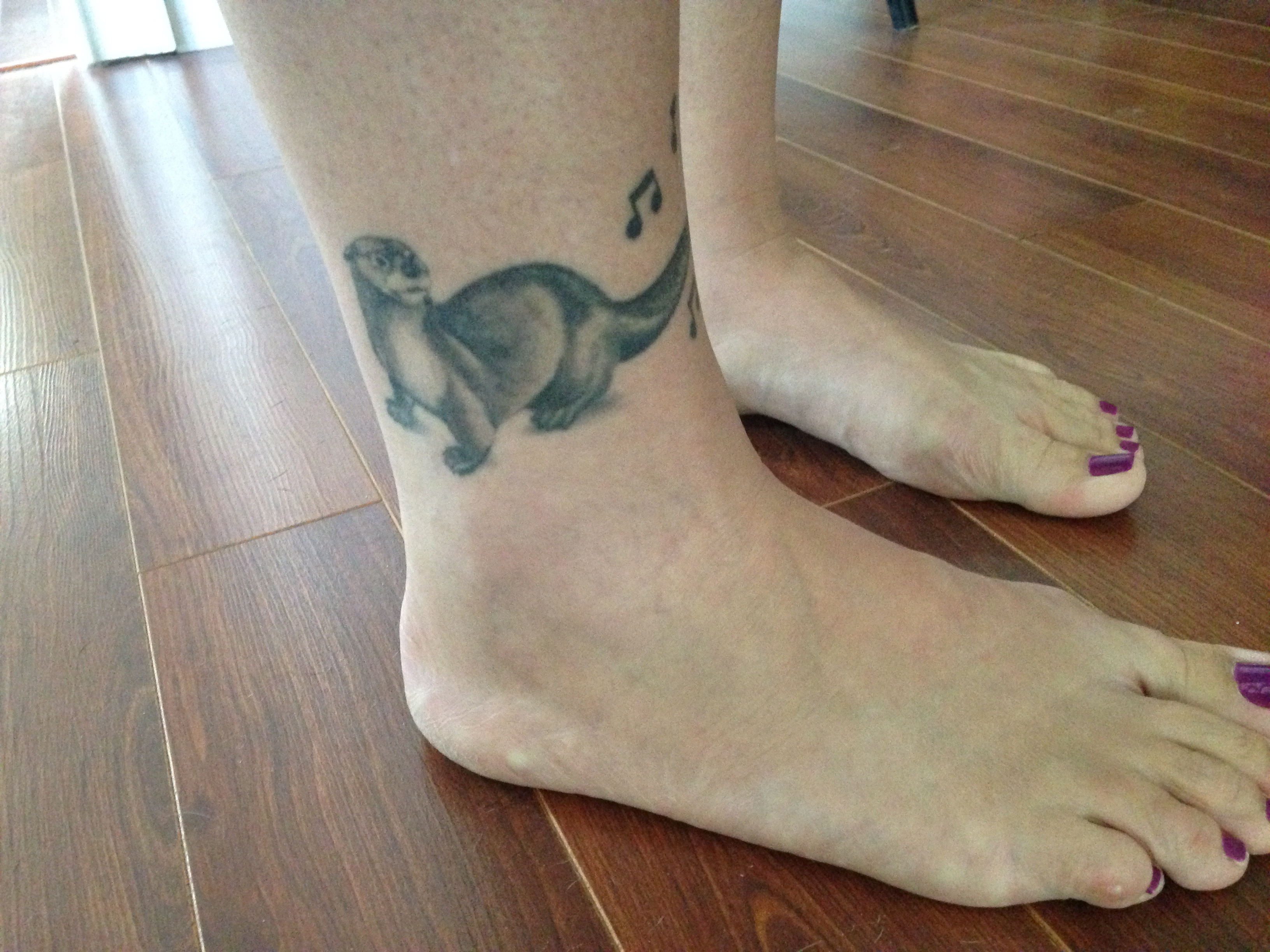
Fast forward another decade, the day I told my daughters father I wanted a divorce……. How did I cope with the fear, the adrenaline, the anger, the sadness, the loss……………. Welcome the Otter to my ankle. IMG_8616The otter is a loving and playful mammal whom has ability basically to rip your eyeballs out with its claws. For those whom believe in spirit animals or totems, otters entice you to ask yourself if you are “having enough fun?”, they are fearless and ferocious and make excellent friends. After 11 years of feeling like a caged bird, I was ready to BE the otter!

The next year, my friend whom I had traveled Thailand with had just become certified to practice permanent make up. She brought her tools to South America on a trip in which we were both going to visit my mom. So, one night when my daughter and mom fell asleep, I convinced her to let me be her first tattoo. It’s likely I was her only tattoo.   This was my final and probably my most meaningful tattoo. It was another number, 1312, with the 3 being a Hindi “OM” symbol. “Om” for me is the sacred symbol and sound of GOD, and 1312 was the address of my childhood home. It was the home that all my childhood memories reside. It was the home that I sat next to my grandfather for weeks until he transitioned to the next place and where I did the same for my grandmother. It was the home that was going to be my daughter’s one day. It was the family home that got caught up in my divorce and cost my mother, my daughter and me more pain than just the loss of a financial investment.

Yesterday, I sat in the planning meeting for today’s big event. I was asked by a committee member, “What are you going to wear today” and half jokingly replied, “I don’t know, but I’m going to attempt to hide my tattoos”.   I realize now, my tattoos are the story of my pain and my joy and I’m not going to hide them today, or tomorrow. Fortunately, my mom and grandma were wrong about one thing, I am totally employable and on occasion, even employed. I think after volunteering today, I might even take the time to add to my story.

IMG_8637

Darcy Flierl is a Licensed Clinical Social Worker, Certified Addictions Professional, and Certified Yoga Teacher currently offering individual and family psychotherapy in Stuart, Florida.  She also enjoys teaching in the Human Services Department as an Adjunct Instructor for Indian River State College and is Consultant for Non Profits along the Treasure Coast.

She has held board positions on for a variety of local and statewide agencies from the Department of Juvenile Justice’s State Advisory Group to CHARACTER COUNTS! and others.  Darcy has received a variety of awards for her community work such as;  Soroptimist’s Rising Star Award, the Community Champion Award from the United Way and for community advocacy from the Tobacco Free Partnership and was a 2013 Nominee as a Woman of Distinction.

Besides working to make Martin County a healthier place, she donates her time doing River Advocacy for the Indian River Lagoon and raising awareness about many issues effecting young people and families.  She treasures her time with her husband, and children attending local events and enjoying Martin County’s recreational opportunities.

For more information about Darcy you can visit her website at:  www.darcyflierl.com

headshot

H2 Worker Documentary. Legal Slavery.

H2 Worker Documentary. Legal Slavery.

MV5BMTgyMzIyMDc0Nl5BMl5BanBnXkFtZTcwMTA5NTU0Mg@@._V1_SY215_CR3,0,146,215_

Here is your music!

To everyone running for President:

Tonight I watched this incredible documentary by Stephanie Black.

Before they had harvesting machines every year people 10,000 Caribbean men were  selectivity chosen by American sugar corporations to harvest sugar cane for six months in Florida under temporary “H2” visas.
They came from Jamaica in the middle of the night and put in barracks in Belle Glade.

“If we didn’t have the Jamaicans it wouldn’t get harvested because the local people wouldn’t do it.” One of the sugar field managers said. They were essential jailed. Brought from the barrack to the bus to the field to bus to the barrack and not being allowed to leave.
They got paid one dollar and few cents pr hour.

This was released in 1990.

Even before the Duke and Duchess of Windsor (Who used to hang out in Indiantown) sent workers from their Islands in the Bahamas.

“H-2 Worker is a controversial expose of the travesty of justice that takes place around the shores of Florida’s Lake Okeechobee—a situation which, until the film’s release, has been one of America’s best-kept secrets. There, for six months a year, over 10,000 men from Jamaica and other Caribbean islands perform the brutal task of cutting sugar cane by hand-a job so dangerous and low-paying that Americans refuse to do it.

H-2 Worker is the first documentary to tell the story of these men—named for their special temporary guestwork “H-2” visas. They live and work in conditions reminiscent of the days of slavery on sugar plantations: housed in overcrowded barracks, poorly fed, denied adequate treatment for their frequent on-the-job injuries, paid less than minimum wage, and deported if they do not do exactly as they are told.

The sugar plantations who employ the H-2 workers sustain this exploitation—and their own profits—with the help of the U.S. government, which authorizes the importation of Third World workers while it blocks the importation of cheaper Third World sugar through a system of quotas and price supports, citing “national security” as the reason for its costly subsidizing of a domestic sugar industry. The scandal of the H-2 program has existed for over 45 years. It began in 1942, when the U.S. Sugar Cane Corporation was indicted for conspiracy to enslave black American workers. In 1943 the first West Indian cane cutters were brought in. This scandal has largely been kept out of the public eye, and the sugar companies and their government supporters have escaped accountability. On the contrary, a new immigration law has paved the way for a rapid expansion of the H-2 program.

Directed by: Stephanie Black
Produced by: Stephanie Black
Released: 1990
Running Time: 70 min

For more information about this film and other films in the Collective Eyes Catalog, please visit: collectiveeye.org/products/h2-worker

AWARDS:

Grand Jury Prize Best Documentary – Sundance Film Festival (1990)
Best Cinematography, Sundance Film Festival (1990)
Quotes

“‘H-2 Worker’ is that rare hybrid that succeeds as both film and advocacy. The documentary’s look and form is smooth and sophisticated … [and] it solidly frames issues about the economy, employment and the treatment of workers who seem just steps away from slavery.” —The New York Times
With admirable fluency, Black combines straightforward information and analysis with more evocative glimpses of the workers’ lives …. Black and her collaborators have an unsentimental conviction that these workers are fully human, that they experience not just anger and suffering but also love and pleasure – and even hope.”—The Nation”

Today when you go to Belle Glade you drive past the same buildings that were in this film.

Slave Barracks.

https://en.wikipedia.org/wiki/H-2_Worker

“H-2 Worker is a 1990 documentary film about the exploitation of Jamaican guest workers in Florida‘s sugar cane industry. It was directed by Stephanie Black, and won the Sundance Film Festival Grand Jury Prize for documentaries in the 1990 festival.[1] It was shot in Belle Glade, Clewiston, and Okeelanta, Florida as well as Jamaica and includes cane fields and worker camps (Ritta Village, Prewitt Village) owned by US Sugar Corporation and the Okeelanta Corporation.

The cane harvesters were brought in to perform the autumn harvest of sugar cane under the H-2A Visa program. The Jamaicans replaced earlier generations of Bahamian seasonal workers who in turn replaced migrant labor recruited from the Cotton Belt (region) in the first half of the 20th century. A documentary short that accompanies the DVD version of the film states that human labor was abandoned for mechanical harvesters in 1992.

The film features interviews with a United States Department of Labor official, a Florida Sugar Cane League official, Jamaican Prime Minister Michael Manley, local merchants, and a dozen or so field workers. It also includes footage of César Chávez, US Representative Thomas Downey, and US Senator Bill Bradley.”

I think it’s important for “us” ( and you know who I’m referring to) to watch this so we never get soft against the people who created these human rights abuses for corporate profit. Not only do they treat people like slaves they collect corporate welfare.

( Are we calling them corporate entitlements yet?)

It’s also important for those of you that think all these people are coming and taking your jobs away. The reason they have, yes I said have this program is to to the work no one else would do. Interesting enough when I worked in Boca in the hospital we got nurses from England and from the Philippines and there were plenty of nurses around to do the job.  It’s been here since the 40’s. So even at your work you may have H2 workers or even the hospital you go to when your ill.

They may even be hiding your bed.
http://www.uscis.gov/working-united-states/temporary-workers/h-2a-agricultural-workers/h-2a-temporary-agricultural-workers

H-2A Temporary Agricultural WorkersThe H-2A program allows U.S. employers or U.S. agents who meet specific regulatory requirements to bring foreign nationals to the United States to fill temporary agricultural jobs. A U.S. employer,a U.S. agent as described in the regulations,or an association of U.S. agricultural producers named as a joint employer must file Form I-129, Petition for Nonimmigrant Worker, on a prospective worker’s behalf.

Who May Qualify for H-2A Classification?

To qualify for H-2A nonimmigrant classification, the petitioner must:

  • Offer a job that is of a temporary or seasonal nature.
  • Demonstrate that there are not sufficient U.S. workers who are able, willing, qualified, and available to do the temporary work.
  • Show that the employment of H-2A workers will not adversely affect the wages and working conditions of similarly employed U.S. workers.
  • Generally, submit with the H-2A petition, a single valid temporary labor certification from the U.S. Department of Labor.  (A limited exception to this requirement exists in certain “emergent circumstances.”  See e.g., 8 CFR 214.2(h)(5)(x) for specific details.)

H-2A Program Process

  • Step 1: Petitioner submits temporary labor certification application to the U.S. Department of Labor (DOL).  Prior to requesting H-2A classification from USCIS, the petitioner must apply for and receive a temporary labor certification for H-2A workers with DOL. For further information regarding the temporary labor certification requirements and process, see the Foreign Labor Certification, Department of Labor page.
  • Step 2:  Petitioner submits Form I-129 to USCIS.  After receiving a temporary labor certification for H-2A employment from DOL, the employer should file Form I-129 with USCIS. With limited exceptions, the original temporary labor certification must be submitted as initial evidence with Form I-129.  (See the instructions to Form I-129 for additional filing requirements.)
  • Step 3: Prospective workers outside the United States apply for visa and/or admission.  After USCIS approves Form I-129, prospective H-2A workers who are outside the United States must:
    •  Apply for an H-2A visa with the U.S. Department of State (DOS) at a U.S. Embassy or Consulate abroad, then seek admission to the United States with U.S. Customs and Border Protection (CBP) at a U.S. port of entry; or
    • Directly seek admission to the United States in H-2A classification with CBP at a U.S. port of entry, if a worker does not require a visa.

You can order it thru amazon.

https://www.amazon.com/gp/video/detail/B003PLC5PY?ie=UTF8&*Version*=1&*entries*=0

I got mine from Netflix.

Here is another review.

http://www.reggaeplanet.com/p/h2-worker/

“H-2 Worker is the first documentary to tell the story of these men – named for their special temporary guestwork “H-2” visas. They live and work in conditions reminiscent of the days of slavery on sugar plantations: housed in overcrowded barracks, poorly fed, denied adequate treatment for their frequent on-the-job injuries, paid less than minimum wage, and deported if they do not do exactly as they are told.
The sugar plantations who employ the H-2 workers sustain this exploitation – and their own profits – with the help of the U.S. government, which authorizes the importation of Third World workers while it blocks the importation of cheaper Third World sugar through a system of quotas and price supports, citing “national security” as the reason for its costly subsidizing of a domestic sugar industry.
The scandal of the H-2 program has existed for over 45 years. It began in 1942, when the U.S. Sugar Cane Corporation was indicted for conspiracy to enslave black American workers. In 1943 the first West Indian cane cutters were brought in. This scandal has largely been kept out of the public eye, and the sugar companies and their government supporters have escaped accountability. On the contrary, a new immigration law has paved the way for a rapid expansion of the H-2 program to other agricultural industries.
H-2 Worker was shot clandestinely in the cane fields and workers’ barracks around Belle Glade, Florida. It contains footage shot in places where no media has been successful in filming before, and where the filmmakers were denied permission to enter by the sugar corporations and the local police.
H-2 Worker focuses on the lives of the workers themselves – travelling with them to the fields, where they endure long hours of monotonous labor; to their isolated barracks; to the town where they shop for American goods to bring home to their families. Following them through one six-month season, it tell their stories: Like migrant workers worldwide, these men are driven by soaring unemployment in their home countries and promises of high wages abroad. Dreaming of American opportunities to build better lives for their families, they arrive in the U.S. with high hopes – only to confront the harsh realities of the Florida cane fields.
Providing an in-depth analysis, H-2 Worker includes voices from all sides of the issue: representatives of the sugar companies and the U.S. Department of Labor, as well as U.S.l congressmen and Jamaican Prime Minister Michael Manley. An historical analysis combine archival footage with the testimony of 80-year-old Samuel Manston, who escaped the cane fields at the time of the peonage indictments in 1942.
But the voices of the workers themselves are foremost: They are heard through extensive interviews, and through their recordings of actual letters to and from their families in Jamaica. These voices tell an eloquent story which rings with painful truth, and will not easily be forgotten. H-2 Worker is both a compelling expose of institutionalized injustice, and a moving record of human endurance.
H-2 Worker, a 70-minute, 16 mm, color documentary made over the course of 3 1/2 years, combines the talents of director/producer Stephanie Black, award-winning editor John Mullen and cinematographer Maryse Alberti. It is a film with powerful impact and resonance, certain to be both compelling and controversial.
“‘H-2 Worker’ is that rare hybrid that succeeds as both film and advocacy. The documentary’s look and form is smooth and sophisticated … [and] it solidly frames issues about the economy, employment, and the treatment of workers who seem just steps away from slavery.” -The New York Times
“‘H-2 Worker’ is a revealing look at these men and the treatment they receive on our shores … [Stephanie Black] manages to capture the scope as well as the intensity of the problem. -New York Newsday
“With admirable fluency, Black combines straightforward information and analysis with more evocative glimpses of the workers’ lives …. Black and her collaborators have an unsentimental conviction that these workers are fully human, that they experience not just anger and suffering but also love and pleasure – and even hope.” -The Nation”

According to the update 1992, a class action suit found five sugar cane companies guilty of cheating more than 10,000 cane cutters of their contractually guaranteed minimum wage during the  two seasons documented in the film.

51,000.000 in back pay was awarded.
Then the decision was revered by the Florida Appellate court finding that the H-2 contract was “ambiguous.”

Sugar cane is being harvested mechanically however the number of H-2 workers has substantially increased.

North Carolina: 10,000 workers
Colorado 2,000 workers
Maryland 9,622 (crab houses, fire work, hotel work)
Most of the workers come from Mexico.
In March 2008, over 100 guest workers from India, walked off their H-2B jobs at Signal, an oil rig construction company in Louisiana, protesting the company’s unacceptable living and working conditions.
These are not illegals. These are people that come here legally.

In the country where the people are coming from there are labor brokers that sell assess to the people from all these countries. In India that access was sold for 20,000 dollars.
People come here and they are not paid what they are told plus they had to pay the recruiters.

Over 2,100 H-2 shepherds from Peru, Chile, Mexico and Nepal work for American Ranchers. They are expected to work 24 hours a day, 7 days a week for a minim monthly wage of less that 1,000.

If you think it’s just farm workers you’re wrong.

http://allnurses.com/international-nursing/h2b-visa-338815.html

“That visa is also not valid for nurses and is grounds to get one deported from the US. We see it being advertised in the Philippines but it makes one subject to immigration fraud. It is for untrained workers for a very specific length of time, and nurses do not meet those requirements from the start. We see this being used for the LPN, and there are no legal visas for them to enter the US and work here.

Please forward a copy of any of the garbage that you see offering this, and that is exactly what it is, to the US Embassy there in Manila. You would be sold as a slave to the highest bidder

They would also have you giving false information to the US Embassy officials and this is grounds for deportation for up to ten years after a stay in immigration detention before you are deported. You would be placed in a nursing home to work and they are undergoing frequent raids exactly for this.

Save yourself from having nightmares about being picked up by ICE.”

http://allnurses.com/international-nursing/h2b-visa-338815.html

Businesses continue to lobby for an expanded guest worker program with reduced wages and less government oversight. The violations are rampart.

No one talks about this. They talk about fences. The very people who push the hatred of the illegal people that come here use the H-2 workers as slave labor.

We’re being duped. Our attention is being diverted.
Pay attention.
We still have slaves in America. We call them H-2 workers.


Summer Book Club: Paving Paradise Florida’s Vanishing Wetlands and Failure of no Net Loss.

Summer Book Club: Paving Paradise Florida’s Vanishing Wetlands and Failure of no Net Loss by Craig Pittman and Matthew Waite.

What is no Net Loss? Is it even on our radar?

https://en.wikipedia.org/wiki/No_net_loss_wetlands_policy

“No net loss” is the United States government’s overall policy goal regarding wetlands preservation. The goal of the policy is to balance wetland loss due to economic development with wetlands reclamation, mitigation, and restorations efforts, so that the total acreage of wetlands in the country does not decrease, but remains constant or increases. To achieve the objective of no net loss, the federal government utilizes several different environmental policy tools which legally protect wetlands, provide rules and regulations for citizens and corporations interacting with wetlands, and incentives for the preservation and conservation of wetlands. Given the public benefits provided by wetland ecosystem services, such as flood control, nutrient farming, habitat, water filtration, and recreational area, the estimations that over half the acreage of wetlands in the United States has been lost within the last three centuries is of great concern to local, state, and federal agencies as well as the public interest they serve.”

So while all these political people are running around having debates etc. I’m concerned with the BS that goes on. How people say one thing and do another? I’ll bet not one of these people running understand this including the two from Florida because it’s so far off their radar.

I think we need to start making a reading list for anyone running for office. This would be on the top of my list.

You guys know I hate to read books my self. Books are meant to be talked about, discussed, educate people.

This is what I’m reading this summer.

paving-paradise-pittman-waite-cover-alt

http://www.tampabay.com/features/books/review-paving-paradise-by-craig-pittman-and-matthew-waite-illuminates/988011

Bulldozed and buried wetlands underlie the foundations of thousands of mines, highways, golf courses and shopping malls all over our state, despite clear federal and state policy calling for no net loss of wetlands. It was President George H.W. Bush who first articulated this policy in 1988. “We are going to stand wetlands protection on its ear,” declared the marsh- and duck-loving president.

Pittman and Waite explain why that hasn’t happened, and their probing, well-crafted narrative will keep you turning every page of their book. The prize-winning pair of St. Petersburg Times reporters spent four years researching the state of wetlands protection in Florida. They interviewed hundreds of people, ferreting out political pressure points, cynical numbers games and all the inventive ways we are lied to. (You don’t really believe in mitigation, do you?)

http://gothere.com/Florida/paving-paradise-book-review.htm

Florida has lost over 84,000 acres of wetlands since 1990, this despite  “no net loss” mandates. For 4 years Journalists Craig Pittman and Matthew Waite investigated how Federal, state and local legislators failed to protect Florida’s wetlands from developers and their developments.

In this book Pittman and Waite explain how “wetland protection” often just gives the illusion of protecting the environment while it allows Florida’s native habitat to be paved over.

Pittman and Waite are both reporters at the St. Petersburg Times and have twice earned the top investigative reporting prize in the nation from the Society of Environmental Journalists as well as the Waldo Proffit Award for Excellence in Environmental Journalism in Florida.

http://www.goodreads.com/book/show/4251875-paving-paradise

Florida possesses more wetlands than any other state except Alaska, yet since 1990 more than 84,000 acres have been lost to development despite presidential pledges to protect them. How and why the state’s wetlands are continuing to disappear is the subject of “Paving Paradise”. Journalists Craig Pittman and Matthew Waite spent nearly four years investigating the political expedience, corruption, and negligence on the part of federal and state agencies that led to a failure to enforce regulations on developers. They traveled throughout the state, interviewed hundreds of people, dug through thousands of documents, and analyzed satellite imagery to identify former wetlands that were now houses, stores, and parking lots. Exposing the unseen environmental consequences of rampant sprawl, Pittman and Waite explain how wetland protection creates the illusion of environmental protection while doing little to stem the tide of destruction. What is happening to Florida’s ‘protected’ wetlands?

Here is Craig’s Twitter which is very funny and informative. You can see for yourself.

https://twitter.com/craigtimes

Here is the book’s website. This is one person that Elliot or the RC could invite invite to talk to us.

http://pavingparadise.org/

n an award-winning newspaper series, two investigative reporters from the St. Petersburg Times chronicled how federal rules meant to protect the nation’s wetlands were more illusion than law. Now, that series has been expanded into a book, delving into how we got to this point, starting with land speculators making waterfront property out of sand dredged from the bottom of the ocean. Now, read how the nation’s wetlands protections were formed in clashes between developers, bureaucrats, judges, activists and con artists over Florida swamps.

“This is an exhaustive, timely and devastating account of the destruction of Florida’s wetlands, and the disgraceful collusion of government at all levels. It’s an important book that should be read by every voter, every taxpayer, every parent, every Floridian who cares about saving what’s left of this precious place.” — Carl Hiaasen”

“I am amazed, horrified and delighted that you wrote Paving Paradise! You have uncovered the perfidy that we always knew existed … You have named the key figures that led to the loss of thousands of acres of Florida wetlands.” –Nathaniel Reed”

and don’t tell me the ending!

So long john and thanks for all the fish! Plus hysterical republican debate on Fox.

So long john and thanks for all the fish! Plus hysterical republican debate on Fox.

Last night I did two things: I watch an entire Republican “debate” on “Fox News.” and I stayed up way past my bedtime and watched the last “Daily Show.”

I didn’t think I was going to watch the debate because I have “Dish” and they had some kind of issue with “Fox News” and a while back it was taken off.  Fox news would only let you watch if you had cable. That’s because everyone MUST have cable. RIght? Then I looked and it was there. I DVR’d it so I”m going to back and watch but today I’ll let the experts do their thing.

Before the show Bill O’Reilly was on doing his “fair and balanced” assessment and was busy sharpening his knives against Trump.

What was different and actually fun for me is I watched it with Twitter on so I had the benefit of some great real time discourse going on.

There was a statement made at the beginning that if they had ALL the candidates up there it would be like “herding cats.”

https://en.wikipedia.org/wiki/Herding_cats

Herding cats may refer to:

  • An idiom that refers to a frustrating attempt to control or organize a class of entities which are uncontrollable or chaotic.

I also found out that Eve Sample Dog Blue has a twitter account.

I will say this. The “Fox” team must have gotten their marching orders to demolish Trump because they asked him really stupid questions. They were actually spewing at him. It was not pretty. I never heard of this pledge which was a pledge to not run as an independent and Donald Trump said no thanks. New to me. The only pledge I know if Grover Norquist’s pledge not to raise taxes.

http://www.cbsnews.com/news/election-2016-donald-trump-gets-no-love-from-the-koch-brothers/http://www.cbsnews.com/news/election-2016-donald-trump-gets-no-love-from-the-koch-brothers/

As Donald Trump seeks to build on his momentum in the Republican primary, turning the evident voter enthusiasm surrounding his candidacy into the concrete infrastructure of a viable campaign, he’ll have to do so without help from two of the GOP’s biggest benefactors.

Industrialists Charles and David Koch, who have used their multibillion-dollar business empire to build a network of conservative advocacy groups, have decided that Trump will not be able to access their extensive database on voter information, nor will he be invited to participate in their conservative cattle-calls, CBS News’ Julianna Goldman confirms.

Trumps attitude is “bite me!”

This a wonderful and amazing thing.

https://twitter.com/maxasteele/status/629463408165933056

This is good. The world has gone a little wild.

It pains me to put a link to the Drudge Report. Here it is!

http://www.newsmax.com/Headline/drudge-poll-donald-trump-wins/2015/08/07/id/666039/

Here is a breakdown of the poll results:

  • Donald Trump: 38 percent
  • Ted Cruz: 15.5 percent
  • Neurosurgeon Dr. Ben Carson: 10.2 percent
  • Florida Sen. Marco Rubio: 9.7 percent
  • Kentucky Sen. Rand Paul: 9.3 percent
  • Ohio Gov. John Kasich: 4.9 percent
  • Wisconsin Gov. Scott Walker: 4.5 percent
  • Former Arkansas Gov. Mike Huckabee: 3.5 percent
  • Former Florida Gov. Jeb Bush: 2.5 percent
  • New Jersey Gov. Chris Christie: 1.4 percent
Interesting.

http://finance.yahoo.com/news/fox-news-focus-group-just-035846501.html

 This was Republican pollster Frank Luntz’s group. On the Today Show Donald said basically “I don’t need no stinkin Frank Luntz focus group. They are fixed!” He also said that Frank had spoken to him and he had no use for him. I feel the same way!
Here is Frank with his boo boo face and his typical BS. This is going to be said by Fox over and over again. So you guys have to smarten up!

Donald Trump spokesman Michael Cohen makes Frank Luntz STFU

Someone bring Roger Ailes a bottle of tums.

Last night there was even humor!

and remarks from old candidates

Interesting ideas

But in the end no one talked about anything that was important to us. They talked about what was important to them.

Then after this we all tuned into the Daily Show for the last show.

foxjohn

You can watch the whole episode here.

http://thedailyshow.cc.com/full-episodes/pjkw01/august-6–2015—jon-stewart-s-final-episode?xrs=youtube_tds_fullep_endslate

I thought this was the funniest part.

http://thedailyshow.cc.com/videos/e20bid/jon-s-targets-strike-back

We’ll miss you John and we will take your advice to heart.

Quite a night and lot’s to do.

Fox News: Not everyone has cable. I’m getting rid of mine now that John has left the Daily Show. If you really want to spread democracy then open it up to everyone and not just the people who subscribe to you on cable.

You GOPer’s running with your  hair on fire from Donald Trump: How in the world will you  sit in the Oval Office and deal with other world leaders. Are you going to whine at Vladamir Putin?  (speaking of oligarchs)

vlad

Well thats all Folks.

Its a wrap!

Managing caregiver stress and preventing burnout.

Managing caregiver stress and preventing burnout.

Why is managing stress so important?

http://www.webmd.com/balance/stress-management/effects-of-stress-on-your-body

Stress that continues without relief can lead to a condition called distress — a negative stress reaction. Distress can lead to physical symptoms including headaches, upset stomach, elevated blood pressure, chest pain, and problems sleeping. Research suggests that stress also can bring on or worsen certain symptoms or diseases.

DSC_0006

How does stress affect the immune system?

Stress can make up ill as it affects out immune system.

http://www.apa.org/research/action/immune.aspx

“For stress of any significant duration – from a few days to a few months or years, as happens in real life – all aspects of immunity went downhill. Thus long-term or chronic stress, through too much wear and tear, can ravage the immune system.

The meta-analysis also revealed that people who are older or already sick are more prone to stress-related immune changes. For example, a 2002 study by Lyanne McGuire, PhD, of John Hopkins School of Medicine with Kiecolt-Glaser and Glaser reported that even chronic, sub-clinical mild depression may suppress an older person’s immune system. Participants in the study were in their early 70s and caring for someone with Alzheimer’s disease. Those with chronic mild depression had weaker lymphocyte-T cell responses to two mitogens, which model how the body responds to viruses and bacteria. The immune response was down even 18 months later, and immunity declined with age. In line with the 2004 meta-analysis, it appeared that the key immune factor was duration, not severity, of depression. And in the case of the older caregivers, their depression and age meant a double-whammy for immunity.

Emerging evidence is tracing the pathways of the mind-body interaction. For example, as seen with the college students, chronic feelings of loneliness can help to predict health status — perhaps because lonely people have more psychological stress or experience it more intensely and that stress in turn tamps down immunity. It’s also no surprise that depression hurts immunity; it’s also linked to other physical problems such as heart disease. At the same time, depression may both reflect a lack of social support and/or cause someone to withdraw from social ties. Both can be stressful and hurt the body’s ability to fight infection.

Managing stress, especially chronic or long-term stress (even if it’s not intense), may help people to fight germs. When burdened with long-term stressors, such as caring for an elderly parent or spouse with dementia, health can benefit from conscientious stress management.

Finally, the newest findings on social stress underscore the value of good friends; even just a few close friends can help someone feel connected and stay strong. Social ties may indirectly strengthen immunity because friends – at least health-minded friends — can encourage good health behaviors such as eating, sleeping and exercising well. Good friends also help to buffer the stress of negative events.”

IMG_0069

Preventing and dealing  with caregiver stress.

I first want to clarify what I mean when I say “caregiver.” I’m talking about the main person who is doing the hands on care. The wife, husband, mother, father, daughter, son or other people who is the number one person caring for someone.

Lot’s of people interface with caregivers. We do as nurses. You do as friends, family and neighbors. We get to go to the house, spend an hour, do our assessment, say what we think and then leave the person behind to deal with this on their own.

My general attitude is everyone is different, every one has different coping skills and styles. It’s our job as nurses, friends, families and neighbors to be accepting and to be helpful. Everyone copes with this differently but the needs still remains the same.

The one point I always try to make is this: This will end and at the end of the day when you have to make peace with yourself and move on in your life will you being to look back and say “I did everything I could and I am at peace.” I think the best way to get to that place is not getting burnt out.

The most important thing that a caregiver can do for themselves is to make sure they leave time for themselves and do something, even if its the littlest thing, every day. Being a martyr is a sure road to burnout and feeling like your stuck in a situation.

I know it hard. Sometimes there is no one around to relieve you and you feel like this is on your shoulders. Some places have great resources and some places have next to none.

In this day and age unless you can afford it there’s not a lot of help out there and if there is the older person living by themselves they get addressed first before the person with a caregiver. (Unless the person is under Hospice)

I thought instead of just googling I’d ask my friends first what they thought. So here goes. Some of these folks are in the medical field and some are or have been the main caregivers for a family member.

This is what they had to say:

Carol said “Get help!”

I know that’s a tall order sometimes. Many people can’t afford help. The first thing you should do is call your Elder Hotline. Our number around here is 866-684-5884. There is a process and it takes a while  to this so don’t wait until you need something. Do it now so by the time you need it the information is there.

Call the local chapter of the appropriate disease and see if someone can come out and talk to you about the disease and what is available to you. Often they have respite set up and know everyone who is available.

Call your church or temple and ask if there is anyone available to help. Many times they will mention this at services and people will volunteer.

Lisa Ray said

“#1 Take care of yourself first and foremost … it may sound selfish but it is not. If you are not emotionally and physically healthy then you can’t help the other person. #2 Ask or pay for help. Don’t turn away help … accept the gift. You are not the only one that can care for your loved one. Let other family members become involved in the care. Or pay someone to help. #3 Don’t take the mean things they say and do personally. They are sick and realize they have lost much of their independence, this is an expression of that frustration #4 Join a support group… you will learn things from others & help others with your experiences. #5 This also goes along with #2 Get out of the house and have fun, stay in contact with your friends, don’t become isolated.”

Aimee Said:

For sure don’t become isolated. I broke free finally in June and took a long weekend to myself and went to Missouri and met up with some other ladies. It didn’t go over well but he survived it. Never had been away without him. I never let him play that card. He tries often but when there is something he wants to do he finds a way. Take time for yourself and do whatever it is you love to do. Meet up with friends, take that trip and take care of yourself. And try not to stress (easier said than done) about that next scan or blood test. It is what it will be and I can’t change that.”

Susan said:

“Take time for yourself. While helping with my father’s cancer and death I would get their local paper (very small town) and circle garage and estate sales.  Then I would steal away for a few hours every Friday to treasure hunt. Try to keep some of your own little routines and hobbies going during this time. It was fun to share my finds and create memories with my parents while giving me something else to focus on.”

Irene said:

You must have someone to come in to give the caretaker a break from the emotional roller coaster

Eileen said: Have a network of friends or support group to support you the caregiver.

What is caregiver burn out?

http://www.webmd.com/heart-disease/heart-disease-recognizing-caregiver-burnout

“Caregiver burnout is a state of physical, emotional, and mental exhaustion that may be accompanied by a change in attitude — from positive and caring to negative and unconcerned. Burnout can occur when caregivers don’t get the help they need, or if they try to do more than they are able — either physically or financially. Caregivers who are “burned out” may experience fatigue, stress, anxiety, and depression. Many caregivers also feel guilty if they spend time on themselves rather than on their ill or elderly loved ones.”

What Are the Symptoms of Caregiver Burnout?

“The symptoms of caregiver burnout are similar to the symptoms of stress and depression. They include:

  • Withdrawal from friends, family, and other loved ones
  • Loss of interest in activities previously enjoyed
  • Feeling blue, irritable, hopeless, and helpless
  • Changes in appetite, weight, or both
  • Changes in sleep patterns
  • Getting sick more often
  • Feelings of wanting to hurt yourself or the person for whom you are caring
  • Emotional and physical exhaustion
  • Irritability

What Causes Caregiver Burnout?

Caregivers often are so busy caring for others that they tend to neglect their own emotional, physical, and spiritual health. The demands on a caregiver’s body, mind, and emotions can easily seem overwhelming, leading to fatigue and hopelessness — and, ultimately, burnout. Other factors that can lead to caregiver burnout include:

  • Role confusion: Many people are confused when thrust into the role of caregiver. It can be difficult for a person to separate her role as caregiver from her role as spouse, lover, child, friend, etc.
  • Unrealistic expectations: Many caregivers expect their involvement to have a positive effect on the health and happiness of their loved one. This may not always be realistic.
  • Lack of control: Many caregivers become frustrated by a lack of money, resources, and skills to effectively plan, manage, and organize their loved one’s care.
  • Unreasonable demands: Some caregivers place unreasonable burdens upon themselves, in part because they see providing care as their exclusive responsibility.
  • Other factors: Many caregivers cannot recognize when they are suffering burnout and eventually get to the point where they cannot function effectively. They may even become sick themselves.

I’ve heard many people say to me “She was the mother and I was the child now i’m the mother and she is the child.’ It may feel that way but it not. Your still the child taking care of your mother.

More Ways to Prevent Burnout.

  1. Find someone to talk to. There is always someone to talk to and sometimes just saying things out loud can make you feel better.  If you have a computer there are many Facebook groups that you can join and speaks to others. In this day and age if you join a local support group online you can also benefit from the other member’s knowledge of resources.
  2. Be realistic about your loved one’s disease.

http://www.helpguide.org/articles/stress/caregiving-stress-and-burnout.htm

A list much like the the one my friends made above.

  1. Ask for help.
  2. Give yourself a break
  3. Practice Acceptance: Focus on the things you can control,find the silver lining,avoid tunnel vision.
  4. Take care of your own health: Exercise, meditate, do yoga, eat well and don’t skimp on sleep.

Cyndi Lenz is a psychiatric home health nurse in the Treasure Coast.

I’ll miss you Jon Stewart! Here is some advice for you. Don’t listen to anyone’s advice.

I’ll miss you Jon Stewart! Here is some advice for you. Don’t listen to anyone’s advice.

A long time ago in a galaxy far away when I lived Boca and my son was a teenager I got turned on to the Daily Show. At the time I was pretty addicted to C-span which I got up and watched every morning.

Every evening my son, Adam, watched the Daily Show and one night I sat down and watched and never stopped. The only good thing about Jon leaving is I’m step closer to getting rid of my cable.

http://news.yahoo.com/factbox-jon-stewart-stamped-mark-u-political-pop-160439441.html

Goodbye C-Span. Hello funny and deal able politics!

Here are some milestones of his tenure on “The Daily Show”, whose influence on American life is much larger than its small nightly TV audience.

– Stewart took over as host in January 1999

– “The Daily Show” won 18 Primetime Emmy Awards

– Stewart hosted the Oscars twice, in 2006 and 2008

– “The Daily Show” Twitter account has 3.7 million followers

– The regular TV audience for nightly broadcasts of “The Daily Show” is about 1.5 to 2 million people, or less than 1 percent of the U.S. population

– A 2004 Pew Research Center poll found that 21 percent of 18-29 year olds cited “The Daily Show” as their regular source of political news.

– Stewart helped launch the careers of Stephen Colbert, Larry Wilmore and John Oliver

– Prominent “Daily Show” guests included U.S. President Barack Obama, first lady Michelle Obama, U.S. Vice-President Joe Biden, former U.S. Presidents Bill Clinton and Jimmy Carter, former Pakistan President Pervez Musharraf, science fiction writer Kurt Vonnegut and numerous celebrities.

– Favorite targets for satire included Fox News, Bill O’Reilly, former U.S. President George W. Bush, Donald Trump, Sarah Palin, Glenn Beck, the Tea Party, Obamacare, the 24/7 news cycle of cable TV news.

– Jon Stewart topped a July 2009 Time magazine poll as the most trusted U.S. newscaster, with 44 percent of the vote, ahead of NBC’s “Nightly News” anchor Brian Williams.

– Some 200,000 people attended Stewart and Colbert’s “Rally to Restore Sanity and/or Fear” at the National Mall in Washington, D.C., days ahead of 2010 U.S. mid-term elections.

– In 2014, Stewart released his first movie, “Rosewater,” which he wrote and directed, about the real-life detention in Iran of Iranian-Canadian journalist Maziar Bahari. The movie won a Freedom of Expression award from the National Board of Review.

– Stewart, 52, hosts his last edition of “The Daily Show,” on Aug. 6 with fellow comedians Amy Schumer, Louis C.K. and Denis Leary as his guests.

(Reporting by Jill Serjeant; Editing by Eric Walsh)

Jon is going to go live on a farm in New Jersey with his wife Tracey Stewart who just wrote a book called “Do unto Animals!”

dounto

http://www.philly.com/philly/blogs/trending/Jon-Stewart-buys-New-Jersey-farm-to-create-animal-sanctuary-post-Daily-Show.html

The couple recently bought a farm in New Jersey with the intention of providing a home for farm animals rescued from cruelty, and in November, Tracey purchased Adopt a Farm Animal sponsorships for all of their Thanksgiving guests. Even their children are living the Farm Sanctuary life, with Tracey noting that “promises of animal shelter visits in exchange for completed homework are the norm in the Stewart household.”

Stewart, of course, has long been an animal-rights advocate, with that aspect of his political identity creeping into Daily Show segments such as in his skewering of Chris Christie’s support of gestational pig crates (and in a follow-up), or the recent interview with Farm Sanctuary co-founder and president Gene Baur.

Tracey, Stewart’s wife and a Philly native, is also a prominent animal-rights supporter, with a book on the subject, Do Unto Animals, slated for an October 2015 release. She also runs magazine Moomah, which dedicated its most recent issue to living a vegan lifestyle.

Read more at http://www.philly.com/philly/blogs/trending/Jon-Stewart-buys-New-Jersey-farm-to-create-animal-sanctuary-post-Daily-Show.html#X3kowlv0fPBW0GHZ.99

As an experienced  advocate, golden rescuer and author of the Florida all Breed Rescue Book  I offer you the following advice:
1. Don’t tell anyone where you live. There’s nothing like waking up with a dog tied to your mail box. In your case you go to get the mail and there is a pig there with note. Or someone comes to the house in the middle of your mother’s birthday party demanding you adopt one your foster’s to them.
2. Love the people that bring your their animals no matter what. Sometimes it hard. Do it. Better off with you then in some horrible situation. All the people I adopted to were always supportive of me but the one’s that I helped to place their pets without judgement always kept in touch and were always supportive.
3. Read Nathan Winograd’s “Redemption”. Know the history. There’s no one better or fairer.
4. Then go forward and create your own philosophy. No rules. You create a rule it gets broken every time.
5. Do what’s right in your heart and not other peoples. If you think politics is crazy you’ve seen nothing yet. Someday’s you’ll wish you had that desk to hide under. Other’s are filled with joy and happiness.
6. Don’t give up your vision to other people. Everyone is an expert. Don’t listen to anything but your own hearts.
I’m sure there is more but this is the big picture.
We wish you only the best!

When will our medical community step and do something about people getting sick and dying in the Indian River Lagoon

When will our medical community step and do something about people getting sick and dying in the Indian River Lagoon?

I just want to say THANK YOU to our TC Palm reporters and also to Eye on Miami for actually paying attention to this issue and being a supportive voice and advocate for our Indian River Lagoon.

DSC_0085

Three years ago we were talking about this. Before I even got involved in the water but doing research for a potential documentary I read reports about people going into the water and getting sick and dying. Then when we got organized and starting talking to each even more information came forward. One of our local citizens has been collecting data but there is really nothing that is out there and a part of our hospital system and health department.

Here is Robert Lord from Martin Memorial talking about our unhealthy water at our rally last year.

Our friend, Cliff Barnes suggested we called it Lagoon water born flesh rot disease after Gov. Scott.  I said “Rick Rot.” Some people said “Rick Scott Rot.”

Some one even invented this.

RIVER_ROT_RX_WEBSITE_PIC_grande

(Here is the website https://www.facebook.com/PrepConsultantsPC/app_410312912374011?hc_location=ufi)

Last year this happened.

http://www.tcpalm.com/news/indian-river-lagoon-bacteria-killed-fort-pierce-man-in-2014_97423759

Bill Benton went swimming in the Indian River Lagoon on a Saturday afternoon. He was dead by Tuesday, a rare fatality from Vibrio vulnificus bacteria.

The bacteria occurs naturally throughout the lagoon year-round, but infections increase in summer, according to researchers at Florida Atlantic University’s Harbor Branch Oceanographic Institute in Fort Pierce.

Benton was among seven people who died from Vibrio vulnificus in Florida in 2014. It’s unknown whether Vibrio vulnificus is to blame in the July 20 death of Port St. Lucie resident David Trudell, two days after a fin fish punctured him while fishing in the lagoon. Doctors attributed his death to the incident, but did not determine what type of bacteria it was.

Then this happened.

http://www.tcpalm.com/franchise/indian-river-lagoon/health/bacteria-from-indian-river-lagoon-fish-fin-puncture-kills-port-st-lucie-man_79674879

We all knew what it was.

“A 65-year-old Port St. Lucie man died Monday, two days after being stuck by a fish fin while fishing in the Indian River Lagoon.

David John Trudell died from a blood infection as a result of a bacteria that entered his body because of the fin prick, said Treasure Coast medical examiner Dr. Roger Mittleman.

The type of bacteria could not be determined, Mittleman said.”

Why were there no blood cultures drawn at the time?

Then it happened to one of our own River Warriors. Because our friend Gayle posted the above article our friend Barb took her husband Bruce to the ER.

She wrote this

Took Bruce to the ER yesterday for an infected left leg. He had a sore on his knee on Monday, went in the IRL on Wednesday. We took several church families out on our new catamaran and anchored off Sailfish point (near the Walgreen house). Of course they all jumped into the IRL from the deck of the boat.

Yesterday Bruce’s knee and leg was black and swollen, hot to the touch and oozing. He had a fever. He NEVER complains of pain but I forced him to the ER. GOOD thing. The doctor thinks it is a blood infection from the bacteria from the IRL water on Wednesday. We will get the culture back on Monday to see what the bacteria actually is.

Gayle Ryan’s link to the TC Palm article regarding the local man who died within two days of a fish fin puncture bringing in bacteria from the IRL into his system, probably saved Bruce’s life. I wouldn’t have taken a closer second look at Bruce’s knee had I not read her article link. The doctor lanced and drained the “volcano” the size of a grapefruit on his knee. His whole leg was swollen and hot to the touch.

Today Bruce’s leg ‘s swelling is down and it is not throbbing anymore. He is on Bactrim and Keflex. Doctor said he was so correct to come into the ER when he did, could have become so dangerous to Bruce. Thank you Gayle Ryan.”

It looked like this.

11231257_10206985109846931_6511913140618739585_n

Here’s is a great piece from our friend at Eye on Miami.

http://www.eyeonmiami.blogspot.com/2015/07/floridas-water-crisis-impacts-compound.html

“This post on Face Book should remind Miami that the current water crisis is not just one in a series of crises: it is a cumulative event where impacts are compounded. The mismanagement of fresh water resources in South Florida is mainly to benefit the big campaign contributors to state legislators and to Gov. Rick Scott. Big Sugar.

In a just world, state legislators would be made to swim in the Indian River Lagoon, then see how much they like gambling with people’s water to benefit their patrons.”

You got that right  Mista Gimleteye!

DSC_0022

A friend of mine asked me if I would go on the news. I said no. This is not about me. What I will say is our local Health Department and People running the hospital need to read the newspaper. Then they need to come up with a plan to alert the physicians in the area and come up with some sort of tracking system and people need to be warned before they go in the water.  I know that everyone has a lot on their plates but this is something we have to do. What if I didn’t know any of this and my grandson had a cut and I took him in the lagoon and he died?

You can check the salinity level

http://www.tcpalm.com/franchise/indian-river-lagoon/health/worried-about-vibrio-check-salinity-levels

“Water quality sensors in the lagoon and its tributaries can’t detect the deadly bacteria’s presence, but the salinity level is a good indicator of whether there’s Vibrio. The bacteria can’t live in saltwater, but thrives in stagnant, nearshore, freshwater — particularly near rainfall runoff discharges.”

Really so the millions of gallons of freshwater discharges have nothing to do with that? Really?

SFWMD and ACOE you need to be aware. After all we have begged you to fix the issue with the discharges. It comes down to one thing: Salinity of the water. So besides all the other damage that you do we can add killing people to the list.

So we know this

http://www.tcpalm.com/franchise/indian-river-lagoon/health/cuts-are-key-to-infection-by-indian-river-lagoons-deadly-bacteria_66884711

“Healthy people who boat, fish and swim in the Indian River Lagoon are not likely to get a potentially deadly bacterial infection, especially if they take certain precautions, according to a researcher conducting a premier study of Vibrio vulnificus.

It’s people with cuts and weak immune systems like the elderly, infants, alcoholics, diabetics and those with other long-term illnesses who are at most risk and need to take the threat most seriously.”

HEALTHY PEOPLE ARE NOT LIKELY TO GET AN INFECTION! NOT LIKELY.

But

“The people most likely to get it — in this order — are: lagoon fishermen, seafood processors and waders or swimmers.”

http://www.tcpalm.com/opinion/editorials/editorial-health-officials-must-improve-tracking-reporting-of-waterborne-illnesses_15574383

And the longer this vacuum persists, the greater the threat to Treasure Coast residents who swim, boat, wade, paddleboard and fish in the waterway.

“The bacteria, which is also found in estuaries like the St. Lucie and St. Sebastian rivers, occurs naturally and is not linked to pollution, Barbarite said. Quantities vary depending on climatic conditions.”

But it is connected to the Salinity of the water which also is what kills everything else like our oysters. So by forcing millions of  gallons of fresh water down the river into the lagoon the salinity is changed.

“Most likely in spots near freshwater discharges.”

“29.5 percent of cases resulted in deaths (2004-13)”

People affected: Those with Alcohol Abuse, Liver Disease, Diabetes, Heart Disease

I can’t wait to see the spin. Because just two years ago we were assured there was nothing wrong with the water.

http://www.tcpalm.com/opinion/editorials/editorial-health-officials-must-improve-tracking-reporting-of-waterborne-illnesses_15574383

“and the longer this vacuum persists, the greater the threat to Treasure Coast residents who swim, boat, wade, paddleboard and fish in the waterway.

Two recent incidents — one fatal — have ratcheted up the importance of identifying the microbial culprits, case by case, and establishing cause-and-effect relationships between exposure to tainted lagoon water and bacterial infections.”

“Health officials and health care providers need to get ahead of the issue. Given the fact doctors don’t have a protocol for testing or reporting waterborne illnesses, it’s easy to see why so many questions remain unanswered.”

It should be standard procedure for doctors to report all suspected cases of waterborne illnesses to the Florida Department of Health.

Moreover, this information needs to be collected in a database. Over time, this knowledge may reveal trends that prove beneficial in protecting lagoon aficionados and treating those who contract waterborne infections.”

http://www.floridahealth.gov/about-the-department-of-health/about-us/mission-and-vision.html

MISSION :

To protect, promote & improve the health of all people in Florida through integrated state, county, & community efforts.

VISION :

To be the Healthiest State in the Nation

VALUES (ICARE) :

I nnovation: We search for creative solutions and manage resources wisely.

C ollaboration: We use teamwork to achieve common goals & solve problems.

A ccountability: We perform with integrity & respect.

R esponsiveness: We achieve our mission by serving our customers & engaging our partners.

E xcellence: We promote quality outcomes through learning & continuous performance improvement.

” Salt is the key to safe water.”  by Tyler Treadway

I’ll post the link when I can find the article. According to Gabrille Barbarite death are rare but how do we even know this if no one is reporting or logging water born illnesses?  So I would refraise  that to ” We have no earthly idea how many people have gotten sick from the Indian River Lagoon.”

“Some areas of the lagoon are safer than others.”

You can check the LOBO and Kilroy water sensors.

http://sea-birdcoastal.com/lobo

http://www.oceanrecon.org/cfiles/kilroy_manateepocket.cfm

But keep in mind salinity can change with rain or out going tide.

What do we need now?

Our local lawmakers need to all talk to our health departments and our hospitals and doctors and urgent cares and come up with some kind of reporting system.

Warnings need to be posted for people with immune system disorders, alcoholics, people with liver diseases, diabetes, heart disease , the elderly and infants etc. We have this information now. We have a duty to warn people.

Our wonderful Dr Edie Widder from Orca said in this piece that she suspects these cases have gone unreported for years. She also said she does not think that clinics and doctors are not taking the time to culture the bacteria. How hard is that? One Agar plate zoom zoom zoom done! Or a blood culture. 2 second blood draw.

The world has gone a little wild and we have seen it up close and personal this past year with our legislators. Lets not let this  happen with the people are suppose to be taking care of us. I’m sure there is a grant out there that someone can get to do what needs to be done and there are plenty of volunteers in the medical field that would be willing to help.

If we don’t speak up nothing will be done.

Where do we start? Please add your suggestions to this blog post!

Let’s make this happen.

Atrazine: It brings bad things to life!

We spent a lot of time talking about the discharges to our rivers from Lake O. We talked fertilizer. We have a fertilizer ban.

We really don’t talk about pesticides and herbicides and they are everywhere.

Invisible to us.

Today I want to talk about Atrazine.

https://en.wikipedia.org/wiki/Atrazine

“Atrazine is a herbicide of the triazine class. Atrazine is used to prevent pre- and postemergence broadleaf weeds in crops such as maize (corn) and sugarcane and on turf, such as golf courses and residential lawns. It is one of the most widely used herbicides in US] and Australian agriculture.]It was banned in the European Union in 2004, when the EU found groundwater levels exceeding the limits set by regulators, and Syngenta could neither show that this could be prevented nor that these levels were safe.

As of 2001, Atrazine was the most commonly detected pesticide contaminating drinking water in the United States.Studies suggest it is an endocrine disruptor, an agent that can alter the natural hormonal system. In 2006 the U.S. Environmental Protection Agency (EPA) had stated that under the Food Quality Protection Act “the risks associated with the pesticide residues pose a reasonable certainty of no harm”, and in 2007, the EPA said that Atrazine does not adversely affect amphibian sexual development and that no additional testing was warranted. EPA´s 2009 review concluded that “the agency’s scientific bases for its regulation of atrazine are robust and ensure prevention of exposure levels that could lead to reproductive effects in humans.” EPA started a registration review in 2013.

The EPA’s review has been criticized, and the safety of atrazine remains controversial.”

http://www.ncbi.nlm.nih.gov/pubmed/16967834

Int J Occup Environ Health. 2006 Jul-Sep;12(3):260-7.

European Union bans atrazine, while the United States negotiates continued use.

Abstract

“Atrazine is a common agricultural herbicide with endocrine disruptor activity. There is evidence that it interferes with reproduction and development, and may cause cancer. Although the U.S. Environmental Protection Agency (EPA) approved its continued use in October 2003, that same month the European Union (EU) announced a ban of atrazine because of ubiquitous and unpreventable water contamination. The authors reviewed regulatory procedures and government documents, and report efforts by the manufacturer of atrazine, Syngenta, to influence the U.S. atrazine assessment, by submitting flawed scientific data as evidence of no harm, and by meeting repeatedly and privately with EPA to negotiate the government’s regulatory approach. Many of the details of these negotiations continue to be withheld from the public, despite EPA regulations and federal open-government laws that require such decisions to be made in the open.”

PMID:
16967834
[PubMed – indexed for MEDLINE]
http://www.nrdc.org/health/atrazine

Banned in the European Union and clearly linked to harm to wildlife and potentially to humans, the pesticide atrazine provides little benefit to offset its risks. In 2009, NRDC analyzed results of surface water and drinking water monitoring data for atrazine and found pervasive contamination of watersheds and drinking water systems across the Midwest and Southern United States. This May 2010 report summarizes scientific information that has emerged since the publication of our initial report and includes more recent monitoring data.

Approximately 75 percent of stream water and about 40 percent of all groundwater samples from agricultural areas tested in an extensive U.S. Geological Survey study contained atrazine. NRDC found that the U.S. EPA’s inadequate monitoring systems and weak regulations have compounded the problem, allowing levels of atrazine in watersheds and drinking water to peak at extremely high concentrations.

The most recent data confirms that atrazine continues to contaminate watersheds and drinking water. Atrazine was found in 80 percent of drinking water samples taken in 153 public water systems. All twenty watersheds sampled in 2007 and 2008 had detectable levels of atrazine, and sixteen had average concentrations above the level that has been shown to harm plants and wildlife.

Given the pesticide’s limited usefulness and the ease with which safer agricultural methods can be substituted to achieve similar results, NRDC recommends phasing out the use of atrazine, more effective atrazine monitoring, the adoption of farming techniques that can help minimize the use of atrazine and prevent it from running into waterways.”

http://www.panna.org/resources/specific-pesticides/atrazine

Atrazine in drinking water

“Atrazine is one of the most widely used herbicides in the U.S., and is found in 94% of U.S drinking water tested by the USDA — more often than any other pesticide. An estimated 7 million people were exposed to atrazine in their drinking water between 1998 and 2003.

The highest levels of contamination are in the Midwest where it is widely used on corn fields. USGS monitoring shows drinking water concentrations typically spike during the spring and early summer as rains flush the freshly applied herbicide into streams — and into local water supplies.

Data from the EPA’s Atrazine Monitoring Program show that atrazine levels in drinking water can spike above the legal limit of 3 parts per billion in some U.S. water supplies. Although the EPA bases its limit on an annual average (not seasonal peaks), the monitoring results reveal alarming levels of human exposure.”

In Florida

http://sofia.usgs.gov/projects/eco_risk/atrazine_geer03abs.html

To determine the distribution and concentration of atrazine at south Florida sites, multiple water samples were collected from several canals/ditches at each of two agricultural sites every two weeks from February through June, 2002 . Adult toads were collected from two sugarcane agricultural areas Canal Point (CP), and Belle Glade (BG) as well as from a University of Miami pond/canal (reference site with little to no atrazine use or agricultural input) during April-June 2002. Adult Bufo marinus were collected from these three sites: Canal Point (N=55), Belle Glade (N=50), and University of Miami (N=24). Body weight, length, and coloration were recorded, blood was collected, and gonads were removed and weighed. This species is sexually dimorphic, with females having a mottled appearance and males having a solid coloration. Sex was identified as follows: the presence of ovarian tissue and absence of testicular tissue = female; presence of testes and absence of developing eggs, oviduct, and ovarian tissue = normal male; and presence of testes with developing eggs or oviduct or ovarian tissue = intersex . Macroscopic identification of additional testicular anomalies included: segmented testes, abnormal shaped testis, twisted or curled testes, and multiple testes. Gonads from each individual that had testicular tissue were both macroscopically and histologically examined. Blood plasma was analyzed for phospho-lipoprotein (an indirect measure of vitellogenin) and estradiol and testosterone concentrations were analyzed using RIA procedures.

DSC_0020

Children at a water park in Belle Glade directly across from a huge sugar cane field.

DSC_0014

Playground at Pioneer Park in Belle Glade directly across from a huge sugar cane field.

Atrazine levels were highest at Canal Point during March, but were highest at Belle Glade in February. B. marinus tadpoles were potentially exposed to atrazine concentrations as high as 20ppb during development at Canal Point and 26ppb at Belle Glade during 2002. Toads collected from the nonagricultural /reference, University of Miami, site exhibited the characteristic gender-specific pattern which correlated to subsequent gonadal morphology and histology. However, all toads collected from both agricultural sites, Belle Glade and Canal Point, exhibited the distinctive female pattern, although subsequent gonadal morphology and histology demonstrated male, intersexed, and female toads. The frequency of males exhibiting “testis abnormalities” was not significantly different among sites. The frequency of intersexed animals was significantly different among sites: 39 percent and 29 percent of the individuals at the agricultural sites, Canal Point and Belle Glade. No individuals from the non-agricultural/reference site were intersexed. The types of abnormal female tissue found in association with testicular tissue varied between CP and BG. Plasma sex steroids did not differ between intersexed and normal males. However, plamsa phospholipoprotein (an indirect indicator of vitellogenin was increased in intersexed males to levels which were similar to those for vitellogenic females.

Sugar cane in Belle Glade

Sugar cane in Belle Glade across from Pioneer Park

The purpose of this preliminary study was to determine if animals found in sugarcane exhibit reproductive abnormalities similar to those seen in African Clawed Frogs exposed to atrazine in the laboratory. The incidence of testicular anomalies, other than intersex were similar across sites. However, the incidence of intersex was increased for both agricultural sites as compared to the non-agricultural/reference site. Nonetheless, Bufo marinus adults were active and breeding at all sites. Data suggests that agricultural exposure, including exposure to atrazine, may explain the differences in the percent of intersexed individuals and length of oocytes between Canal Point and Belle Glade sites. However, we can not conclude that atrazine is responsible for these abnormalities, since other agricultural chemcials are likely present at both sites. In addition, water quality analyses were not conducted for the non-agricultural/reference site (University of Miami) and exposure to atrazine at this site is unknown. The University of Miami site is expected to have low levels of atrazine, but is probably not atrazine free. Further research should be conducted to determine whether atrazine is capable of causing the effects we have documented in B. marinus under controlled laboratory conditions as well as expanded field studies of these and other sites. Nonetheless, these results indicate an increased incidence of intersex in toads exposed to agricultural contaminants. The implications of these data to future and ongoing restoration is unknown, however, a redistribution of water resources in the greater everglades ecosystem could result in additional exposures for amphibian populations in this sensitive ecosystem.

Contact: Timothy S. Gross, USGS-FISC, 7920 NW 71st St., Gainesville, FL 32653., Phone: 352-378-8181 Ext 323, FAX: 352-378-4956, Tim_s_gross@usgs.gov”

A Million people a day are exposed to Atrazine. Atrazine is used in sugar cane fields.  Read this or watch the videos and weep.

https://en.wikipedia.org/wiki/Tyrone_Hayes

In 1997, the consulting firm EcoRisk, Inc. paid Hayes to join a panel of experts conducting studies for Novartis (later Syngenta) on the herbicide atrazine.[1][3] When Hayes’ research found unexpected toxicities for atrazine, he reported them to the panel, however the panel and company were resistant to his findings. He wanted to repeat his work to validate it but Novartis refused funding for further research; he resigned from the panel and obtained other funding to repeat the experiments.[1][3]

In 2002 Hayes published findings that he says replicate what he found while he was working for EcoRisk,[1] that developing male African clawed frogs and leopard frogs exhibited female characteristics after exposure to atrazine, first in the Proceedings of the National Academy of Sciences (PNAS)[4] and then in Nature.[5][6]

In 2007, Hayes was a co-author on a paper that detailed atrazine inducing mammary and prostate cancer in laboratory rodents and highlighted atrazine as a potential cause of reproductive cancers in humans.[7] At a presentation to the U.S. National Institute of Environmental Health Sciences in 2007, Hayes presented results of his studies that showed chemical castration in frogs; individuals of both sexes had developed bisexual reproductive organs.

In one of the 2005 e-mails obtained by class-action lawsuit plaintiffs, the company’s communications consultants had written about plans to track Hayes’ speaking engagements and prepare audiences with Syngenta’s counterpoints to Hayes’s message on atrazine. Syngenta subsequently stated that many of the documents unsealed in the lawsuits refer to “ideas that were never implemented.”,