Attention Martin County: Fracking Info please contact commissioners.
From Floridians Against Fracking
Need your help here in Martin County, where FPL is headquartered and fracked gas is a commodity to be bought and sold from all over the United Sates and proposed to be shipped via Sabal Trail natural gas pipeline to here.
We need citizen support to ask BOCC to support a ban on fracking in FL.
also, please share with folks in the Indian River Lagoon area:
Here’s a one liner: for phone or email use:
On Tuesday, September 1st, the Commission will be voting to adopt a Resolution in support of a statewide ban on hydraulic fracturing, also known as fracking. I am calling to encourage you to support adopting this Resolution.
The following is a link to contact all of the Martin County Commissioners by email:
Chair – Ed Fielding 772-288-5421
Vice Chair – Ann Scott (772) 221-2357
John Haddox (772) 221-1357
Sarah Heard (772) 221-2358
Doug Smith (772) 221-2359
Confirmation that the vote for the Resolution in Martin County is on this coming Tuesday, Sept. 1st. Most likely it will take place in the afternoon. If you know anyone who would like to attend, the address is 2401 SE Monterey Road, Stuart, FL 34996 (Next to the Blake Library. The item is not specifically shown on the main agenda, but it is shown under Individual Agenda Items in Section 8A3, page 82. Please see the following link for the text. You have to scroll down to page 82.
Please ask all our friends to come out and join us or at least send the Commissioners an email encouraging them to support the resolution. The following is a link which allows you to contact all of the Commissioners by email:
Yesterday I had to laugh because if I just had clean water I probably wouldn’t even be sitting here on my day off computing. I would be in the water.
Yesterday after I posted my blog I was having a conversation with my friend Kenny Hinkle and between the both of us we came up with some interesting information. Team work yay. We were both interested in this web site.
I got there because I got a little confused with all the liberty blogs that are out there and different liberty caucuses but then a few things caught my eye.
and this
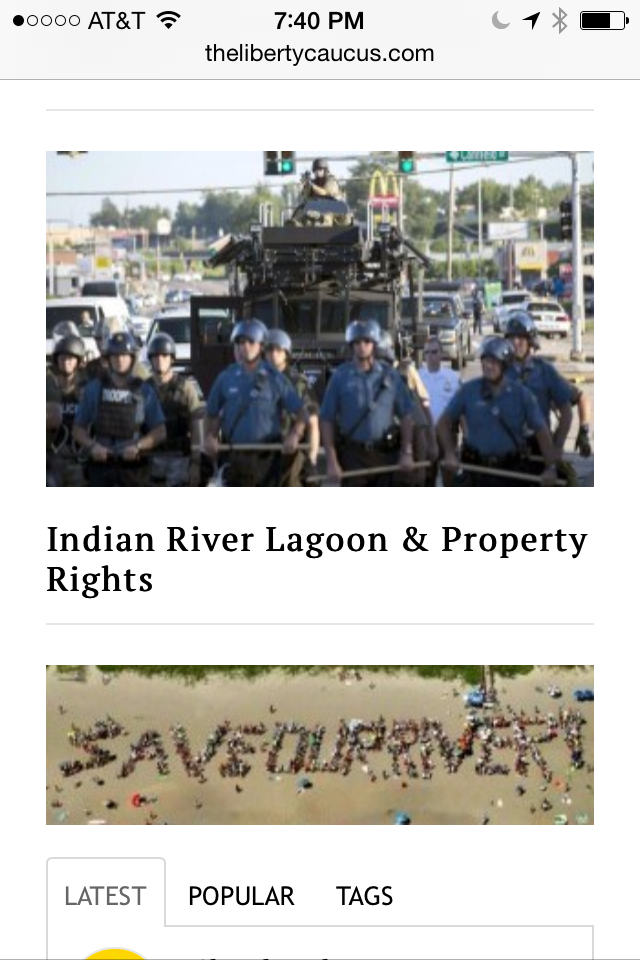
What could these people possible want with FNAA and our Indian River Lagoon. So I dared to go a little further and they had a whole local section.
June was an abysmal month for freedom on the Treasure Coast as 290 area residents were violently abducted at gunpoint by men in costumes for non-violent vices.
Saint Lucie
June was a terrible month for freedom in Saint Lucie as costumed men with guns abducted and caged 177 people for non-violent vices.
Indian River
Indian River saw a much lower total with 57 people being kidnapped and caged by costumed men with guns for non-violent vices.
Martin
A total of 56 citizens were abducted at gunpoint by men in costumes for alleged non-violent vices.”
Who are these costumed men who are kidnapping and caging people? If my friend Gayle Ryan was in town she would say “Are they single?”
Did they look like this?
did they look like this?
If the police are costumed men with guns am I a costumed female with a stethoscope?
“The lagoonists and their goons have banned fertilizers (though no evidence of damaged caused by the fertilizers exists just their presence) and now facing the calamity of rain one has to wonder: Will the loony lagoonists soon ban rain?”
Funny but we are lagoonatics! Get your jargon correct puleeeze Brightlight.
and then I saw that they were all obsessed with Eve Samples.
I felt terrible because I was having such a good laugh and then this.
You can go over and search. It’s a good search engine and also has a store where you can buy all kinds of nifty things. Like stickers and books. You can buy the Libertarian Manifesto for 11 bucks!
I love manifestos. Here are some other people that wrote manifestos.
kazinski manafesto
At any rate you get the picture and honestly like I have said hundreds of times. Free speech! Keep on writing. Please!
So we were interested in who owned the website because these people are local and thought it would be a good thing to know. All these funny people hiding behind their nom de plumes! I don’t have issue’s with nom de plumes. Some of my friends have these. I could just never figure out what mine would be.
So anyway, the owner of the site is Registrant Email: gatorlandrhett@hotmail.com
This I find very confusing since he previously made me very sad with those not so nice posts about Eve Samples.
I’m so confused.
This is his job.
“Creating solutions for local and small businesses to connect with their target audience wherever they are, collecting useful information for how consumers interact with them and implementing steps to increase conversions and ROI for business partners.”
I’m wondering what he puts in to target us? Lagoonakooks?
What would you use to target me? #noseylagoonakook? or maybe #socialistlagoonakook?
“.. scarcity is a reason most people work since their financial resources are limited and finite and work provides them the income necessary to accumulate resources to exchange for the goods and services of another. Consumers demand scarce goods (housing, clothes, a night out, travel, school supplies) and people have to economize their decisions based on scarcity.
In the case of water scarcity, however, we find that the challenge of scarcity is met in some very peculiar ways.
For examples, we can look to the Indian River Lagoon, Lake Okeechobee, and the Everglades where water is plentiful, but clean water is scarce. Moreover, we might look to the western United States where an arid climate makes all types of water scarce.
Yet in all of these places there is one thing in abundance — clean and drinkable bottled water.
Why is it that we can we have too much dirty water in one place, not enough water in another, and be surrounded by an abundance of bottled water?
The first thing to be said about this is that on the free market, regardless of the stringency of supply, there is never any “shortage,” that is, there is never a condition where a purchaser cannot find supplies available at the market price. On the free market, there is always enough supply available to satisfy demand. The clearing mechanism is fluctuations in price. If, for example, there is an orange blight, and the supply of oranges declines, there is then an increasing scarcity of oranges, and the scarcity, is “rationed” voluntarily to the purchasers by the uncoerced rise in price, a rise sufficient to equalize supply and demand. If, on the other hand, there is an improvement in the orange crop, the supply increases, oranges are relatively less scarce, and the price of oranges falls consumers are induced to purchase the increased supply.
In the case of droughts government monopolies set prices arbitrarily and this sends consumers distorted prices. Just as bad crops increase the price of oranges so should droughts increase the price of water. Individuals then internalize their decisions to make best use of the scare resources — their own finances and the water commodity. Government distorting prices prevents individuals from acting most efficiently to conserve scarce resources.
The Indian River Lagoon and other areas in South Florida are impacted by the lack of clear pricing signals to individuals. Meanwhile, bottled water is so easy to obtain that this past weekend at the Indian River Lagoon Clean Water Rally, free clean bottled water was given away during an event to protest the lack of clean water in the environment.
Bottled water is the only water product that Americans have routinely priced and marketed. We now happily pay as much as four times the cost of gasoline for potable water that we could have for free from fountains and taps. Of course, economists will tell us factually that bottled water is not the same good. The square Fiji bottle is a sexy statement; and the ubiquitous bottle of water in hand is a fitness and convenience statement. Subjective valuation determines price. A real market in this water product does exist.
Markets for other water products are, meanwhile, mainly nonexistent. We routinely do not pay market prices for most other forms of water. Until recently, water has been viewed and treated as a free good by all Earth’s peoples. As with all free goods, water experiences unlimited demand. But water cannot meet unlimited demand. Water needs prices in order to signal scarcity and inform demand. Different categories of water need different prices to reflect the different preferences of users. Free can no longer be water’s price. The profligate glory days of limitless water everywhere seem to be over.
The lack of market pricing affects the Indian River Lagoon as it encourages pollution. By allowing farms and industries to pump byproduct into the water the waterways are essentially being used as a free garbage dumping ground. The permitting of pollution by government recklessly encourages more pollution by firms rather than firms benevolently opting to pay to have it properly disposed. The business who pays extra to have waste properly treated and disposed of may not be able to compete with the businesses who opt to take advantages of government allowing dumping of byproduct into waterways at virtually no cost.
The lack of market pricing occurs largely due to lack of ownership and governmental edict. With “public” ownership bureaucrats and politicians charged with maintaining resources lack capital value interest in the resources. They only preside over the current use as Hans Hoppe taught us, “it makes exploitation less calculating and carried out with little or no regard to the capital stock. Exploitation becomes shortsighted and capital consumption will be systematically promoted.” The long-term calculations of the bureaucrat is distorted by this.
Ownership being replaced with stewardship and the lack of the profit and loss mechanism prevents the water bureaucrats from making the most efficient decisions. It is not for the lack of caring but the inability to make economic calculation as Mises explained in Bureaucracy:
Bureaucratic management is management of affairs which cannot be checked by economic calculation.
… The bureaucrat is not free to aim at improvement. He is bound to obey rules and regulations established by a superior body. He has no right to embark upon innovations if his superiors do not approve of them. His duty and his virtue is to be obedient. … Nobody can be at the same time a correct bureaucrat and an innovator.
Yet if the same waterways were privately owned the property owners could charge for the all uses of waterways. Non-pollutive by products may be charged less than damaging pollutive byproducts which negatively affect water quality. The scarcity of the water quality would set prices to discourage pollution and incentivize firms to find cleaner and more efficient production methods.
Furthermore with ownership provides the long-term capital value incentive which encourages conservation. We see this in forestry where forests are replanted to ensure the forest owner has income in the future. We see this at Adams Ranch where the stock of cattle is not wiped out all at once. Adams Ranch does a particularly good job of conserving grass to feed and support their cattle because the land they have to raise cattle on is limited. If grass goes so does the cattle.
In the case of the Lagoon, waterway owners might decide not to allow pollution. Instead, deciding that the boaters, fisherman, divers, swimmers, etc., are a preferable source of revenue for decades into the future.
Prices would help owners calculate that using the water for leisure and conservation is more efficient and useful than making it unusable dumping grounds. Prices would help consumers appreciate the use of clean waterways. Up the Kissimmee River Disney is able to charge huge entrance fees to maintain a safe clean park and facilities. In other unmaintained areas people dump litter in the river, like they do on the roadways. Notice, other than on trash day, people do not litter their own driveway. That is because of the tragedy of the commons. Nobody has an incentive to keep it clean as nobody owns it.
When we fail to understand the basics of scarcity and prices, however, we are left with the current and dominant view of water in which everyone owns it, and action to maintain it can only be undertaken communally. We see this attitude reflected in recent social media posts (1, 2, 3,) on the Indian River Lagoon, including: Thousands of people came out to rally for the lagoon cleanup and to raise awareness and money. Obviously, a clean lagoon is valuable to many people, but we will never know just how valuable as long as government precludes pricing from working in the lagoon’s favor.
In other words, let’s allow the people who care to put money where their mouths are and allow the marketplace to incentivize the people who are most motivated to have a long-term stake and interest in conserving the capital value of the lagoon.
Only the market can provide this, for no matter how hard bureaucrats try they cannot imitate market forces. Lilley explains:
And, no, command economies cannot play at market. There is no third way. Only private property and the rule of law can create a viable market; bureaucratic mandates can deliver only shortages, higher costs, and poorer quality.”
Alrighty then. ok. Funny about the clean water at the rally. We were concerned that people would get dehydrated so we made sure that everyone had water. Don’t read into it. I’m a nurse and it get’s very hot out there in the summer and we didn’t want anyone passing out. We all know this past winter’s failure to buy the land is a part of the big picture to privatize out water. But is it to increase bottled water sales? That’s interesting.
As for the rest I think the whole thing is very thoughtful but misguided and I hope some of my experts will chime in here on my blog or you can go to there and read about men in costumes with guns. Maybe Robin of Loxley will show up. And don’t forget “You gotta be a man to wear tights.”
update: 7/11/15 I just got a correction from a friend of mine that this person was let go from scripts. More on that later.
I’m sending this blog post to my state rep, rick scott and my state senator. None of these people actually care about anyone especially older people who are ill. They are under some kind of delusion that these people can have help. In the case of Ms Harrell she thinks people can go to a free clinic if they have no health insurance.
Right now if you call the Elder Hotline they are wonderful about getting assessments done but they have one problem. There are no funds to help. People are put on a list by need and usually people with dementia are on top of the list. I have no issues with these folks. They are doing the best they can. But no money is no money. It’s could be months before people get services.
And thats for people over 65.
What happens to the younger person who is not on Medicare that get’s diagnosed with
Alzheimer’s Disease or dementia?
Where do they go and how do they manage? What about the people who live by themselves?
Lisa Genova graduated valedictorian, summa cum laude from Bates College with a degree in Biopsychology and has a Ph.D. in Neuroscience from Harvard University. She is the author of the New York Times bestselling novels Still Alice, Left Neglected, Love Anthony, and Inside the O’Briens.
“Dr. Alice Howland (Julianne Moore), a linguistics professor at Columbia University, celebrates her fiftieth birthday with her physician husband John (Alec Baldwin) and three adult children. During a lecture, Alice forgets the word “lexicon”, and during a jog becomes lost on campus. Her doctor diagnoses her with early onset familial Alzheimer’s disease.”
Julianne Moore won a well deserved “Oscar” for her performance.
“Alzheimer’s is a pretty brutal disease — and as Moore pointed out in her acceptance speech for Best Actress at the 2015 Oscars:
I’m very happy — thrilled, actually — that we were able to hopefully shine a light on Alzheimer’s disease. So many people with this disease feel isolated and marginalized, and one of the wonderful things about movies is that it makes us feel seen and not alone. And people with Alzheimer’s deserve to be seen, so that we can find a cure. “
“An estimated 5.3 million Americans of all ages have Alzheimer’s disease in 2015.
Of the 5.3 million Americans with Alzheimer’s, an estimated 5.1 million people are age 65 and older, and approximately 200,000 individuals are under age 65 (younger-onset Alzheimer’s).
Almost two-thirds of Americans with Alzheimer’s are women. Of the 5.1 million people age 65 and older with Alzheimer’s in the United States, 3.2 million are women and 1.9 million are men.
Although there are more non-Hispanic whites living with Alzheimer’s and other dementias than people of any other racial or ethnic group in the United States, older African-Americans and Hispanics are more likely than older whites to have Alzheimer’s disease and other dementias.”
Why is there an issue disclosing the diagnosis?
“disclosing a diagnosis
Most people living with Alzheimer’s are not aware of their diagnosis.
Despite widespread recognition of the benefits of clear and accurate disclosure, less than half (45 percent) of seniors diagnosed with Alzheimer’s disease or their caregivers report being told the diagnosis by a health care provider, compared with 90 percent or more of those diagnosed with cancer and cardiovascular disease.”
I’d like to remind everyone that Alzheimer’s is a bipartisan disease. It doesn’t really care if your rich or poor, Democrat or Republican.
In Palm Beach County there are more than 55,000 people affected by Alzheimer’s disease. In Martin County there are more than 6,400 people and close to 9,000 people in St. Lucie County affected by Alzheimer’s disease.
Alzheimer’s Community Care operates nine Specialized Alzheimer’s Care and Service Centers with locations throughout Palm Beach, Martin and St. Lucie Counties. All are licensed in accordance with the higher standards of Florida’s Specialized Alzheimer’s Day Care Act of 2012. The cost for a full-day, up to 10 hours, is $65, while half-day care plans begin at $40. The organization provides dementia-specific care for the patient and his or her caregivers.
This is great if you have 40 Bucks a day.
I’m not in any way criticizing the wonderful people from any of the organizations that do this work. I applaud them. I am however criticizing our representatives for not even having this on their radar and telling people if they have no health insurance they can go to a free clinic which btw was line item vetoed by Rick Scott.
Please watch ” Still Alice.” It’s an amazing movie. You all know someone just like Alice. My heart breaks for these people and for the people who love them who bravely take care of them the best they can every day. You are the unsung heros.
In a few week we’ll be going to the Sugar Summit that is being put together by our great friends, the Florida SIerra Club. I thought it was a good time to bone up on who’z who and what’s what.
Please feel free to chime in. Even at sugarcard2 – we want to hear from you!
Yesterday, my friend Jules and I went out to Clewiston. The headquarters for US Sugar Corporation resides there.
They call themselves ” America’s Sweetest Town.” Maybe sweet in sugar but not sweet people. The last time I went out there was to shoot “The Sugarland Rally”
The Sugarland Rally was a really sincere effort to bring people together to discuss our water issues together. Lead by our friend Justin Riney. This was their message.
An open letter to Florida residents from The Sugarland Rally Committee:
Dear Florida,
Please read these important details regarding a bicoastal rally we have planned for September 1st on Lake Okeechobee. There are multiple organizations involved in planning this event, and we need your help immediately to get the word out.
The Sugarland Rally will unite the east and west coasts of Florida in a peaceful, historic demonstration to speak out against the pollution of our estuaries from Lake Okeechobee discharges. We support both immediate and long-term solutions, but ecosystems and communities along the St. Lucie and Caloosahatchee Estuaries are in crisis. We cannot afford to wait for ecological and economic collapse. We urge all stakeholders–especially local, state and federal governments–to act immediately.
We chose Clewiston as a central location to unify east and west at Lake Okeechobee, the source that is polluting our estuaries, and because we believe Florida’s sugar industry can be part of the solution. Please don’t misinterpret our intentions–we are NOT holding a rally at Clewiston to protest or point fingers at “Big Sugar.” It’s quite the opposite, actually. We invite Florida’s powerful sugar industry to join us in crafting an immediate solution to the ecological and economic crisis caused by discharges from Lake Okeechobee. Here’s a golden opportunity to earn the respect, loyalty, and trust of Floridians for generations to come–to squash the stereotypes–by standing with the people in support of a solution. Without the healthy longevity of Florida’s land and water, we’re all out of business. Our children and grandchildren are out of business. We invite Florida’s sugar industry to stand with us in support of preserving the wonderful land and water that keeps us all in business. We must think longer term, we must think sustainably, and the time to act is now.
Our message is a peaceful one to emphasize a powerful sense of unity needed among ALL Floridians, and to urge local, state, and federal governments to act immediately to stop the pollution of our estuaries from Lake Okeechobee discharges. We are all entitled to healthy land and water, and it is our responsibility as citizens, working with our government, to preserve these treasured assets and ensure their longevity for generations to come. Let’s all unite as Floridians in support of both immediate and long-term solutions. The Sugarland Rally will be a peaceful demonstration that we can all be proud of.
Join The Sugarland Rally conversation on the event page at http://www.bit.ly/sugarlandrally, and please share this post with as many concerned Floridians as possible. This is a call to action, and we need your help.
Respectfully,
The Sugarland Rally Committee
This was a rally to have a discussion to pull us all together. US= east coast, west coast, and the people of Clewiston. For us it was to make sure we respect the people that live in the south of the lake and make sure they are safe. Human being stuff. Community stuff.
Here is the video I shot. As you can see at the beginning we were quit stoked to be there.
After the rally we went on the invitation of the Mayor to the Roland Martin Marina for some food. When we got there they refused to serve us. Every person in the room stared us down and honestly if they had guns they would have shot us down.
We went next door where I met up with friends Bob and Lisa Riney (parents of justin) and ate lunch and my friends did end up getting a few drinks because Mayor Roland showed up.
Mind you, I’m the video girl, who’s only job was to document the event. And I was starving, hot, tired. So so much for Southern Hospitality. So much for olive branches.
Afterwards in the Clewiston New’s more hate came from the people who were quite verbal, quite nasty and totally unwilling to listen to any kind of reason.
To this day, I still believe in the mission of the Sugarland rally and our extended Olive Branch.
I can’t tell you why. I’m not a psychic. I can only tell you what happened.
In spit of that, I still worry about the people who live there and how much work is being done on the dike and always hope they will be safe.
When we went out yesterday I even wore my Marshall Tucker Band T shirt. I mean who would shoot a video girl with a Marshall Tucker Band Shirt? (Really didn’t stay there long enough to find out)
This stop BTW just a pit stop on our way to STA 5/6.
Robert Coker is Senior Vice President, Public Affairs, of United States Sugar Corporation. He is responsible for managing the company’s federal, state and local government affairs department and the company’s corporate and charitable giving programs encompassing numerous community and employee-relations activities. As a member of senior management, Coker also actively participates in corporate matters involving real estate, environmental regulation, budgeting and allocation of capital.
He is a former Chairman of the Board of Regents for Leadership Florida. He serves on the board of directors for the Florida Sugar Cane League, the Board of Trustees of BIZ-PAC of Palm Beach County and is a member of the Board of Governors for the Florida Chamber of Commerce. He is a member of the Board of Trustees and serves on the Executive Committee of Florida Taxwatch.
Malcolm “Bubba” Wade
Sugar execs, w/ Gaston Cantens of Florida Crystals and Robert Coker of US Sugar, just huddled in back room of #IndianRiverLagoon hearing.
Malcolm S. Wade, Jr. is Senior Vice President, Corporate Strategy and Business Development of United States Sugar Corporation. He has been employed by the Company for more than 27 years and has been a member of the senior management team for over 20 years. Wade, a certified public accountant, joined the company as Director of Internal Audit in 1982 and subsequently was named director, vice president and senior vice president of the Administrative Service Group and is currently senior vice president of sugar operations.
For more than 20 years, Wade has been involved in developing and overseeing the Company’s environmental responsibilities. Through his appointments by two governors and the South Florida Water Management District to working groups on South Florida environmental issues, Wade has helped shape public policy regarding Everglades Restoration.
In March 2005, Governor Bush appointed Wade to a four-year term on the South Florida Water Management District’s Governing Board, a position he resigned in 2008 due to the State’s proposed acquisition of U.S. Sugar.Previously, Wade was a member of the team representing South Florida farmers that spent more than a year negotiating with the Interior and Justice Departments, the State of Florida and the South Florida Water Management District to resolve the legal disputes over Everglades Restoration. He represented farmers on the technical mediation committee that crafted the Technical Mediated Plan for Everglades Restoration, which was adopted by the Florida Legislature in the spring of 1994.
He was appointed by Gov. Lawton Chiles to the Governor’s Commission for a Sustainable South Florida, which worked for four years to establish a consensus plan for Everglades Restoration. The work of the commission became the framework for the Comprehensive Everglades Restoration Plan (CERP) approved by Congress and is currently being implemented throughout south Florida.
Wade’s work on restoration issues continued with his appointment by Gov. Jeb Bush to the Governor’s Commission for the Everglades. He is a past member and co-chair of the South Florida Water Management District Water Resource Advisory Commission (WRAC) as well as a past member and chairman of the Lake Okeechobee Advisory Committee of the WRAC. He is also a past member of the District’s Lower East Coast Water Supply Planning Committee and the Budget Review commission. In addition, Wade served on the South Florida Agricultural Council Water Commission, the Caloosahatchee Water Management Advisory Committee and is a director of the Everglades Agricultural Area Environmental Protection District.
Wade is a Certified Public Accountant and a Certified Internal Auditor. He is a member of the American Institute of Certified Public Accountants, the Florida Institute of Certified Public Accountants and the Institute of Internal Auditors.
Judy C. Sanchez is the Senior Director of Corporate Communications and Public Affairs for United States Sugar Corporation. She joined U.S. Sugar in 1994, transferring from its South Bay Growers vegetable division where she worked as a Marketing Specialist.
Mrs. Sanchez attended the University of Florida College of Journalism and Communications and graduated from Florida Atlantic University with a degree in communications. A fourth generation farmer, she has spent most of her life in and around the sugar cane industry, both in Florida and Louisiana. She currently serves on the board of directors for the Western Palm Beach County Farm Bureau, Childcare of Southwest Florida, and the Agricultural Institute of Florida.
She lives in Belle Glade, Florida, with her husband and two sons.
Judy follows me on twitter so I hope she reads this. We night not like what Judy does or says but for her boss’s she does a great job! Check out the tweets!
So you know when you call someone on the phone and you talk and talk and then they interrupt and say ” You got the wrong number.” Then your embarrassed and apologize and try to figure out what number should have been called. Sometime’s you just dialed wrong and sometimes you have the wrong number.
Or you go to the wrong house and the kindly people at the door direct you to the correct place. That!
You know human things that we do. Honestly. Politeness. Respect of our fellow human beings. Every day life with our fellow travelers.
So, our good friend of the Indian River Lagoon and awesome blogger Jacqui Thurlow-Lippisch wrote this blog.
“A few months ago when the South Florida Water Management District was ignoring a desperate and pleading public that had come before them begging for the purchase of the US Sugar Option Lands through Amendment 1 monies, to help save the St Lucie River/Indian River Lagoon and Calooshatchee, I drove to West Palm Beach and met with high level officials. They were very nice but it was a frustrating meeting. Basically I asked them, “What are you doing?” “Why are you acting like this?”
The answer?
“Commissioner, you know the power isn’t in our hands anymore anyway…”
“What do you mean?” I inquired.
A conversation around the table ensured:
SFWMD: “Well after the debacle that occurred 2008-2010 with then Governor Charlie Christ, the recession, and the attempted buyout of all of US Sugar’s lands, basically a water district was trying to purchase a corporation…..the Florida Legislature got fed up. So later, in section 373.556 of Florida Statutes, the Florida Legislature made sure the District would never be in a position to do that again….Significant legislative changes have occurred related to water management budgeting with substantial ramification for Water Management District land transactions. In 2013, Senate Bill 1986 provided that certain District land transaction should be subject to the scrutiny of the Legislative Budget Commission. As this bill renewed the authority of the Governor to approve or disapprove the SFWMD budget, as with all water management budgets of the state, we can no longer do things we have done in the past like oversee giant land purchases using the monies from our ad-valorem taxes…There is a lot more to it but that’s the main difference now. You are talking to the wrong people….”
I stood there just staring…..”I didn’t know this gentlemen, so how do you expect the public to know this ? Are you telling me, the SFWMD has no power to purchase those Sugar Lands?”
“I am telling you the legislature is in charge of the budget and we don’t have enough money to buy the lands, and couldn’t without their approval….”
“So why don’t you explain that to the public?” I asked.
Stares….
Long awkward silence….
The reply was more or less: “It’s best not to get involved in such a discussion…..”
I lectured them on the importance of communication and education and said they certainly still have influence even if they say they “do not” …..but this did go over particularly well… the meeting ended. I shook their hands. I felt like an idiot. I drove home.”
Poor Jacqui.
We were the uninvited.
“Shall I tell you who taught you the things you’ve done. The things you’ve said”
So my question is who does that? Why not just say so. Why not just say “Your barking up the wrong tree?”
“More specifically, state Sen. Joe Negron, R-Palm City, advocated cuts to so-called soft services, which include mental health and drug-addiction programs, because many of these services address what Negon views as “a lack of willpower, a lack of discipline, a lack of character.” Negron was the chair of appropriations for health and human services in the state Senate.”
This attitude has got to change. We cannot have legislators that do not believe in taking care of our most vulnerable people and do not believe in science.
Mental illness knows no parties. It is a bipartisan disease.
Let’s educate our legislators. Let’s make a difference.
Let’s make June “Educate your legislators on mental illness month.”
Society is Judged By How They Treat the Most Vulnerable.
Brain circuit problem likely sets stage for the ‘voices’ that are symptom of schizophrenia
Scientists have identified problems in a connection between brain structures that may predispose individuals to hearing the ‘voices’ that are a common symptom of schizophrenia. Researchers linked the problem to a gene deletion. This leads to changes in brain chemistry that reduce the flow of information between two brain structures involved in processing auditory information.
Here is a video by ROCHE that is a simple explanation on schizophrenia.
The biology of schizophrenia.
Mental Disorders as Brain Disorders: Thomas Insel at TEDxCaltech
To Our Commissioners in Martin and St Lucie County.
This past Saturday I attended our annual disaster conference. Our area includes Martin County, Port St Lucie County, Okeechobee County and Indian River County. The MRC (Medical Reserve Corp) are volunteers who assist in disasters.
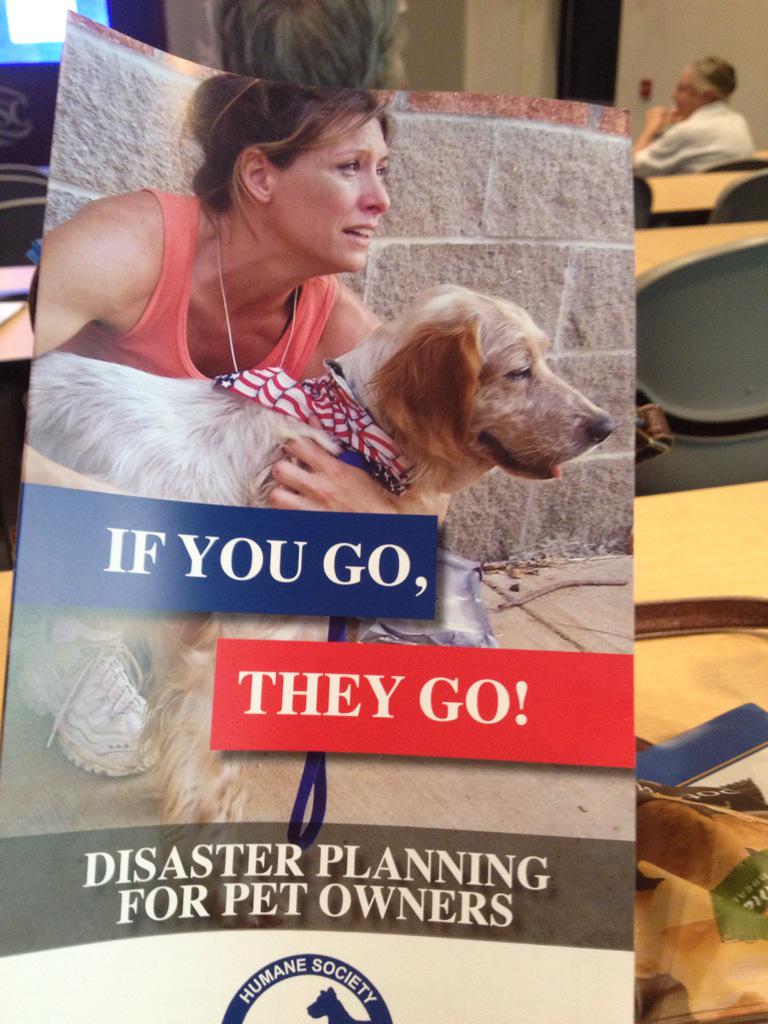
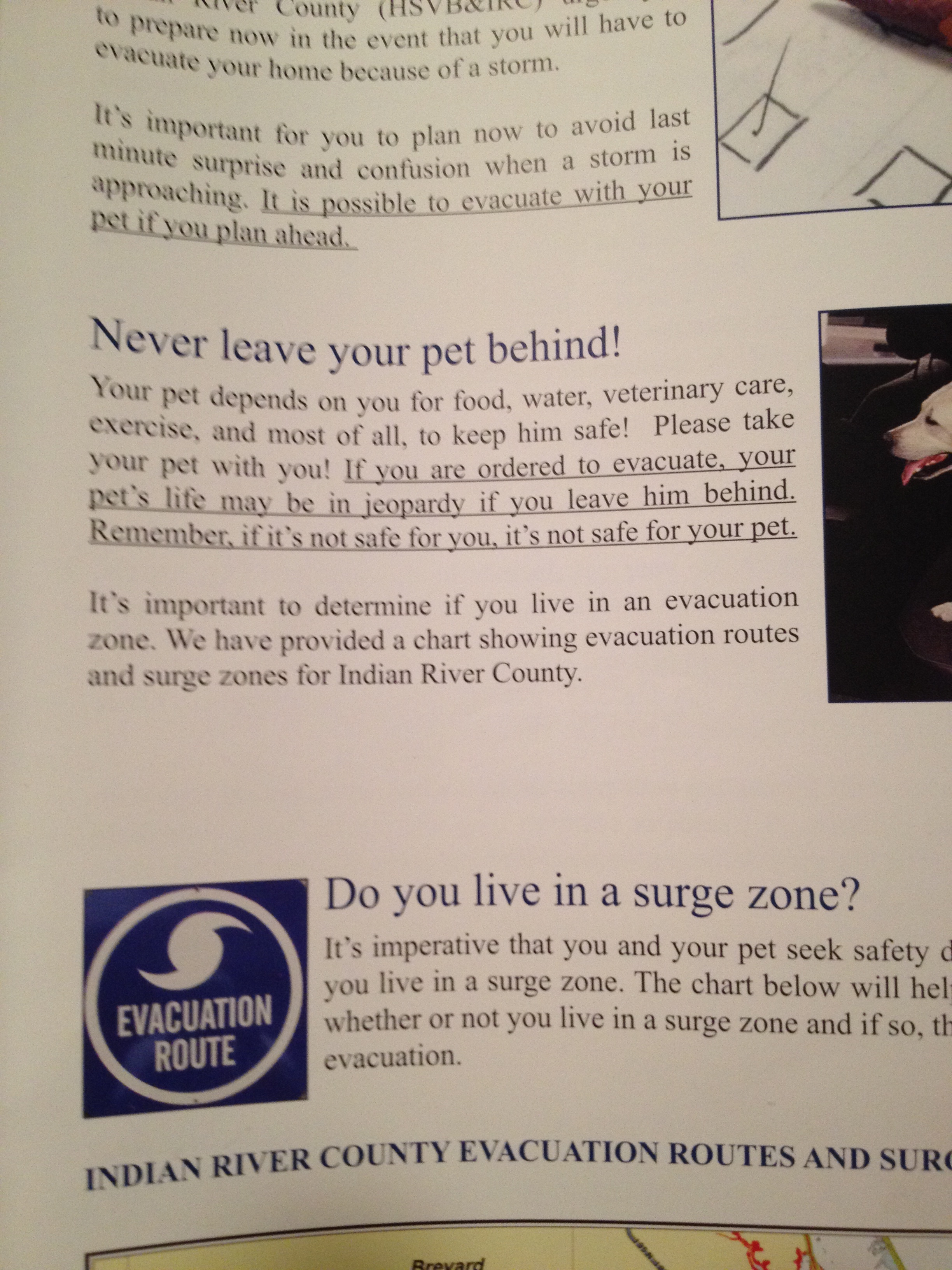
The only county that seemed to have it act together was Indian River County. They have this:
It was suggested you take a photo of yourself with you and your pet so no one can show up and say that your pet is their pet.
meme selfie (you should have your face in the photo)
Do not leave your pets if you have to evacuate. If you go they go!
don’t leave us food source your our only hope!
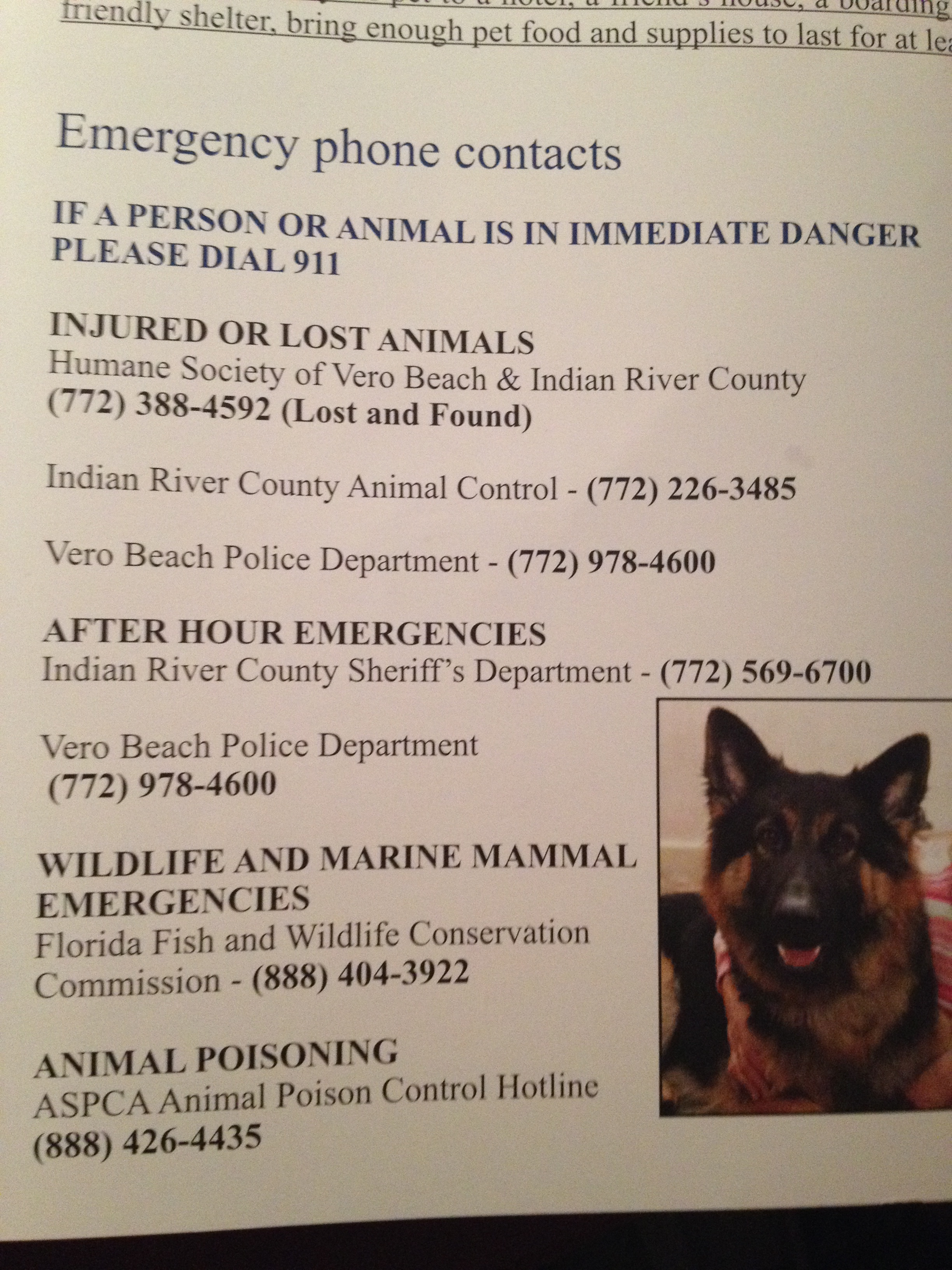
The number for the Humane Society of Vero Beach and Indian River County is 772-388-5492. Our commissioners can call them and get info on how to set up programs in our county. I bet they would be deee-lighted to come down and show you guys how to do this.
In a storm everything east of Federal Hwy is considered an evacuation zone. That means your veterinarians in that area are in a potential evacuation zone.
We still do not have pet friendly shelters in Martin or St Lucie County.
The Humane Society of the Treasure Coast in Palm City, the county’s first pet shelter, can withstand winds of 140 mph or more and accommodate as many as 200 cats and dogs.
The offering, free for up to five days, is a temporary solution that allows Martin County to comply with a new Federal Emergency Management Agency pet shelter strategy requirement, Holman said.
The county in the meantime is working to provide a similarly secure shelter for pets as well as their owners, Holman said.
It’s 2015- what’s the plan?
We really need a plan especially for our seniors who have pets. We have a lot of people who live by themselves with their dog or cat in substandard housing. What are we going to do to help them?
In Indian River County the first pets they take are the volunteers that work the shelter. HINTHINTHINT
Here is a list of pet friendly shelters for Florida. Plan now. Many of these place require that you pre register. Your pets must be up to date on their vaccinations and you need to bring a crate, food, basically everything your pet will need.
We also need an update list of hotels/motels that accept pets and I am told that some that usually don’t take pets will change their policy during a storm.
After Hurricane Katrina hundreds of pets were displaced. Please make sure your pet has at least a tag with a phone number.
Project L.I.F.T. combines job-training, community service and behavior modification with pioneering community solutions during difficult economic times. “At-risk” youth members of Project L.I.F.T. have the opportunity to literally affect the lives of hundreds of individuals in a positive way through innovative interventions and service learning experiences.
This sense of self-management and community responsibility will equip at-risk youth with problem solving capabilities to provide insight into why they choose certain negative behaviors and how to successfully intervene to avoid those behaviors in the future.
Each day, members of Project L.I.F.T. receive the opportunity to learn hands-on job skills, guided by professionals in designated fields. The projects that members work on and learn from are then made available to families in need. Surrounded by positive mentors, members are also provided with a safe and healthy environment to build valuable and meaningful relationships, which help them grow mentally and develop skills to prevent relapses. During this process, members are given opportunities to work on their “self” through structured behavioral interventions led by state licensed mental health professionals.
The product of the Project L.I.F.T. experience is not only a “Restored Youth,” but a youth who is better prepared to live and work independently.
I met up with Matt Churchey at Paddlefest and he told me about Project Lift.
The Dolphin Ecology Project is establishing a long-term field research and monitoring program to collect these data and evaluate how dolphins respond to changes in ecosystem health. Throughout the year, Project staff, scientists and volunteers photograph individual dolphins for identification and observe their activities, along with sampling environmental parameters and identifying and measuring the abundance of important dolphin prey species. Over time the Project intends to gain a better understanding about how dolphins utilize the different habitats that comprise the Florida Keys. The Project’s educational goal is to increase public awareness about dolphins and the interrelated nature of the Florida Keys’ habitats and the importance of South Florida ecosystem restoration efforts.
Volunteer to help with this exciting Project! Contact the Volunteer Stewardship Exchange of The Nature Conservancy at 305-289-9060. Become a Dolphin Ecology Project Member. Your contribution will support the ProjectÕs research and education programs, ensuring a sustainable future for humans, dolphins, and the ocean environment.
If you go to the link above there is a membership form link on the left, you can print the form and send it in with your tax deductible contribution.
They also have a nice poster with all the local dolphins on them and their t-shirts are beautiful.
Let’s make sure we support this wonderful project that supports our neighbors, the dolphins of the southern indian river lagoon.
Most of all lets support our good neighbors the dolphins of the southern indian river lagoon.
Who could blame them if this happened?
“So long and thanks for all the fish” from the hitchhikers guide to the galaxy.





















 cyndi lenz