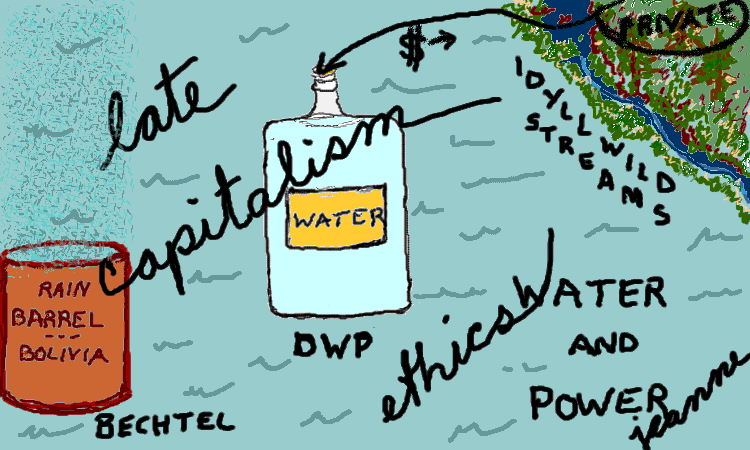
Water Inc: The Story of Bolivia Aqua Para Todos
What do you even know about Bolivia? I know this: Butch Cassidy and the Sundance Kid may or may not have died there.
http://www.ksl.com/?nid=968&sid=17130775
Ernesto Che Guevara was murdered there October 9, 1969 in La Higuera, Bolivia when he executed by a firing squad that was sponsored by the American Government.
Here is a quickie wiki about Bolivia which is a very interesting place and very multicultural.
https://en.wikipedia.org/wiki/Bolivia
“Deforestation in upper river basins has caused environmental problems, including soil erosion and declining water quality. An innovative project to try and remedy this situation involves landholders in upstream areas being paid by downstream water users to conserve forests. The landholders receive $20 to conserve the trees, avoid polluting livestock practices, and enhance the biodiversity and forest carbon on their land. They receive $30, which purchases a beehive, to compensate for conservation for two hectares of water-sustaining forest for five years. Honey revenue per hectare of forest is $5 per year, so within five years, the landholder has sold $50 of honey. The project is being conducted by Fundación Natura Bolivia and Rare Conservation, with support from the Climate & Development Knowledge Network.”
Bolivia has gained global attention for its ‘Law of the Rights of Mother Earth‘, which accords nature the same rights as humans.
This is amazing
https://en.wikipedia.org/wiki/Law_of_the_Rights_of_Mother_Earth
Investing nature with rights
“The law defines Mother Earth as “…the dynamic living system formed by the indivisible community of all life systems and living beings whom are interrelated, interdependent, and complementary, which share a common destiny; adding that “Mother Earth is considered sacred in the worldview of Indigenous peoples and nations.
In this approach human beings and their communities are considered a part of mother earth, by being integrated in “Life systems” defined as “…complex and dynamic communities of plants, animals, micro-organisms and other beings in their environment, in which human communities and the rest of nature interact as a functional unit, under the influence of climatic, physiographic and geologic factors, as well as the productive practices and cultural diversity of Bolivians of both genders, and the world views of Indigenous nations and peoples, intercultural communities and the Afro-Bolivians. This definition can be seen as a more inclusive definition of ecosystems because it explicitly includes the social, cultural and economic dimensions of human communities.
The law also establishes the juridical character of Mother Earth as “collective subject of public interest“, to ensure the exercise and protection of her rights. By giving Mother Earth a legal personality, it can, through its representatives (humans), bring an action to defend its rights. Additionally, to say that Mother Earth is of public interest represents a major shift from an anthropocentric perspective to a more Earth community based perspective.”
I love this! We will see below that corporations think they are people. But in Bolivia Mother Nature has rights!
http://www.thewaterblog.org/bolivia-water-privatization
“2000, California based Bechtel Corporation took over control of all water systems in Cochabamba, Bolivia’s third largest city. At first, many thought the move would be one that was beneficial to Bolivia. To bring that type of business into such financially crippled country was considered to be a savvy win-win move. Bolivia water privatization was welcomed.”
Bectel.. Bectel… Where do I know that name from?
oh ya!
http://www.corpwatch.org/article.php?id=6975
Bechtel: Profiting from Destruction
On April 17, Bechtel received one of the first and largest of the rebuilding contracts in Iraq. Worth $680 million over 18 months, the contract includes the rebuilding, repair and/or assessment of virtually every significant element of Iraq’s infrastructure, from power generation facilities to electrical grids to the municipal water and sewage systems. The contract was granted in backroom deals without open and transparent bidding processes and the content remains hidden behind a veil of secrecy. The contract has not been publicly disclosed to American taxpayers, who will be paying the majority of the bill. While there is no doubt that Bechtel has experience in these areas, it is an experience from which the people of Iraq should be spared.
War profiteering and political cronyism is just part of this story.”
Yes this Bechtel
http://www.thenation.com/article/six-rigged-rules-corporations-use-to-dodge-taxes/
At the time the law was enacted, the wide differential between top corporate tax rates (52 percent) and top individual rates (91 percent) was a disincentive for gaming the system to dodge taxes. Fast forward half a century and top tax rates have collapsed to only 35 percent for corporations and individuals, erasing the previous disincentive for big corporations to change their business status. By incorporating as an S Corporation, enormous businesses like Bechtel pay just individual taxes, rather than having their corporation pay taxes on corporate profits and shareholders pay taxes on their dividends.
S Corporations, and other businesses where income is taxed only at the individual level, have become the new tax haven, where large businesses have fled to avoid US corporate income taxes. In 2008, more than 14,000 S Corporation tax returns were filed by firms with more than $50 million in revenue, according to the IRS. These 14,000 firms, with an average profit of $6.4 million each, collectively reported 29 percent of the total profit on nearly 4 million S Corporation tax returns. Preserving S Corporation status for real small businesses can help level the playing field, but closing the loophole that allows giant multinational corporations to avoid the corporate taxes that their peers have to pay is key to bringing more fairness to the tax code and more funds into public coffers.
As the 99% Spring unfolds, restoring fairness to our tax code must be at the center of the debate. As it stands, our tax system rewards those at the top, robbing the rest of us of the public money we need to transform the economy from one that works for the 1 percent to one that works for the 100 percent.A note on the chart. Corporate tax rates were calculated using current federal corporate income taxes paid in 2011 divided by 2011 US pretax income, as reported in company 10-K annual reported filed with the Securities and Exchange Commission. Deferred taxes, which might be paid some day in the future, were excluded, as were income taxes paid to state or local governments. Individual tax rates were taken from a recent Citizens for Tax Justice report.”

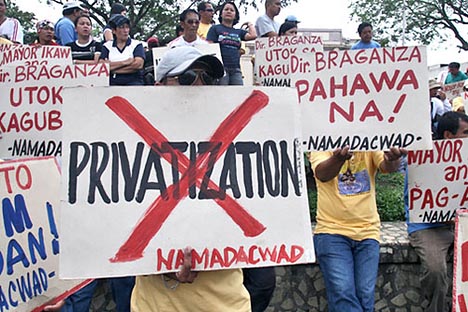
Many Cochabambans objected to the rates that Bechtel imposed on its customer. Their water bills tripled and quadrupled. Half their monthly income went to water. To fuel the fire, Bechtel was granted control to seize homes of delinquent customer when ownership arrangements were defined. Large groups of enraged Cochabamban residents took to the streets and began the protest against Bechtel.
Also just an FYI
https://en.wikipedia.org/wiki/Agriculture_in_Bolivia
Agricultural runoff is one of the main contributors to water pollution in Bolivia, together with domestic municipal wastewater and dumping by industries and mines. The greatest percentage of the pollution load is due to diffuse dumping from agricultural and fishing activities and runoffs of urban areas. There are no regulations or controls over major dumping from non-specific sources, despite its volume and toxicity.
Sound familiar?

http://www.citizen.org/documents/Bolivia_%28PDF%29.PDF
https://en.wikipedia.org/wiki/History_of_Bolivia#2000_Cochabamba_protests
In 2001, Bechtel filed suit against the Bolivian government, citing damages of more for $25 million. Bechtel argues that its contract was only to administer the water system, which suffered from terrible internal corruption and poor service, and that the local government raised water prices. The continuing legal battle attracted attention from anti-globalization and anti-capitalist groups. This topic is explored in the 2003 documentary film The Corporation and on Bechtel’s website. In January 2006, Bechtel and the other international partners settled the lawsuit against the Bolivian government for a reported $0.30 (thirty cents) after intense protests and a ruling on jurisdiction favorable to Bechtel by the International Centre for the Settlement of Investment Disputes.
So what’s going in Bolivia right now.
http://www.coha.org/on-water-scarcity-and-the-right-to-life-bolivia/
Political Implications of Current Scarcity
“Despite political strides after the “Water Wars,” much of Bolivia still suffers from limited access to water and from poor sanitation. Currently, access to water in rural areas is only 71 percent, while sanitation coverage is often as low as 10 percent. [9] This continuing water scarcity is a humanitarian and a human rights issue that must be addressed from a public policy perspective. Nongovernmental organizations such as Water for People have developed local initiatives with area governments to increase access to clean water in rural parts of the country, but the impetus for change must come from the central government in order to create sustainable policies. To be effective, these policies must incorporate the citizen participation that drastically altered Bolivian politics after its transformative “Water Wars.”
Past social demonstrations in Cochabamba still demand domestic and international attention and should inspire natural resource policy internationally. As stated by David Solnit of Upside Down World, “Bolivian social movements catalyzed by [the “Water Wars”] are, perhaps, the most radical and visionary in the world with their mass participatory, democratic and horizontal way of organizing and mobilizing, drawing on the communitarian roots of the majority indigenous country.” [10] While the movement’s previous successes are certainly praiseworthy, the issues it addressed are not fully resolved. The strong collective spirit that mobilized these protest victories is deeply established in much of the country, and it must be respected as a force for national change. The intersection of civilian activism and governmental policy can finally produce the reforms necessary to confirm water as a human right.”
Then we have ingenuity and SCIENCE!
http://www.sciencedaily.com/releases/2013/01/130130082250.htm
“Researchers from the University of Oklahoma have discovered a technique to remove pollutants from water that requires minimal labor costs and is powered by nature itself. After 15 years of testing, research has shown this passive water treatment method to be successful in as diverse geography as the flatlands of Oklahoma and the mountains of Bolivia.
The passive water treatment system is created by engineering an ecosystem consisting of a series of filtering ponds. As the water moves through each specifically designed pond, a natural chemical or biological process removes certain contaminants as it slowly moves from one cell into the other before being re-released into natural waterways.
“When the water reaches the last pond, it has gone from looking like orange, sediment-laden sludge to clear water,” said Robert Nairn, associate director for OU’s Water Technologies for Emerging Regions Center and director of the Center for Restoration of Ecosystems and Watersheds.
Here is the trailer to the corporation:
Here is the full movie The Corporation. Please watch and make a donation to these incredible filmmakers.
Here’s a good word to remember
https://en.wikipedia.org/wiki/Externality
In economics, an externality is the cost or benefit that affects a party who did not choose to incur that cost or benefit.
For example, manufacturing activities that cause air pollution impose health and clean-up costs on the whole society, whereas the neighbors of an individual who chooses to fire-proof his home may benefit from a reduced risk of a fire spreading to their own houses. If external costs exist, such as pollution, the producer may choose to produce more of the product than would be produced if the producer were required to pay all associated environmental costs. Because responsibility or consequence for self-directed action lies partly outside the self, an element of externalization is involved. If there are external benefits, such as in public safety, less of the good may be produced than would be the case if the producer were to receive payment for the external benefits to others. For the purpose of these statements, overall cost and benefit to society is defined as the sum of the imputed monetary value of benefits and costs to all parties involved. Thus, unregulated markets in goods or services with significant externalities generate prices that do not reflect the full social cost or benefit of their transactions; such markets are therefore inefficient.
So all kinds of fun stuff today. Mother Earth has rights, we have a cool doc to watch and we learned all about Bolivia!
To my Bolivian Readers: I loved learning about Bolivia today and I hope there is more you can share with me!
Aqua para todos mi amigos! El agua es vida!
 cyndi lenz
3 responses to “Water Inc: The Water Story of Bolivia. Aqua Para Todos”
Cindy,
Thanks for writing on this important topic. The emerging scarcity of water, especially clean water, is making water privatization more attractive to private corporations. Increased water use driven by population growth, salt water intrusion due to rising sea levels, and depleted aquifers all reinforce this trend. We have obviously passed the point where recharge of aquifers is sufficient to balance withdrawals. Depleting aquifers is like living off savings- not a good idea and not sustainable for an indefinite period of time.
When we were trying to get the State and the SFWMD to exercise the U.S. Sugar option, I was struck by the lack of widespread concern in Palm Beach, Broward and Miami-Dade counties. Our three main arguments for buying the land were: 1) stop the discharges to save the estuaries; 2) rehydrate and save the remnant Everglades; and 3) recharge the aquifers that supply South Florida with drinking water. If we’re going to get the needed land, we have to change the political equation by getting meaningful support from the populous counties.
I think the trend is clear. This year’s drought has the aquifers drawn down to all-time lows. As the saltwater intrusion boundary moves even more rapidly inland, more existing wells will be abandoned and new wells and piping will be needed. The South Florida water supply bomb is going to explode- the question is how long is the fuse? Another question: if salt water intrusion continues to push the remaining fresh water west- who owns that land and stands to profit? Just sayin’.
Your word of the day, “externality” is really appropriate for any discussion that touches on our current water woes. Economists talk about “negative externalities” when discussing private profits which rely on society to pick up costs which should be charged to producers or their customers. In our area we have at least two parasitic groups that are seeking profits at the direct expense of the community as a whole- Big Sugar and All Aboard Florida.
These abuses are difficult to combat for a couple of reasons. One is that the costs, while obvious in a common sense way, are difficult to measure and document. It stands to reason that dirty water is going to cut into tourism, marine businesses, and real estate values- but how much? The train forces us to offer another guesstimate.
A second problem was clearly explained by David Guest of Earthjustice at the Big Sugar Summit: the benefit of a subsidy tends to be concentrated and beneficial to a small, but highly motivated group. The costs of the subsidy, by contrast, are spread out over a very large group, most of whom are either unaware or insufficiently annoyed to be motivated to action.
I believe that every nickel or dime of sugar profit comes at a cost of a dollar or more to the general public. This is exactly the kind of situation that cries out for government intervention and regulation…unless government officials are bought and paid for…
I also really liked the Bolivian part of your blog post- making Mother Nature a legal person is so much wiser than giving blood-sucking corporations that status.
LikeLiked by 1 person
Wow thank you Dave as always amazing thoughtful remarks. I loved the story of Bolivia. They still have water issues but they should serve an inspiration for all us. If you haven’t watch “The Corporation” I just finish and im going to watch again. Your always welcome here to write your own damm blog. hint hint
LikeLiked by 1 person
[…] https://cyndi-lenz.com/2015/07/27/water-inc-the-water-story-of-bolivia-aqua-para-todos/ […]
LikeLike